
- SG$ Singapore Dollar
- A$ Australian Dollar
- £ British Pound Sterling
- C$ Canadian Dollar
- € Euro
- MYR Ringgit Malaysia
- US$ United States Dollar
- đ Vietnamese Dong


 About Us
 Destinations
 Travel Styles
 Travel Guide
 Blogs

How many days Phu Quoc justifies, what order to put them in, and which months will cancel your sea days. The dry season is December to March, not November to April.
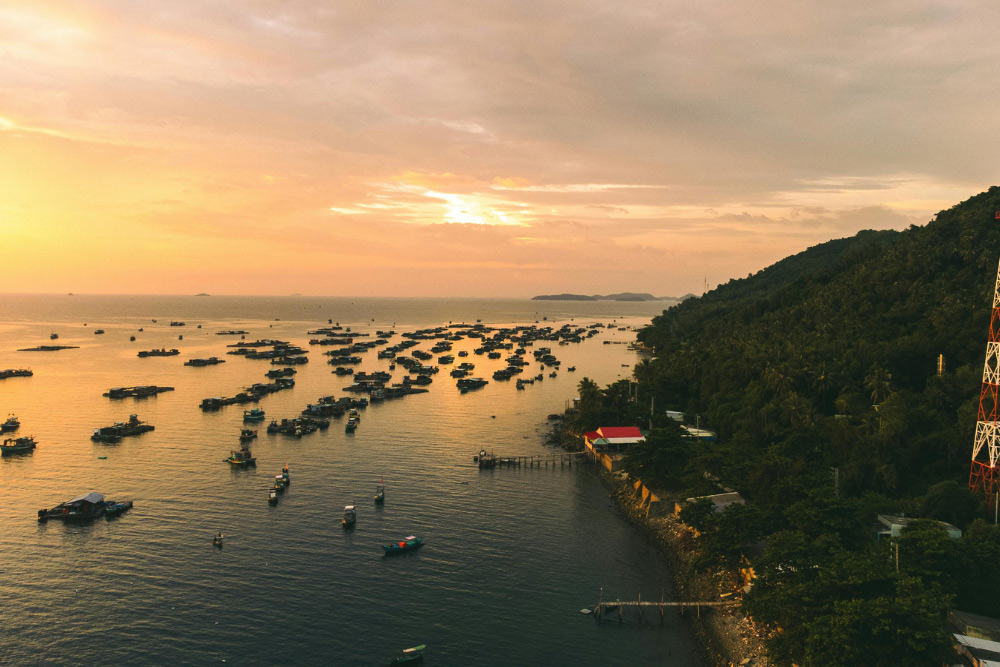
Three to five nights covers Phu Quoc for most travelers, and a working Phu Quoc itinerary puts the weather-dependent day first. Three nights gives one sea day and two beach days; five lets you see the north and the south without moving hotels.
That range is a judgment, not a statistic, and we would rather say so than dress it up. There is no public figure for how long people actually stay on this island, so what follows is the reasoning at each end of the range: what you lose by going shorter, and what runs out if you go longer.
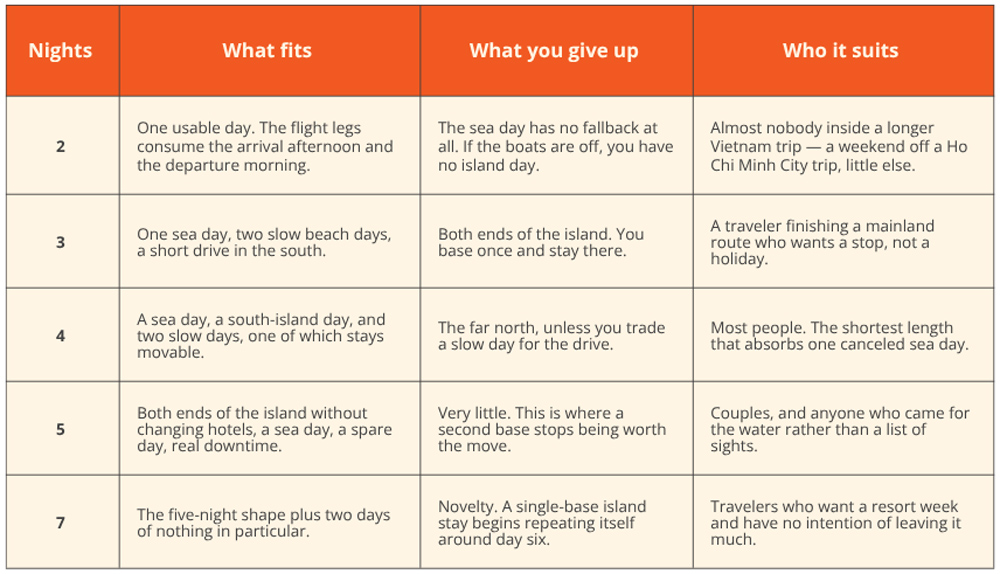
One sea day, booked for the first full morning. One slow day on whichever coast your hotel sits on. One half day of driving in the south, where the roads are shortest and the stops closest together. Nothing pinned to the final morning, which belongs to the airport.
The same opening, then a genuinely empty day in the middle. That empty day is the point of the fourth night: it is where a canceled boat trip goes, and if nothing is canceled it becomes the day you do nothing at all. Keep the south-island driving to one day.
Sea day first, south-island day second, one day that reaches the north, then two days with no plan. Five nights is the first length at which the north earns the drive, because it is no longer a quarter of your stay. It is also the length that can lose a day to weather and still send you home rested.
The airport sits in the south, roughly 10 kilometers from Duong Dong, and published transfer times into town range from about 10 minutes to about 35 depending on who is quoting — treat anything under half an hour as the realistic case and do not plan a tight connection around it. For properties in the far north we could not find a transfer time from any source that states one, so ask for the drive time from your property's exact address before you commit to a northern base: it is the difference between a south-island day being easy and being a two-hour round trip. South puts you near the airport, the town and the night market; north is quieter and further from everything. Which area and which property is its own decision, and so is what fills the days once you are there — our island activity guide runs through it beach by beach, which is the list this page deliberately does not repeat.
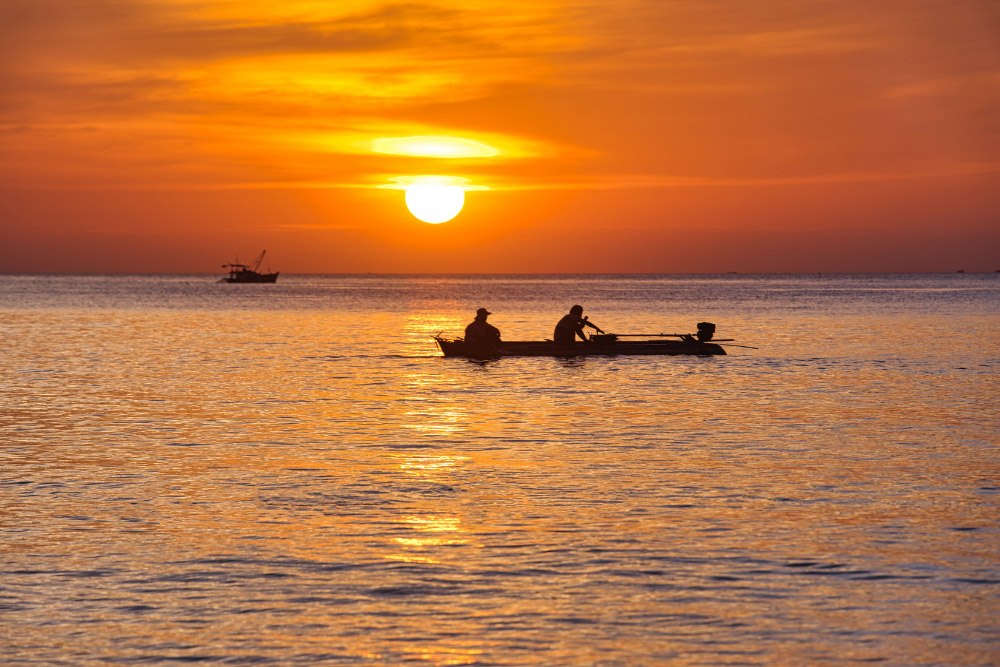
December through March is Phu Quoc's genuine dry season. November and April are advertised as dry season and are not — April averages 150 mm across 12 rain days, November 170 mm across 13 — and October is the month that cancels itineraries, at 385 mm across 22 rain days.
Two sources with nothing to sell on this island put the dry window at December to March: the Kiên Giang provincial government's own description of the province's natural conditions, and the climate reference climatestotravel.com, which states a 2000-2020 period for its Phu Quoc averages. Every commercial page we checked says November to April instead. Rainfall figures move with the reference period and the station, so read the table as the shape of the year rather than a forecast, and check the outlook close to your dates.
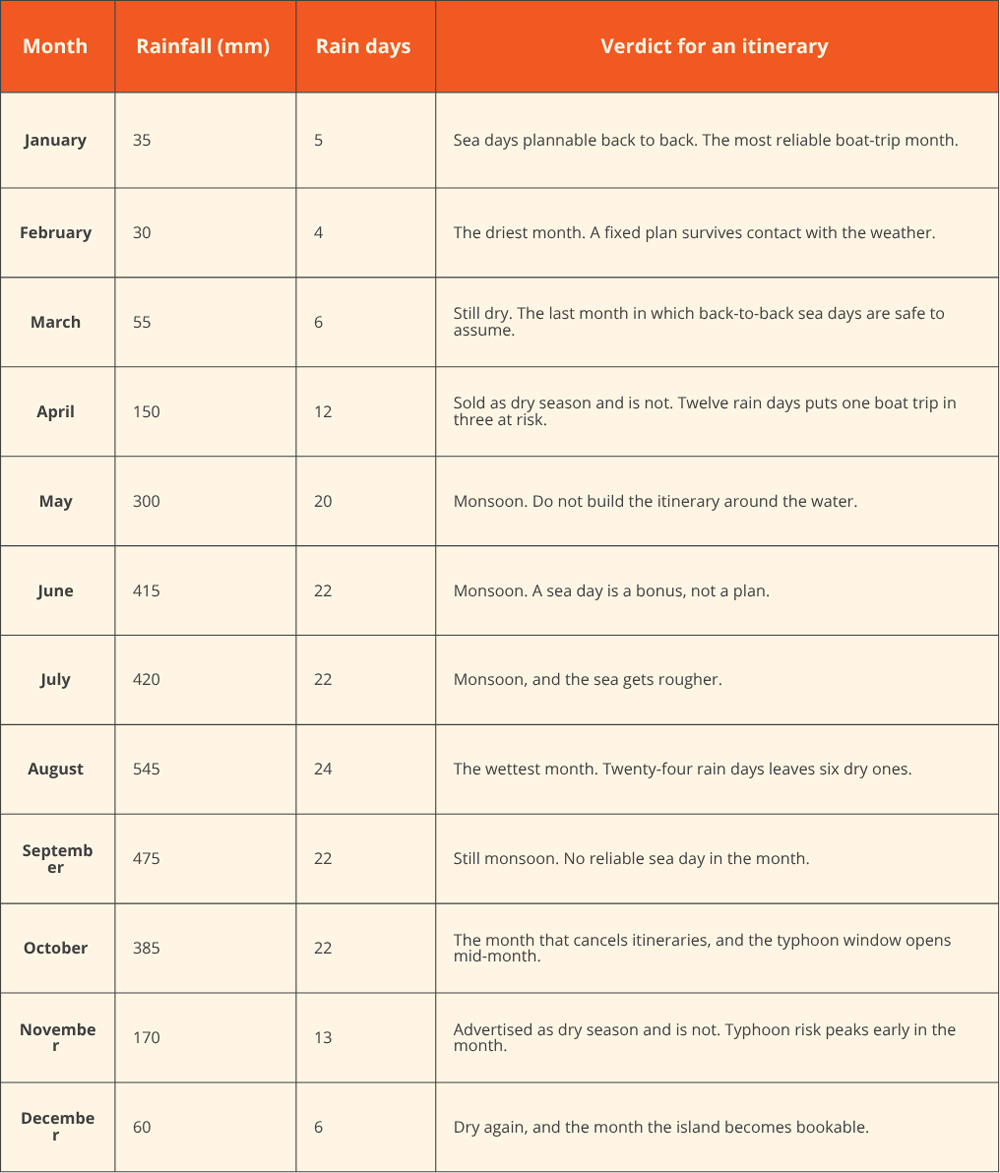
An itinerary is a sequence of days, and the days this island sells are sea days. Twelve rain days in April is not a wet fortnight spread thinly across a month — it is a boat trip called off and an afternoon with no fallback in a plan that had no slack in it. The one-month overstatement at each end of the season is therefore structural, not cosmetic. It does not make your holiday damper. It removes the day you came for.
Southern Vietnam's typhoon season runs from around 15 October to 20 December, peaking in early November, according to the same climate reference. That covers the back half of October and all of November, and it is the second reason a November itinerary built around the water is a gamble.
Because the sources cannot agree on one. The figures in circulation for Phu Quoc run from roughly 2,400 to 2,800 mm in the provincial material to about 3,000 mm elsewhere, with 4,000 mm claimed for the north of the island, and Vietnam has no published standard climate normal to settle it. The monthly shape and the season boundaries are consistent between the two non-commercial sources, so those are the numbers above. A single annual total would be a choice dressed as a fact.
Phu Quoc belongs at the end of a Vietnam itinerary, as the slow stretch after the cities and the north. It is a domestic flight from everywhere else in the country, which costs most of a travel day each way.
There is no road or rail link, so arrival is a flight for almost every international traveler. The flying time is short — around an hour from Ho Chi Minh City, about an hour and three quarters from Da Nang, roughly two hours to two hours twenty from Hanoi on current schedules. Nonstop service and timings shift with the season, so confirm the schedule for your dates. What the leg costs is not the flying time. It is the transfer to the airport, the check-in margin, the flight, the transfer at the other end, and the fact that neither the departure morning nor the arrival afternoon is a usable day on a beach: most of a day in each direction.
Run that arithmetic against a two-night island stop and it collapses — four half-days of movement to buy one usable day. It is why the island belongs at the end of a trip rather than wedged into the middle of one.
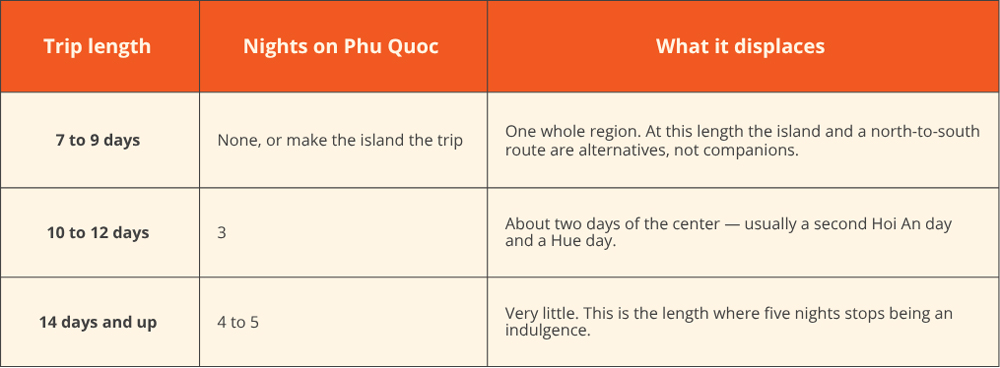
Two of our routes already do this arithmetic. Our six-day Da Nang and Phu Quoc route is the one to look at for the coast and the island in a single run — it is the pairing that costs the fewest travel days. If the island is the whole point, our five-day Phu Quoc route is the day-by-day version of the five-night shape above.
Two things undo Phu Quoc itineraries: the sea day that does not happen, and a stay long enough that a single-base island holiday starts repeating itself.
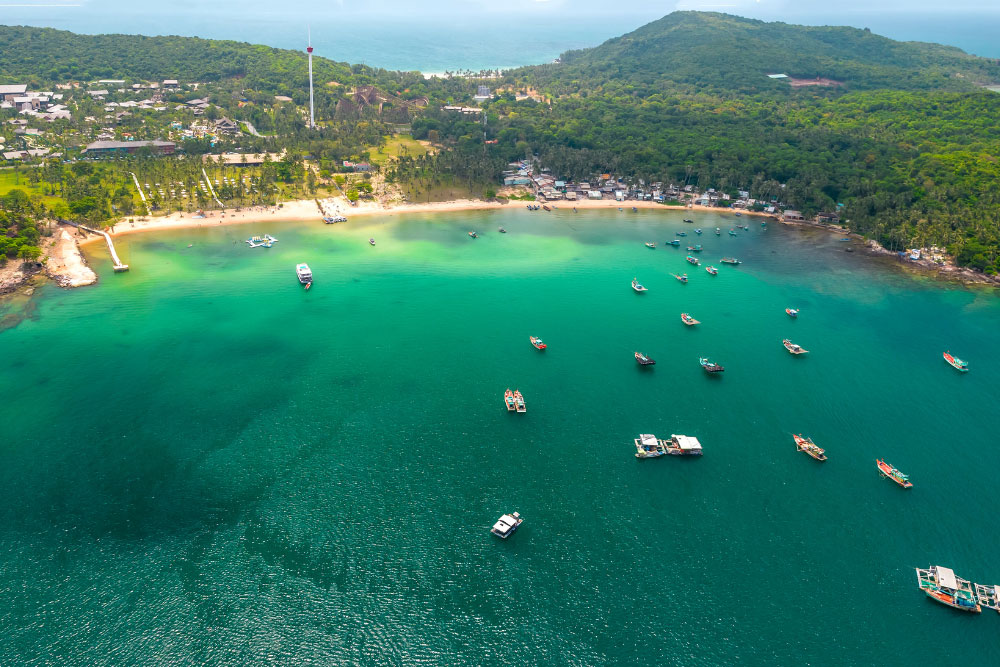
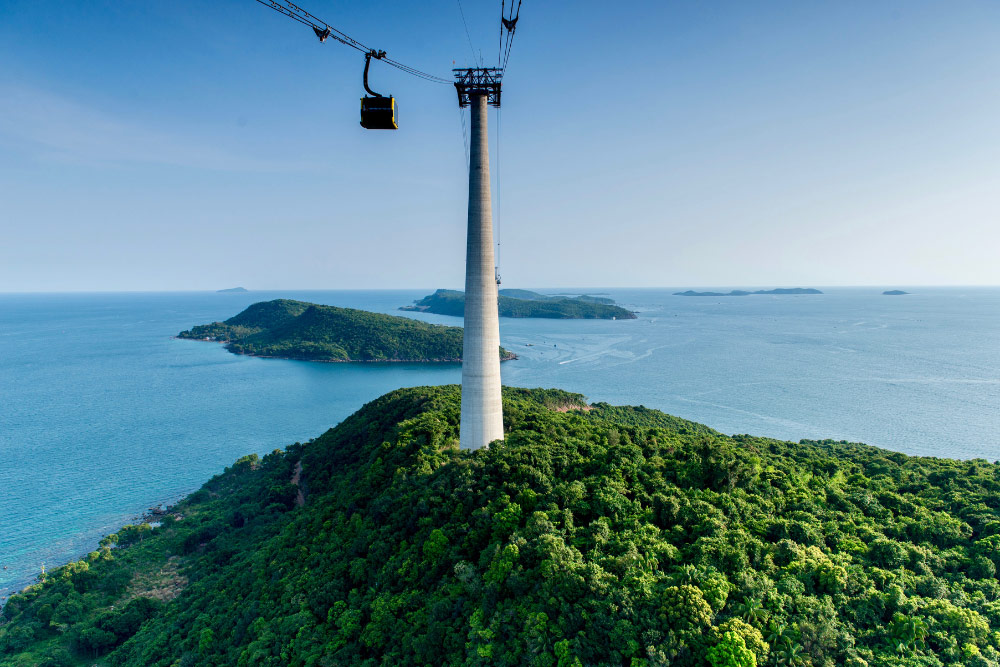
The boat trips are the reason most people book this island and the first thing to be called off. Operators cancel on sea state, not rainfall, so a bright morning with a stiff wind will do it — repeatedly, in the monsoon months. The island is also under heavy construction in places, which is not a weather problem but has the same effect on a plan: the beach in the photograph may have a crane behind it. And the marquee attractions — theme park, cable car, safari, water park — are substantially one company's venues, so a day spent on all four is a day inside one operator's ecosystem rather than a day on Phu Quoc.
We talk travelers out of two things here more than anything else. The first is a two-night stop inside a two-week trip: the flights cost more than the stop delivers, and the nights are better spent elsewhere. The second is April, which arrives on a lot of brochure dates because the industry calls it dry season — twelve rain days is not dry, and April is where travelers who booked the island for the water end up under cloud on a sun lounger. Past five or six nights, a single-base island stay with no town to wander into starts repeating itself, and we would rather say so than sell you the extra nights.

Every sample Phu Quoc itinerary that ranks for this question reads like a neutral list of the island's highlights. Look at who publishes them: an attraction operator, a property developer, and a handful of marketplaces. The circuit they lay out — theme park, cable car, safari, water park — is substantially one group's portfolio: reasonable for them to promote, a poor basis for your week. The useful distinction is between the days that are a single company's venues and the days that are the island itself: the water, the south-coast roads, the fishing towns, the pepper and fish-sauce country inland. We will tell you which is which and let you choose. Our itineraries are built around what you want rather than off a shelf, which is the only reason we can be indifferent about which of those days you keep.
Every ranking itinerary pins the boat trip to day two and offers no fallback, which is a scheduling error rather than a weather note. Southern Vietnam's typhoon window runs from mid-October to 20 December and peaks in early November, sea state calls off trips in every monsoon month, and the headline days here are sea days. So: book the sea day for the first full morning, keep one day genuinely unbooked, and never schedule the water for the last day — a cancellation on the final morning has nowhere to go. On a four-night stay that one movable day is the difference between a canceled trip and a rearranged one. It costs nothing, and no sample itinerary does it.

Three to five nights for most travelers. Three covers one sea day and two beach days; five lets you see both ends of the island without changing hotels.
Yes, and four nights is the most sensible single answer. It gives you a sea day, a south-island day and two slow days, with one of them movable if the boats are off.
Not really, not inside a longer Vietnam trip. The domestic flight each way costs most of a travel day, which leaves roughly one usable day on the island.
December through March, the genuine dry season. Avoid October, which averages 385 mm across 22 rain days and is when sea days get called off.
Yes, as the last three to five nights, once the cities and the north are done. It is the slow end of a trip rather than a stop in the middle of one.

Two decisions, in this order: how many nights the island justifies inside your trip, and then where you spend them. Nights first, property second.
Phu Quoc is almost always booked the other way round. The villa is chosen from a photograph, the nights are stretched to justify the rate, and a holiday that works for four nights is asked to carry seven. The island will not tell you when it has run out, and the calendar will not either — April and November both read as dry season on every page that sells them.
Tell us the dates you are holding and what you want out of the trip, and we will come back with a shape you can pull apart — including an honest answer about whether those dates give you the sea days you are picturing, and what moving them would buy. Free quote, no obligation, and a consultant rather than a booking form. For somewhere to start, our six-day Da Nang and Phu Quoc route is where these conversations most often land, because it buys the island without spending the trip on travel days.
WhatsApp: (+84) 866.22.7878
Email: sales@asiamystika.com
Website: www.asiamystika.com
