 Hotline: +84 866 227 878
- SG$ Singapore Dollar
- A$ Australian Dollar
- £ British Pound Sterling
- C$ Canadian Dollar
- € Euro
- MYR Ringgit Malaysia
- US$ United States Dollar
- đ Vietnamese Dong


 Hotline/Whatsapp: +84 86 622 7878
 Email: sales@asiamystika.com
 About Us
 Destinations
 Travel Styles
 Travel Guide
 Blogs
Blogs

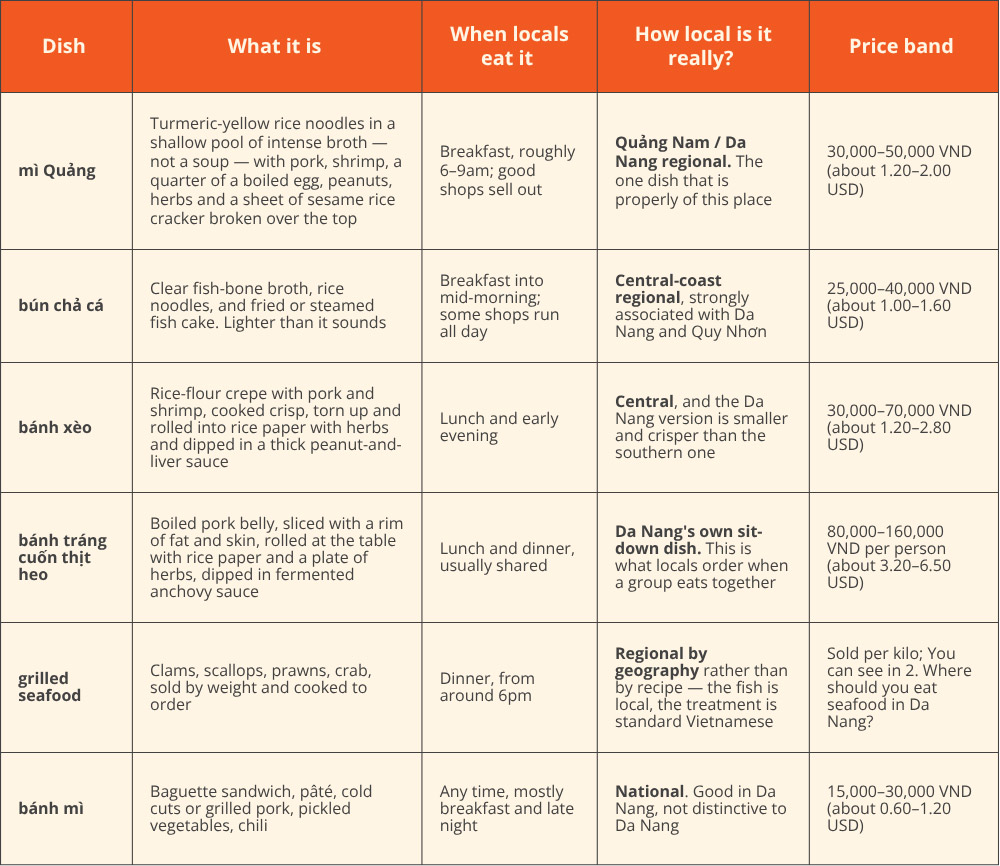
Eat mì Quảng at breakfast, bún chả cá mid-morning, bánh xèo or bánh tráng cuốn thịt heo at lunch, and seafood sold by the kilo at dinner. Those four, eaten at the right time of day, are most of what Da Nang genuinely does well.
The time of day is not a garnish on that answer. It is the answer. Da Nang's best food comes out of shops that cook one dish, open early, and are finished before the afternoon. A traveler who eats the right dish at the wrong hour has eaten a different, worse dish and will go home thinking it was overrated.
On prices in this guide. Every figure below is a band with the month it was captured, and Vietnamese food prices move. Treat them as a shape, not a quote, and confirm on the day.
Six things, and only three of them are actually from here. That distinction matters more than any ranking, because you have roughly twelve meals in a short trip and some of the famous names are national dishes you can eat better elsewhere in Vietnam.
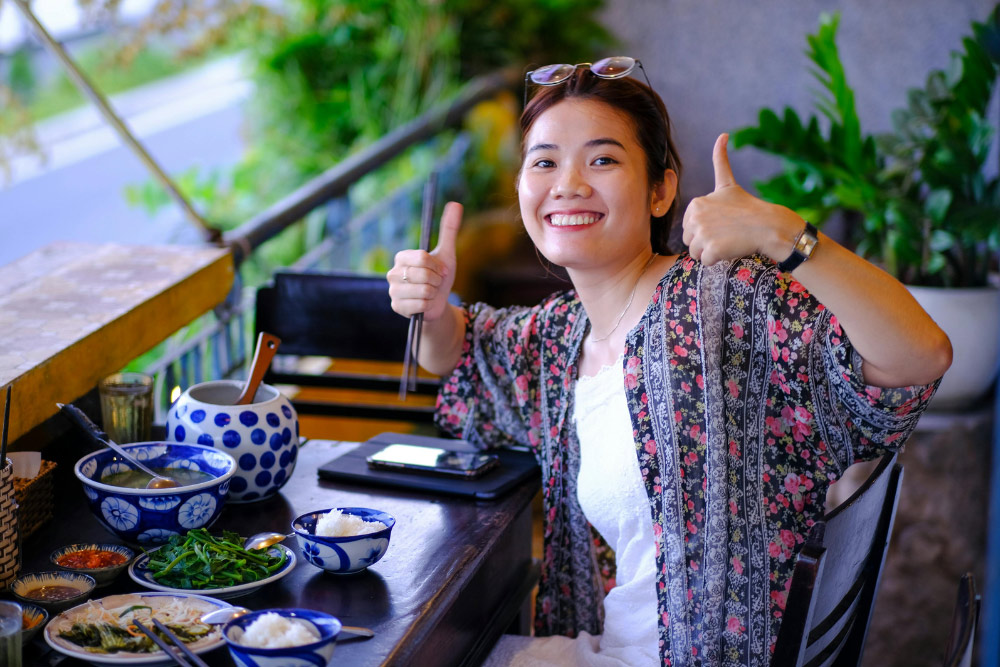
Three more worth a slot if you have the meals to spare: cơm gà, chicken rice with the rice cooked in the stock, more strongly associated with Hội An and Tam Kỳ than with Da Nang; nem lụi, grilled lemongrass pork skewers rolled like bánh xèo, a Huế dish that traveled the 100km south; and chè, sweet bean-and-jelly cups eaten in the late afternoon, which is the one thing on this list that is best at 4pm and worst at breakfast.
On coffee, be equally honest with yourself about origin. Cà phê sữa đá — dark robusta dripped over condensed milk, poured on ice — is national and is excellent here. Egg coffee is a Hanoi invention. Salt coffee is from Huế. Coconut coffee is a modern café-chain drink rather than a regional tradition. All four are sold across Da Nang's café strips and all four are worth drinking; none of them is a reason to choose Da Nang over anywhere else, and any guide implying otherwise is padding a list.
Mì Quảng (often written mi quang, and pronounced closer to "mee kwang") is a noodle dish from Quảng Nam province, the area immediately south of Da Nang. It is not a soup. The broth is reduced hard and served shallow, maybe a centimeter in the bottom of the bowl, so the noodles are coated rather than swimming. You toss it yourself before eating.
The standard version is pork and shrimp. You will also see chicken (mì Quảng gà), fish (cá lóc), and frog (ếch) in shops that specialize. The rice cracker on top is not decoration — break it in and it changes the texture of the whole bowl.
One rule governs it: a shop that makes a good mì Quảng makes a batch of broth in the morning and stops when it is gone. See H2 5 for what that means for your day.
.jpg)
At a by-weight restaurant where you can see the tanks, on the coast road or a block behind it — and the important part is not which restaurant but how you order. The system is the same everywhere and it is where visitors get caught.
How the by-weight system works, in order:
The bill dispute at the end of a seafood dinner is the most common complaint we hear from Da Nang, and it is almost never fraud in the dramatic sense. It is a price per kilo that was never stated, a weight that was never shown, and a total well above what you expected. The defense is entirely in steps 2 to 4 above.
Before you sit down, two tells settle it: a "seafood by weight" board with no price per kilo written on it, and no Vietnamese diners at 7pm. The second is the strongest single signal in this guide and it costs you nothing to check. H2 6 has the full list.
The stretches directly facing the beach resorts are the ones where all four tells cluster. That does not make them bad — it makes them priced for a captive audience. Walking inland changes both the price and, usually, the crowd. Our guide to the Da Nang beach strip covers how that geography sits, which is worth reading before you book a beachfront table for the sake of the view.
Da Nang's seafood is a catch, not a supply chain. In the rough-sea months the boats go out less, the tanks are thinner, the price per kilo goes up, and the quality is less consistent — the same restaurant can be a good dinner in April and a disappointing one in the middle of the storm season. Da Nang's rainy and typhoon window runs roughly September to December; our guide to the best time to visit Da Nang sets out the full season, and it is the page to read if your dates are movable.
If you are here in that window, eat the noodle dishes and the pork, and treat seafood as an opportunistic meal rather than a planned one.
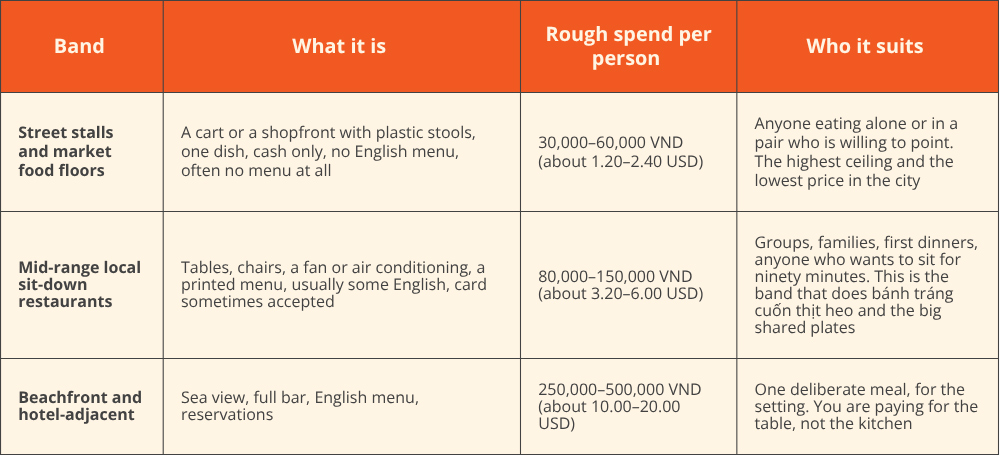
Three bands, and the useful thing to understand is that they are not a quality ladder. The best single dish you eat in Da Nang will almost certainly come from the lowest-priced band.
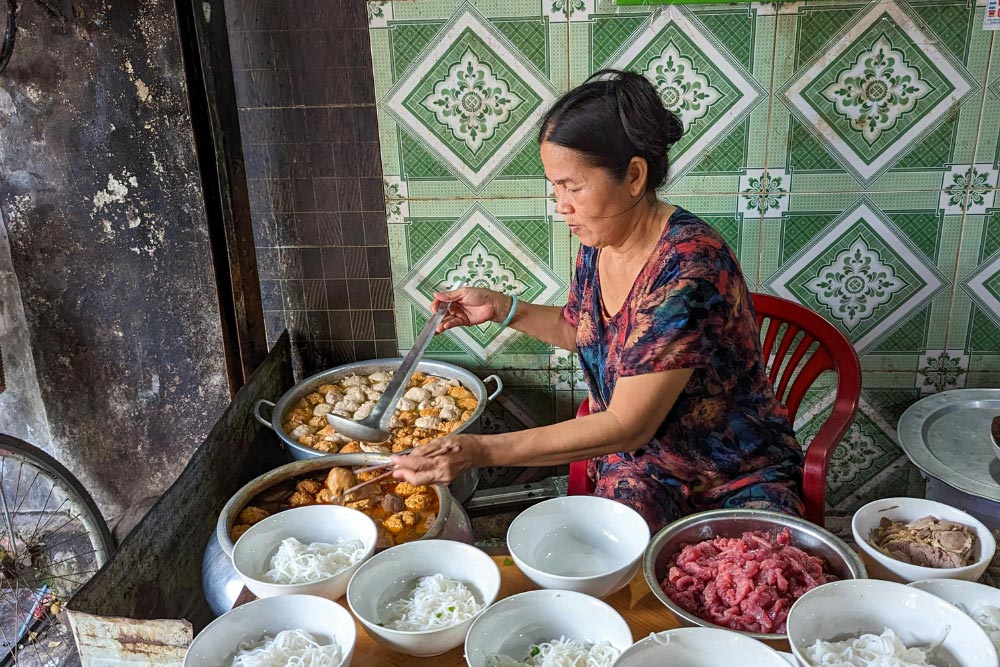
Markets. Chợ Hàn (Han Market) and Chợ Cồn (Con Market) both have food floors, and they are two different experiences: Chợ Hàn sits in the tourist core and is used to visitors, while Chợ Cồn is bigger, more local, and the better eating of the two. In both, the food area runs on different hours from the general market floors — typically opening early and winding down by mid-to-late afternoon, but the exact hours are 6:00 AM to 6:00 PM.
Families ask us this constantly, so, plainly: the reliable dishes are cơm gà (chicken and rice, no chili, no surprises), bánh mì without the pâté and chili if your child is cautious, plain bún noodles with grilled pork, and bánh tráng cuốn thịt heo, which works well because children assemble their own rolls and can leave out anything they do not like. Fresh sugarcane juice and coconut water are everywhere. Most kitchens will cook a dish without chili if you ask — không cay.
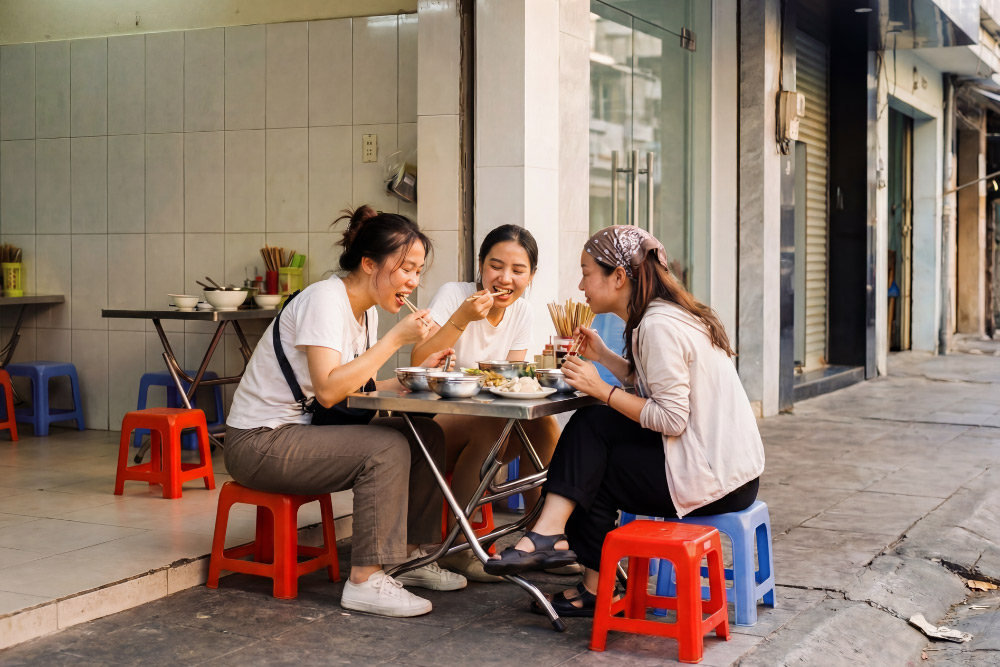
Where to sit matters more than what to order. The mid-range sit-down band is the right default with young children: proper chairs, a fan, a bathroom, and space for a stroller. The band above it is fine and the band below it is where the honest note belongs — a plastic-stool pavement shop at 7am is not where a jet-lagged five-year-old is going to do well. Low stools, no back support, traffic a meter away, and a queue that moves fast. Do that meal on day three or four when everyone has slept, not on the first morning, and go as a pair while the other parent takes the earlier café shift if you can split it.
For the map behind all of this — where the beach strip, An Thượng, the riverside and the city-center local blocks actually sit relative to each other — our Da Nang destination guide is the page to have open. If you would rather build the day around a meal than the other way round, our things to do in Da Nang guide pairs the neighborhoods with what is worth doing in them.
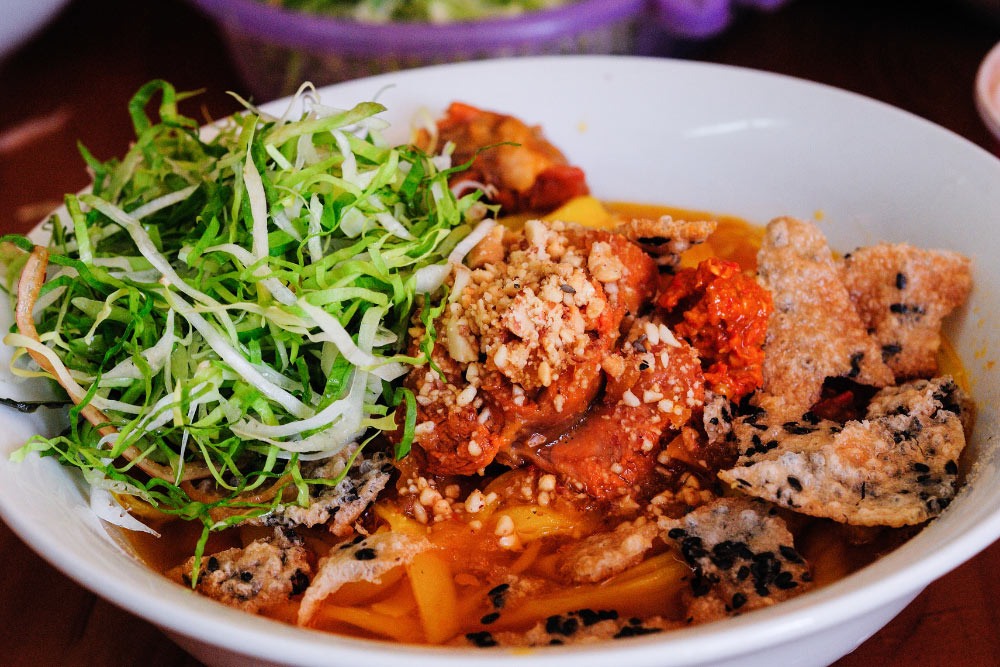
Here is the direct answer first, organized by the thing that actually decides where you eat: the occasion. Then the reframe, which will save you more meals than the list will.
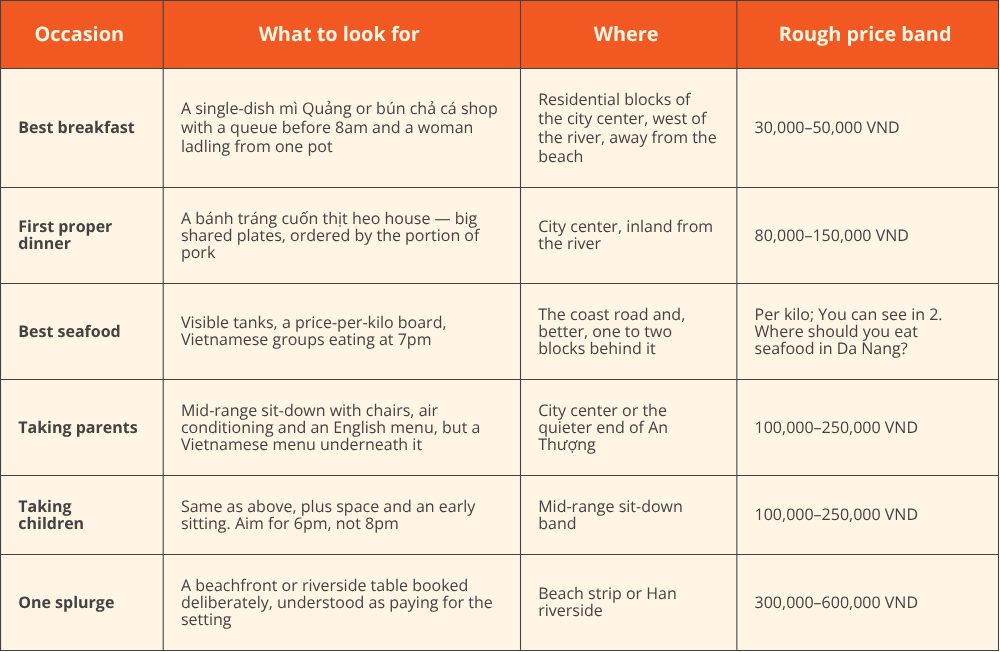
Named venues are deliberately absent from that table. Every ranked list on this query is assembled from other ranked lists, and a fair proportion of the restaurants on them have changed hands, moved, or closed since the list was written. We would rather send you to a type of shop on a described street, which is durable, than to a name we cannot verify is still trading this month.
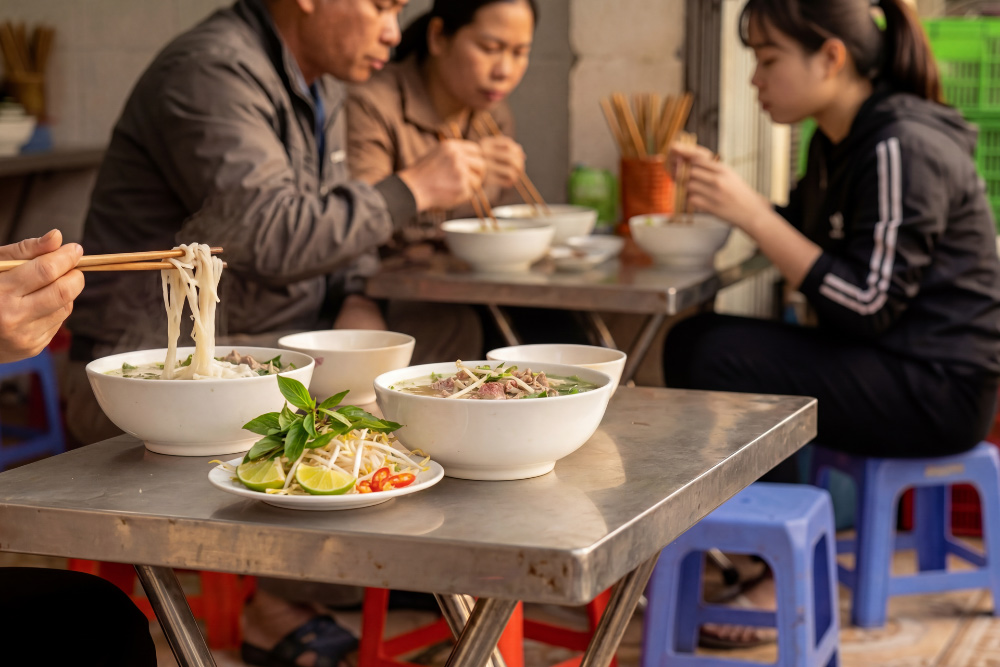
Review-count rankings measure how many tourists left a review, which correlates with how tourist-facing a restaurant is, not with how good it is. In Da Nang the reliable signals are different and you can read them from the pavement:
Learn those six and you do not need a list at all, which is the point — you will be walking past a hundred shops this guide could never name.
And if you want a Western meal, have one. In week three of a Vietnam trip most people want a pizza, a burger, or a plate of pasta, and Da Nang has a large expat food scene concentrated around An Thượng that does all three properly. There is nothing to feel sheepish about, and a guide that pretends nobody ever wants a break from rice noodles is not being honest with you. Have the break, then go back to the 6am shop the next morning.
Yes to all three. Da Nang has halal-certified restaurants, an established Indian restaurant scene, and a real Vietnamese vegetarian tradition — look for the word chay, which marks a dish or a whole restaurant as vegetarian — mostly clustered in the tourist areas and the city center. We handle dietary, religious and allergy requirements as standard on every tour we build, so if this is the deciding factor for your trip, tell your consultant and it gets planned around rather than improvised.
None of them are bad dishes. They are dishes that are commonly eaten at the wrong time, in the wrong city, or in a version made for people who will not know the difference. Here is where a meal slot gets wasted.
Mì Quảng after about 11am. The dish that most disappoints visitors is the dish this city is most famous for, and the reason is scheduling, not cooking. The good shops make one batch of broth in the morning and close when it is gone. What is being served in a tourist-facing restaurant at 2pm is a version built to be available all afternoon, and it is a thinner, flatter thing than the bowl you would have had at 7am. Travelers eat that version, conclude mì Quảng is overrated, and are half right — that mì Quảng is. Eat instead: go to a single-dish shop before 9am. If it is 2pm and you want noodles, have bún chả cá, which holds up better through the day, or wait and eat bánh xèo in the evening.
Bún chả cá sold from an all-day tourist menu. The whole dish rests on a clear fish-bone broth and on fish cake that was fried recently. A restaurant carrying forty items on its menu is not making that broth every morning for one of them. This is not a dish to order in a multi-cuisine place near the beach. Eat instead: the shop with the fish cake in a glass case at the front and nothing else on the sign.
Cao lầu, in Da Nang. Cao lầu is a Hội An dish — the noodles are traditionally tied to Hội An's water — and travelers order it in Da Nang because they have read about it on a central-Vietnam list. You can find it here; it is rarely as good as it is thirty kilometers south. Eat instead: save it for the day you are in Hội An, where it belongs. Our Da Nang versus Hội An comparison covers which of the two towns to eat what in, which is a more useful way to split your meals than treating them as one destination.
Bánh mì, if you are treating it as a Da Nang experience. It is a very good sandwich and it is a national one. If you have twelve meals here, giving three of them to bánh mì means skipping the dishes you cannot get anywhere else. Eat instead: one bánh mì, as breakfast on a travel morning, and spend the other slots on mì Quảng and bánh tráng cuốn thịt heo.
Egg coffee, as a local specialty. It is a Hanoi drink, on Da Nang café menus because visitors ask for it. Eat instead: cà phê sữa đá, or salt coffee, which is from Huế and at least central Vietnamese.
The pattern underneath all five: the good version of a Da Nang dish is tied to a time of day and a shop that only makes that dish. Break either condition and you have eaten a copy.
The geography is simple. Prices climb toward the beach resorts on the east side, and they climb again around the Dragon Bridge on the nights it breathes fire, when the crowd is large, in a hurry, and eating once. Those two zones plus the immediate approach to Chợ Hàn are where the tourist-priced restaurants concentrate. That is not an accusation against any particular place — it is what proximity to a captive audience does to a menu everywhere in the world.
What to walk away from, in order of reliability:
The two-block rule. You do not need to go far. Walk two blocks inland from the beachfront road, or two streets back from the riverside promenade, and both the prices and the customer mix change — usually enough that you are paying local rates and eating in a place that depends on repeat customers. Two blocks. That is the whole trick, and it is why the occasion table in H2 4 says "one to two blocks behind" rather than naming restaurants.
What actually happens if you get it wrong is worth stating plainly, because the internet exaggerates it: you eat an average meal at roughly double the price, and you are mildly annoyed. That is the realistic downside. Da Nang is not a city where tourists are routinely scammed at dinner, and the seafood bill disputes described in H2 2 are overwhelmingly caused by a price that was never agreed rather than by anyone setting out to cheat you. Agree the price, check the room at 7pm, walk two blocks. That is the entire defense.
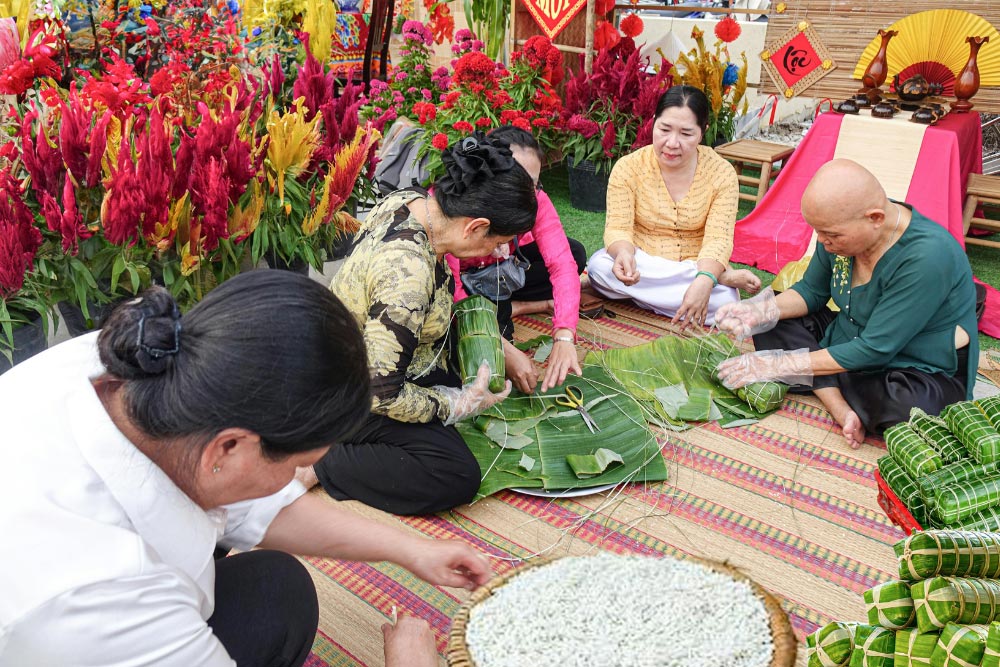
For most people on a first trip, yes — and specifically on the first full day, not the last. A morning market tour followed by a cooking class teaches you what the ingredients are, what the herbs on the shared plate are for, and how a by-weight seafood order works, three hours into the trip instead of on day five. Every meal after it is better because you know what you are looking at. We arrange these with local partners rather than running the school ourselves, which is precisely why we can tell you who should skip it.
Who should skip it: a confident traveler on a three- or four-day stay, for whom half a day is a large fraction of the trip; anyone who has already done a cooking class elsewhere in Vietnam, since the market half is broadly similar from city to city; and repeat visitors, who already have the vocabulary the class exists to teach. If that is you, spend the money on two extra dinners and use the ten-second judgement rules in H2 4 instead.
Prices run roughly 600,000–1,200,000 VND (about 25–50 USD) per person for a market tour plus class as of September 2026, with the wide end of the band reflecting group size and whether the seafood market is included — confirm current pricing when you book, because this is a category where prices move with the season.
One note on Hội An. Hội An's cooking classes are better known and more numerous, and if you are doing both towns it is a reasonable place to put the class instead. It is a thirty-minute drive; our Da Nang to Hội An transport guide covers the options.
If you would rather have the food built into a wider route than bolted on — market morning in Da Nang, cao lầu in Hội An the day you are actually there, and the northern dishes in their own place — that is what our Best of Vietnam tour is for. It is private and the itinerary is drafted with you, so meal timing is a thing you can actually ask us to build around rather than something you work out on the pavement at 2pm.
.jpg)
Three things we tell clients before they land, which do not appear on any ranked list.
The Broth Test. Judge a shop by how few dishes it makes, not by how many reviews it has. One dish on the sign, one pot being ladled in front of you, and a queue of local customers at the hour that dish belongs to. Around 95% of our guides are local to the region they work in, and none of them chooses a restaurant from a ranking — they choose the shop that has been making one thing on that corner for years. This is also the honest answer to "what are the best restaurants in Da Nang": the best food here mostly does not come from restaurants.
The 6 AM Mì Quảng Rule. The best bowl of Da Nang's signature dish is served before most visitors are awake. Good shops make one batch and close when it is gone, often before lunch. If you are building a Da Nang day, put mì Quảng at the front of it, not in the gap between two attractions. We schedule around this — a guide building a morning itinerary knows which shops are finished by 11am, and it changes what time the car arrives.
Do not build a food itinerary from a restaurant list. Build it from meal slots. Take the number of meals you actually have — a three-day stay is about nine — and assign one dish to each, at the hour that dish is good. Breakfast gets mì Quảng or bún chả cá; lunch gets bánh xèo or bánh tráng cuốn thịt heo; dinner gets seafood or the shared pork plate; late afternoon gets chè and a coffee. Then find the shop when you are standing there, using the signals above. A list tells you where to go and gives you no way to handle it being closed, moved, or wrong for the hour. Meal slots survive all three.
.jpg)
Mì Quảng, bún chả cá, bánh xèo, bánh tráng cuốn thịt heo and grilled seafood sold by weight. Of those, mì Quảng and bánh tráng cuốn thịt heo are the two most specifically tied to Da Nang and Quảng Nam rather than to Vietnam generally.
At a by-weight restaurant with visible tanks, ideally one to two blocks inland from the beachfront road rather than facing it. Ask the price per kilo and confirm the weight before anything is cooked — the unstated price per kilo is the cause of nearly every seafood bill dispute in this city.
Low-key compared with Hanoi or Saigon: riverside bars, a cluster of beachfront and An Thượng venues, and the Dragon Bridge fire-and-water show on weekend evenings. Most food shops close early, so plan dinner before the drinks, not after.
Different, not better. Da Nang has the seafood, mì Quảng and the everyday local eating; Hội An has cao lầu, its own bánh mì reputation and white rose dumplings, in a much more tourist-facing setting. They are thirty minutes apart and most people should eat in both — our Da Nang versus Hội An guide breaks down which town to base yourself in.
As of September 2026, roughly 30,000–60,000 VND (about 1.20–2.40 USD) at a street stall or single-dish shop, 80,000–150,000 VND at a mid-range sit-down restaurant, and 300,000–600,000 VND per person at a beachfront place. Seafood is priced per kilo and sits outside those bands.
Broadly yes, and the practical rule is turnover: a busy shop cooking one dish to a queue is safer than a quiet one holding food for hours. Eat where locals are eating, choose things cooked in front of you, and be more cautious with pre-peeled fruit and with ice from an unclear source than with the cooked food itself. Most travelers who have a bad stomach in Vietnam are adjusting to unfamiliar food rather than reacting to anything unsafe.
.jpg)
Da Nang's food rewards planning at the level of the hour, not the restaurant, which is awkward to do from home with nine tabs open and straightforward for a consultant who knows which shops close at 11am.
Tell us the dates you have in mind and what you want out of the trip — how many days in central Vietnam, whether you are traveling with children, and anything you cannot or will not eat — and we will draft a route you can pull apart. Dietary, religious and allergy requirements are handled as standard, not as a special request. Every trip we build is private, the guide is local, and someone is reachable on WhatsApp while you are on the ground.
Free quote, no obligation. WhatsApp +84 866227878 or email sales@asiamystika.com. If you would rather see the shape of a route first, start with our Best of Vietnam tour — it is what most first-time travelers use as a starting point, and it is designed to be rearranged.
