
- SG$ Singapore Dollar
- A$ Australian Dollar
- £ British Pound Sterling
- C$ Canadian Dollar
- € Euro
- MYR Ringgit Malaysia
- US$ United States Dollar
- đ Vietnamese Dong


 About Us
 Destinations
 Travel Styles
 Travel Guide
 Blogs

What the Hoi An Ancient Town ticket actually buys, when the sites and booths open, when the streets close to traffic, and the hours of the day worth avoiding.
Hoi An Ancient Town is a preserved trading port on the Thu Bon river, about 30 km south of Da Nang, UNESCO-listed in 1999 and walkable end to end in an afternoon. There is a ticket, and it buys entry to a set number of heritage buildings rather than the right to walk the streets.
Old Town and Ancient Town are the same quarter, so this page uses Ancient Town throughout.
What survived here is a port that ran from roughly the 15th to the 19th century, when Japanese, Chinese, Dutch and Vietnamese merchants worked out of the same few streets. The river silted up, the trade moved north to Da Nang, and the quarter was left more or less intact instead of being rebuilt. That is the entire reason it exists in this form, and it is why the buildings you pay to enter are merchant houses and assembly halls rather than palaces or temples.
On the ticket, there are three separate questions hiding inside "do you have to pay", and they have three different answers.
1. Walking the streets. The fee is nominally levied on entry to the protected quarter, and the money is stated to go toward maintaining the buildings. In practice, walking down Tran Phu does not put you inside a ticketed building, and the streets themselves have no gate on them.
2. Entering the ticketed sites. This part is unambiguous. The assembly halls, the old merchant houses, the museums and the interior of the Japanese Covered Bridge are ticketed, and a ticket is what gets you through the door.
3. Whether it is enforced. This is the part most pages either overstate or dodge. Ticket booths sit at the main pedestrian approaches to the quarter and are staffed during their own hours, which are not the sites' hours. Outside those hours there is frequently nobody at a booth. We are not going to tell you whether you will be stopped, in either direction. We have not verified it with a date, and a page that assures you the ticket is never checked is handing you a reason to feel cheated on the day it is.
Why figures on this page are blanks rather than numbers. Prices and hours in a heritage quarter change, and the number published on most pages about Hoi An — including, until this update, our own — was copied forward without a date, some of it from 2025. We are not re-stamping an old figure with a new year on it. Where we do not hold a current figure, this page says so and tells you where to confirm. Everything here was reviewed in October 2026; nothing on it was carried over from the previous version unchecked.
One fact governs every arrival: Hoi An has no airport and no railway station. Whatever the map says about where you are coming from, the journey is really "get to Da Nang, then transfer about 30 km" — and it is the transfer, not the flight, that gets under-planned. The drive time depends on the road, the hour and whether the pedestrian blocks are on, so there is no figure for it here; the 30 km transfer from Da Nang sets out the options and what each costs you in time.
One Hoi An Ancient Town ticket admits you to a fixed number of ticketed sites, chosen by you from a longer list of heritage buildings, with a coupon handed over at each door. You cannot use it on everything, which makes it an itinerary decision rather than a cost decision.
We are not publishing a price. The figure on most pages ranking for this question is undated and some of it is from 2025, and a heritage fee you plan around should come with the month it was checked. Confirm the current price at the booth, or ask us and we will check it for your dates. The same applies to how many sites one ticket admits, how long it stays valid, and whether it is priced per person or per group: those are exactly the details a stale page gets wrong, so they are left open here rather than guessed at.
The structural point survives every blank, and it is the one worth understanding. You cannot use the ticket on everything. You are choosing a handful of buildings out of a dozen or so, which is why this is a decision about your morning rather than about your money. Choose badly and you spend that morning on three near-identical merchant houses.
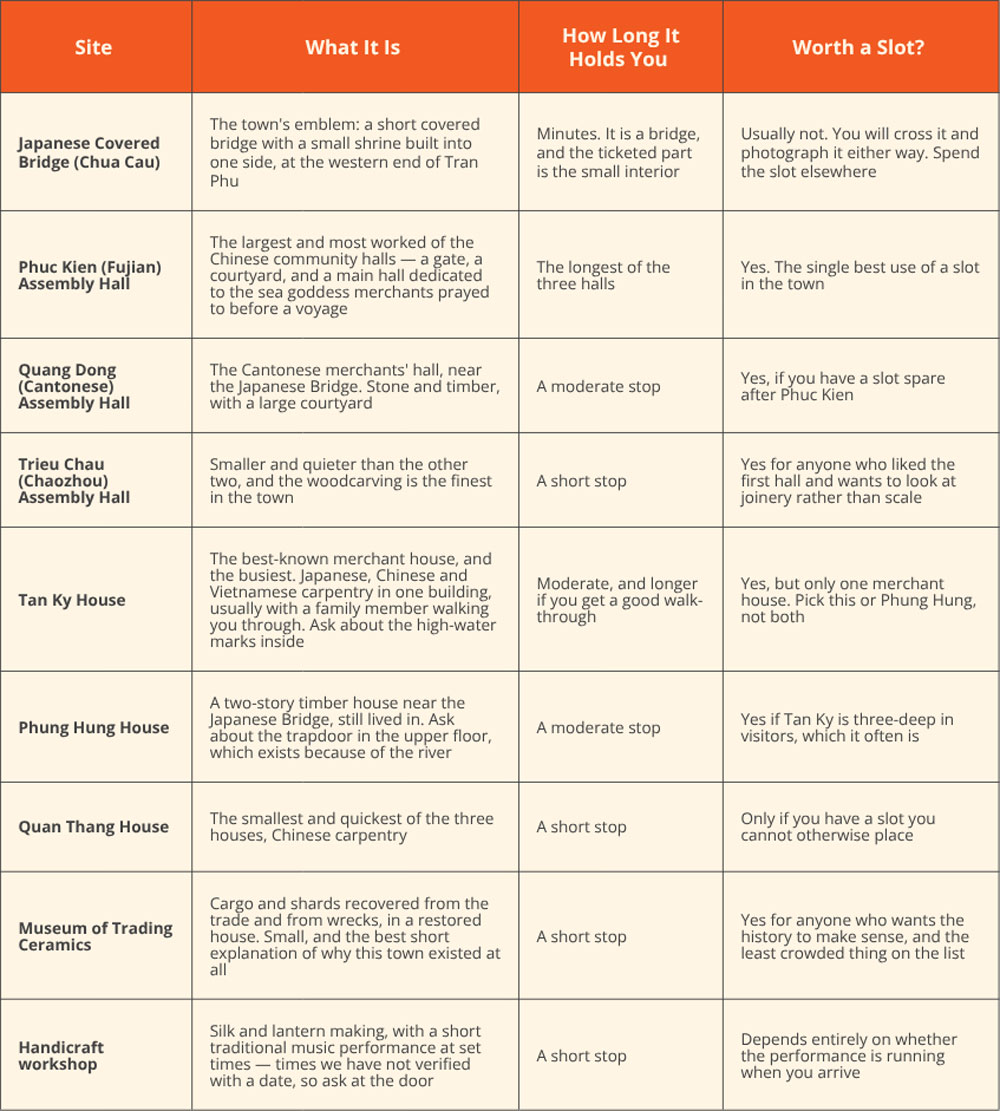
The third and fourth columns are our recommendation and not observed opening data, which is why they are in words rather than minutes. Every page ranking for this keyword lists these sites. None of them ranks them, and the ranking is the part that changes your morning.
If you want the merchant houses in more depth than a table row allows, our guide to the old merchant houses of Hoi An goes building by building — worth reading before you decide which interiors to spend slots on.
Where the tickets are sold. At booths on the main pedestrian approaches to the quarter. The number of booths and the hours they keep are not figures we hold with a date, and the booth hours are not the same as the sites' hours. That difference is section 3, and it is the thing that most often catches people out.
Hoi An Ancient Town's streets never close — there is no gate on the quarter and the evening is when it is busiest. The ticketed sites keep fixed daytime hours, the booths keep their own and close earlier, and the core shuts to motor traffic in set blocks morning and evening.
Three different things are being asked in this one question, and merging them is why most answers do not survive contact with the day.
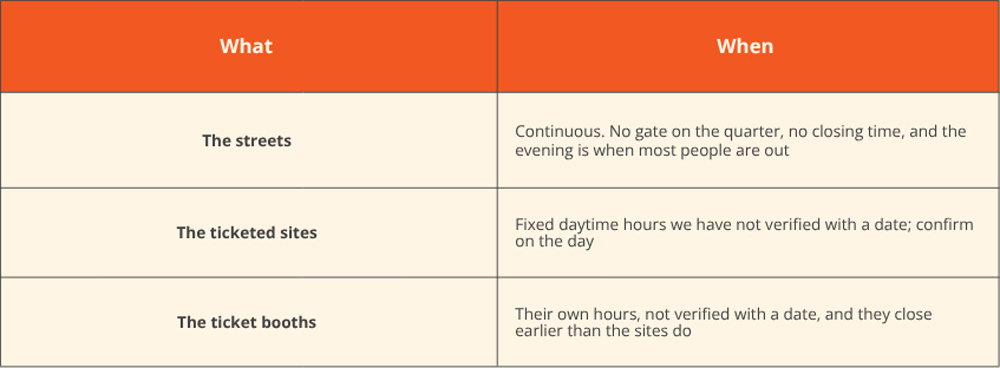
The practical consequence, which is the reason this section exists. Arrive in the late afternoon and you get a short window of ticketed-site access and then a completely different, unticketed evening town. Neither is worse than the other. They are not the same visit, and on one afternoon you are choosing between them rather than getting both. That single fact reorganizes a Hoi An day more than anything else on this page, and it is why section 4 recommends splitting the quarter across two parts of one day rather than doing it in one block.
The protected core is closed to motor traffic in set blocks, morning and evening, and open to it between them. We are not printing the hours of those blocks, because we do not hold them with a date and you may plan a departure around them — see the pickup note below, which is the specific thing that goes wrong. Ask your property for the current blocks the week before you travel, and ask again at reception on arrival, because this is local traffic policy and it moves.
The mechanism, though, does not move, and it is worth understanding in full.
The streets in the restricted core: Tran Phu, Nguyen Thai Hoc, Bach Dang along the river, Le Loi, Chau Thuong Van, and the approaches to the Japanese Covered Bridge. That is the walkable heart of the quarter, and it is where almost everything in section 2 sits.
What "pedestrianized" does not mean. It is not a car-free plaza. Bicycles, cyclos and electric buggies keep moving through the restricted hours, and they move through crowds without much warning. If you are walking with a small child, you are still watching for wheels the whole time.
What happens outside the blocks is the part visitors do not expect: motorbikes come back onto the same narrow lanes people have been strolling down, and there is no separate sidewalk on most of these streets. The quarter changes character for a couple of hours and then changes back.
A car cannot reach a hotel inside the restricted core during a restricted block. If your hotel is in the quarter and your transfer falls in one of those blocks, your pickup is a street corner, not a doorstep, and the walk to it is over uneven paving that was not built for suitcase wheels.
Two things fix it and both are free. Ask the hotel which corner, by name, before the day of departure, rather than assuming the driver will reach the door. And walk the route once in daylight, thinking about how many bags you will be carrying. Ten minutes of uneven stone with luggage, in the dark, twenty minutes before a flight, is a bad way to end a stay in Hoi An and it is entirely avoidable.
The same paving is worth a note if you are pushing a stroller or using a wheelchair. Restricting the traffic does not smooth the ground, and the lanes near the river are the oldest surface in the quarter.
If you are still deciding where to book, our guide to where to stay in Hoi An, area by area sets out which areas sit inside the restricted zone and which do not — the decision that determines whether any of this affects you at all.
Spend a full day plus an evening in Hoi An Ancient Town on a first visit, and take two nights in Hoi An if the wider trip allows it. Half a day covers the ticketed sites and nothing else.
We are contradicting our own previous version of this page, which said two to three days to explore the Ancient Town. That was wrong. Two to three days is a reasonable length for Hoi An — the town and its surroundings, the beach, the countryside, a cooking class, a tailor. It is not a recommendation for a dozen blocks, and a reader who blocks out three days for the quarter itself will spend the third one bored in a shop.
What the second night actually buys is a rain contingency and a half-day out of town. It does not buy more hours on Tran Phu, and nobody needs more hours on Tran Phu.
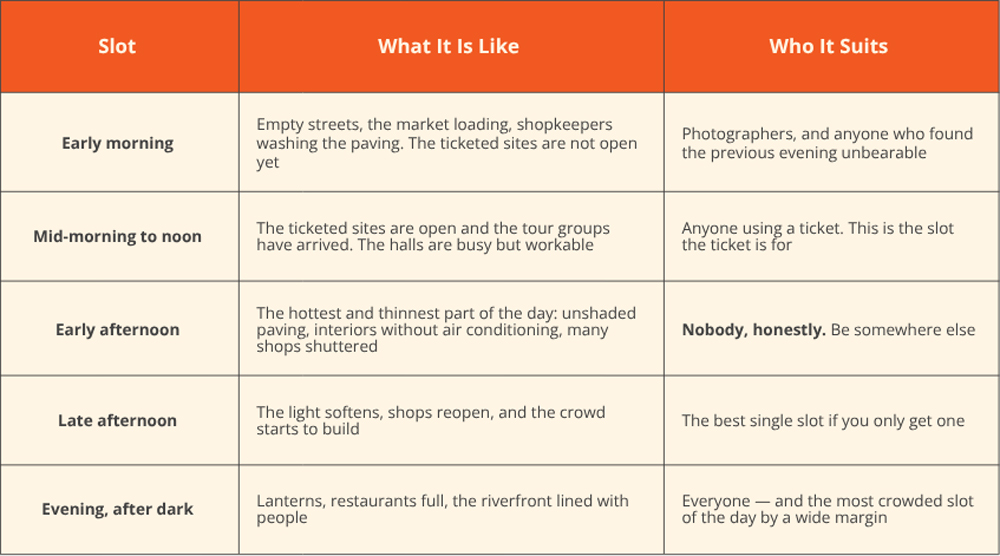
Those verdicts are our editorial judgment rather than measured data, which is why they describe the quarter instead of quoting times.
The afternoon gap is not wasted time; it is where the rest of Hoi An goes. A tailor fitting is the obvious use of it, and it is what fittings are scheduled around — how a Hoi An fitting schedule actually works explains why two or three appointments across two days is the realistic shape. Otherwise it is the beach, the countryside, or a long lunch somewhere with a fan. The evening changes on full-moon nights, when the quarter runs on lanterns and the crowd is at its largest of the month — the full-moon lantern nights has the pattern, and the dates are worth checking before you fix which evening you are here. And Hoi An Central Market, at the eastern end of the quarter on the river side of Tran Phu, is the best orientation point in the town: if you know where the market is, you know where you are.
Hoi An Ancient Town is unpleasant between about 6pm and 9pm in high season, when the central lanes are shoulder to shoulder, and in the early afternoon heat on unshaded paving. Anyone passing through on a half-day who will not go inside buildings should skip the ticket entirely.
Every other page about this town tells you to come. Here is when not to, and who should keep their money in their pocket.
The crowd. Between roughly 6pm and 9pm in high season the central lanes are shoulder to shoulder. That is not atmosphere, it is a queue you are standing in while trying to look at a building. If you dislike crowds, do the ticketed sites in the morning, be out of the quarter for dinner, and come back through it late.
The heat. Early afternoon in the dry months, on unshaded paving, with the interiors of the ticketed sites unairconditioned. The mid-afternoon slot is the worst hour of the Hoi An day and there is no way to make it pleasant. Plan around it rather than through it.
The commercial density. A large share of the ground floors on the main streets are shops, tailors, cafes and restaurants. That is what the quarter is now, and it is not a criticism — but anyone picturing a quiet museum quarter is disappointed inside twenty minutes, and it is better to hear that here than to arrive expecting it.
The flood window. The quarter sits on a river and it floods, from September to December, peaking in October and November — those two months carry 40–50% of the Vu Gia–Thu Bon basin's annual rainfall, per the basin study published in IWA Water Supply in 2022, which does not state its reference period in the accessible text. Bach Dang, on the riverfront, is the first street in Hoi An to go under. That is one or two sentences' worth here; the month-by-month picture is in the best time to visit Hoi An and the street-by-street mechanics are in which streets in Hoi An flood and when.
Directly, because nobody else will say it.
Anyone with a morning and any interest in why this town existed. Three assembly halls and the ceramics museum in one morning is the best thing in the Ancient Town, it is genuinely good, and it is exactly what the ticket is for. If that is you, buy it, start at Phuc Kien, and be finished before the heat arrives.
Every page ranking for this question tells you to buy the ticket and lists the sites. None of them says which sites to spend it on, which is the only part that affects your day.
Whatever the fee turns out to be, it is small against the cost of the trip. The real cost is time: four heritage interiors is a morning, and a morning is a large fraction of a two-night stay in Hoi An. So take two or three sites and skip the rest. Start at the Phuc Kien hall, add the ceramics museum if you want the history to connect, and take one merchant house rather than three. One hall you actually look at beats four you walk through, and the difference is visible in what you remember a year later.
Almost every guide presents the quarter as one block of time. That is how people end up on Tran Phu at 2pm in the heat, having seen the halls and the streets in the wrong order and in the wrong hour.
Split it. Early morning for the sites and the empty streets, evening for the lanterns, and nothing in between — the afternoon belongs to the beach, the countryside or a tailor. Two visits to the same dozen blocks on the same day sounds like a strange piece of advice until you have done it; then it is the only way you would do it again. It is also why we build two nights in Hoi An rather than one, because one night does not contain two visits and a half-day out of town.
There is a ticket for the protected quarter, and it admits you to the assembly halls, merchant houses and museums. Walking the streets and eating in them is a different matter, and we will not guess at current enforcement.
We are not carrying forward an undated figure, and the prices on most pages about Hoi An — some still quoting 2025 — are exactly that. Confirm at the booth, or ask us and we will check it for your dates.
The streets do not close: there is no gate on the quarter, and the evening is when it is busiest. The ticketed sites keep fixed daytime hours and the booths close earlier.
A full day plus an evening on a first visit, with half a day covering the ticketed sites only. Two nights in Hoi An is what we usually build, because the second night buys a rain contingency and a half-day out of town.
Yes, with two honest qualifications: it is a commercial quarter of shops and restaurants as much as a heritage site, and it is genuinely crowded between about 6pm and 9pm in high season. Come early, come again after dark, and skip the middle of the day.
Most years, between September and December, peaking in October and November. Bach Dang on the riverfront is the first street to go under.
The Ancient Town rewards planning at the level of the hour rather than the day. Which sites, which slots, which end of the afternoon you are actually in the quarter — those three choices decide whether you remember three assembly halls or a hot walk past shuttered shops. A dozen blocks does not need three days. It needs a good morning, a good evening, and somewhere else to be at two in the afternoon.
That is tedious to work out from home with nine tabs open and a page of contradictory ticket prices. It is straightforward for someone who builds these routes for a living.
Tell us the dates you have in mind, how many nights central Vietnam gets, whether anyone in the group will struggle on uneven paving, and whether those dates can move if they fall inside the flood window. We will draft a route you can pull apart, with the Hoi An hours arranged the way this page describes rather than as one undifferentiated block. Around 95% of our guides are local to the region they work in, and the itinerary is built with you rather than handed to you.
The route we run most often is the Best of Central Vietnam route — private, and drafted with a consultant, so the number of Hoi An nights is something you argue about rather than something you accept off a shelf.
WhatsApp: (+84) 866.22.7878
Email: sales@asiamystika.com
Website: www.asiamystika.com


