 Hotline: +84 866 227 878
- SG$ Singapore Dollar
- A$ Australian Dollar
- £ British Pound Sterling
- C$ Canadian Dollar
- € Euro
- MYR Ringgit Malaysia
- US$ United States Dollar
- đ Vietnamese Dong


 Hotline/Whatsapp: +84 86 622 7878
 Email: sales@asiamystika.com
 About Us
 Destinations
 Travel Styles
 Travel Guide
 Blogs
Blogs

Wondering is Da Nang worth visiting? Here is a straight answer — what the city actually is, who loves it, who should skip it, how it compares with Hoi An, and how many days it deserves.
The Short Answer: Yes, Da Nang is worth visiting for most travelers — but as a base, not as a headline destination.
The Strength: Within an hour you have Hoi An, Ba Na Hills and the Golden Bridge, the Marble Mountains and Son Tra Peninsula, plus a swimmable beach and an international airport.
The Catch: Da Nang has no old town. If you came to Vietnam for lantern-lit lanes and heritage streets, that is Hoi An, 30 km south.
The Verdict: Give it 2 to 3 days, put weather-dependent trips early, and pair it with Hoi An. Skip it only if your itinerary is very tight.

Yes. For most first-time travelers to Vietnam, Da Nang is worth visiting — but the reason is not the one most travel articles give you.
Da Nang's real strength is position. Within an hour's drive you can reach Hoi An Ancient Town, the Ba Na Hills mountain resort with its famous Golden Bridge, the Marble Mountains, and the forested Son Tra Peninsula. Two to three hours north sits Hue, Vietnam's former imperial capital. Very few cities anywhere put that much within reach of a single hotel room — and almost none also give you a long lifeguarded beach and an international airport in the middle of town.
What Da Nang does not have is a historic quarter of its own. It is a modern, planned, low-rise city. If your mental image of Vietnam is narrow lanes, faded shophouses and lanterns over a river, that image is Hoi An, and it is 30 km away.
Travelers who leave Da Nang disappointed are almost always the ones who arrived expecting a second Hoi An. Travelers who love it arrived wanting a beach, good food and an easy base. Knowing which one you are is the entire decision.

Da Nang sits roughly halfway down Vietnam's coastline on the central coast, with Hue to the north and Hoi An about 30 km to the south. It is the largest city in the region and one of Vietnam's centrally governed municipalities, with a population comfortably over a million.
The city is laid out along the Han River, which flows north into the bay. The beach strip sits on the eastern side, the older commercial center on the western bank, and a series of bridges connects them — including the Dragon Bridge, a road bridge shaped as a dragon that breathes fire on weekend evenings.
Da Nang was heavily rebuilt and expanded from the late 1990s onward, and it shows. The roads are wide, the buildings are new, the seafront has a proper promenade, and the whole city is noticeably cleaner and calmer than Hanoi or Ho Chi Minh City.
For a first-time visitor to Vietnam, that is either exactly what you want, or exactly what you did not come for. There is no wrong answer — but there is a wrong expectation.
You will see the city written three ways, and they all mean the same place:
The airport code is DAD. If a booking site does not find “Da Nang,” try “Danang” or search the airport code directly.
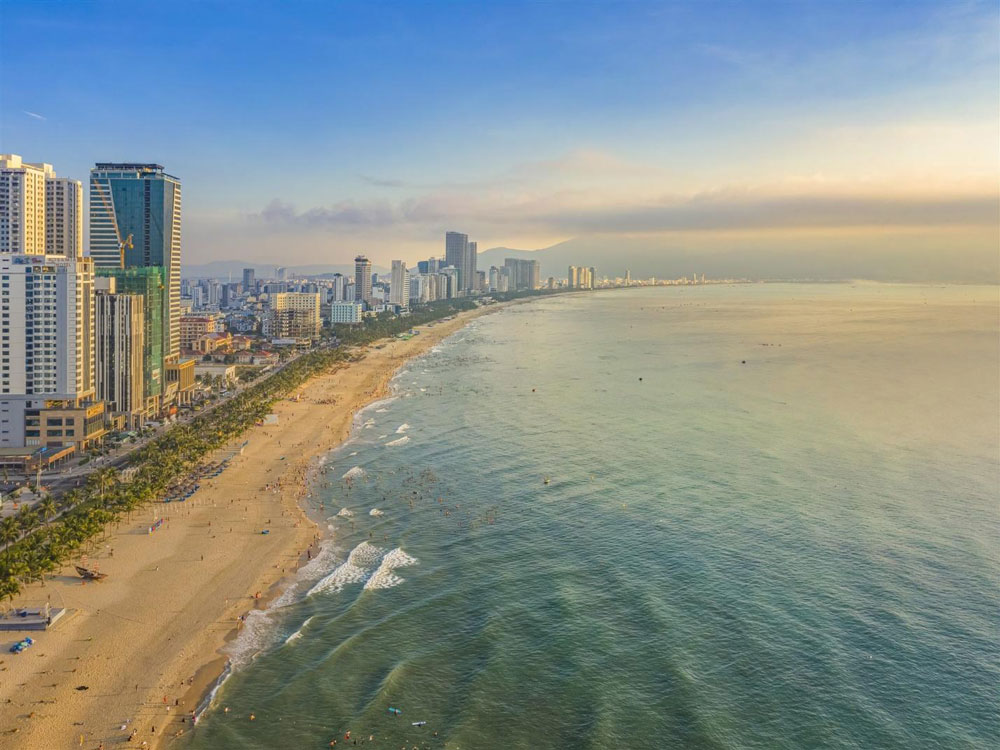
Here is what Da Nang genuinely does better than its neighbors.
My Khe Beach runs for kilometers along the city's eastern edge — pale sand, a wide promenade behind it, and lifeguarded sections patrolled during daylight hours. Many central hotels are a short walk away. Part of this coastline was known to American servicemen as China Beach.
Swimming is best from roughly April to August. From around September the northeast monsoon makes the sea rough and lifeguard cover shrinks.
This is the argument that decides it for most travelers. From one hotel you can reach:
Da Nang is not just somewhere to eat while waiting for Hoi An. Mì Quảng — turmeric-tinted noodles with very little broth, herbs and peanuts — is a Central Vietnamese speciality, and the seafood along the beach road is excellent and inexpensive.
Comfortable modern accommodation, including beachfront resorts, costs considerably less here than in comparable coastal cities elsewhere in Asia.
And Da Nang is easy, which matters more than travelers expect. It is clean, safe, navigable and well covered by Grab — Southeast Asia's ride-hailing app, which shows a fixed fare before you confirm. On a first trip to Vietnam, that ease buys you confidence you can spend elsewhere.

An honest answer has to make the other argument properly, so here it is.
Da Nang has no old town. There is no historic quarter, no lantern-lit lanes, no crumbling colonial shophouses. There are good museums — the Museum of Cham Sculpture holds the largest Cham collection in the world — and there are pagodas. But if atmosphere is what you want, Hoi An has it and Da Nang does not.
It is spread out. The beach strip, the riverside and the western districts are all some distance apart. You will use Grab more than you expect, and casual wandering between neighborhoods is not really how this city works.
The beach closes for part of the year. From roughly September through December, the northeast monsoon brings rough seas, reduced lifeguard cover and frequent rain.
Its best attractions are not really in it. Hoi An, My Son, Hue and Ba Na Hills are all excursions. Strip those out and what remains — the beach, the bridges, the Marble Mountains, Son Tra — is a solid day and a half, not a week.
None of this makes Da Nang a bad destination. It makes it a specific one.

Using Da Nang purely as a gateway is a perfectly respectable choice, and one we arrange regularly.

Most people reading this are not choosing between Da Nang and nothing. They are choosing between Da Nang and somewhere else on Vietnam's coast.
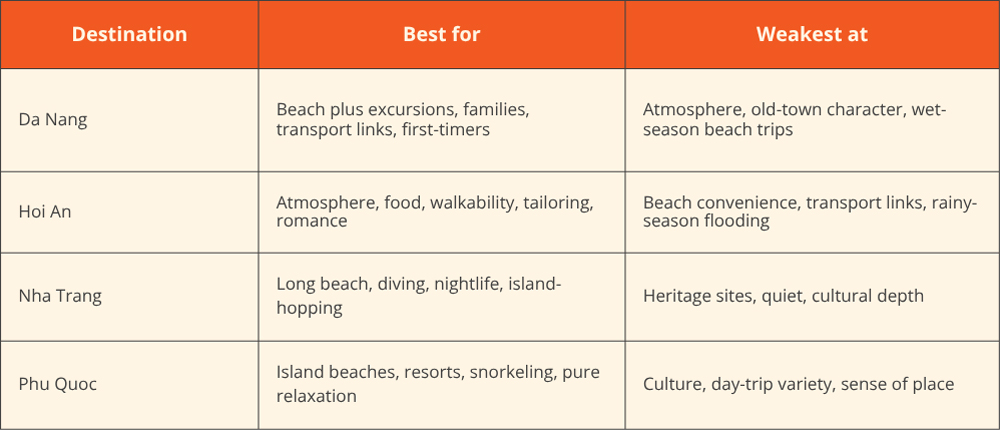
This is the comparison that comes up most, and it is the least binary. They are 45 minutes apart.
The honest answer for most travelers is not Da Nang or Hoi An — it is Da Nang and Hoi An. Stay in Da Nang for the beach and convenience, then visit Hoi An in the late afternoon and evening when the lanterns come on and the day-trip coaches have left.
If you must choose one: Hoi An for atmosphere, food and walkability; Da Nang for beaches, transport and excursions.
Nha Trang has the livelier beach scene and better diving. Da Nang has the heritage sites and the mountains.
Phu Quoc has the better beaches and the better resorts, but it is an island — there is far less to do beyond the sand. Da Nang has everything else within an hour.

Assuming you have decided Da Nang is worth visiting, here is how long to give it.
One planning rule matters more than any other: put weather-dependent excursions early in your stay. If Ba Na Hills is fogged in on day one, you still have days left to try again. Save it for your last day and you may lose it entirely.

An Asia Mystika guide explains:
“The guests who leave disappointed almost always arrived expecting a second Hoi An. The ones who love it arrived wanting a beach, good food and an easy base for getting to everything else — and Da Nang does that better than anywhere on this coast. It is worth being honest with yourself about which one you are before you book.”
— Mieera — Asia Mystika guide, Da Nang.
This is the single most useful thing a first-timer can hear about Da Nang. The city is not competing with Hoi An and it does not want to. It is offering something Hoi An cannot: space, sea, modern comfort and reach.
Set the expectation correctly and Da Nang is one of the most rewarding stops in Vietnam. Set it wrong and you will spend three days wondering what everyone was talking about.
When a guest tells us they only have two days, we ask one thing: is the Golden Bridge the reason you came?
If yes, we build the trip around Ba Na Hills and skip Hoi An entirely. If no, we give them a slow Hoi An afternoon and evening instead.
Trying to do both in two days is how travelers end up remembering the car journeys rather than the destination.

Yes, Da Nang is worth visiting for most travelers. It works best as a comfortable base with a swimmable beach, an international airport, and Hoi An, Hue, My Son and Ba Na Hills all within reach. It is less rewarding if you want a historic old town, which Hoi An does far better.
It is worth visiting for food, culture and Hoi An, but not for a beach-focused trip. The wet season runs roughly September to December, when the sea is rough and lifeguard cover is reduced.
Ba Na Hills is worth it if you want a striking, easy, weatherproof day out. It frustrates travelers looking for authenticity or quiet, because it is a built theme park with a mountain view rather than a hiking destination. Allow a full day and take the first cable car to beat the cloud.
Yes. On a tight two-week trip that already includes Hoi An and Hue, many travelers use Da Nang only as an arrival airport and transfer straight to Hoi An, which takes about 45 minutes.
It is pleasant and very safe, but Da Nang is a family-and-couples beach city rather than a backpacker hub. Solo travelers looking for a social scene usually find Hoi An or Sapa a better fit.
Yes, if you want to add Hue, My Son Sanctuary or Cham Island, or if you are traveling in the wet season and want a buffer day for weather-dependent trips.

Here is the whole answer in one line:
Da Nang is worth visiting as a base, not as a headline — give it 2 to 3 days, pair it with Hoi An, and put the mountain excursion early.
You are getting a comfortable modern coastal city with a good beach and an unusually rich set of things within an hour of it. You are not getting old-world Vietnam, and you should not expect the city itself to fill a week.
It is modern, but not soulless. It is easy, but still local at sunrise. It is a gateway, but also a destination. The only real mistake is arriving expecting lanterns over a river — and then being surprised when you find a beach city instead.
Deciding whether Da Nang belongs on your itinerary is the easy part. The harder part is everything after it: which order to visit Central Vietnam in, how many nights each place deserves, which day to put Ba Na Hills on so the Golden Bridge is not lost in cloud, and how to move between it all without spending your holiday in a car.
If you want to save time and effort while traveling to Vietnam, contact Asia Mystika, a trusted tour agent in Vietnam. We are based here, and we build these itineraries every week — flight advice, vetted hotels, private transfers, guided day trips, Hoi An timing and local food experiences in one smooth program.
And if Da Nang is not the right fit for your trip, we will tell you that too.
