
- SG$ Singapore Dollar
- A$ Australian Dollar
- £ British Pound Sterling
- C$ Canadian Dollar
- € Euro
- MYR Ringgit Malaysia
- US$ United States Dollar
- đ Vietnamese Dong


 About Us
 Destinations
 Travel Styles
 Travel Guide
 Blogs

Da Nang and Phu Quoc run on opposite rain calendars, so your dates decide this more than your taste does. Which coast each month favors, and the two months when neither works.
Key Takeaways: Da Nang or Phu Quoc
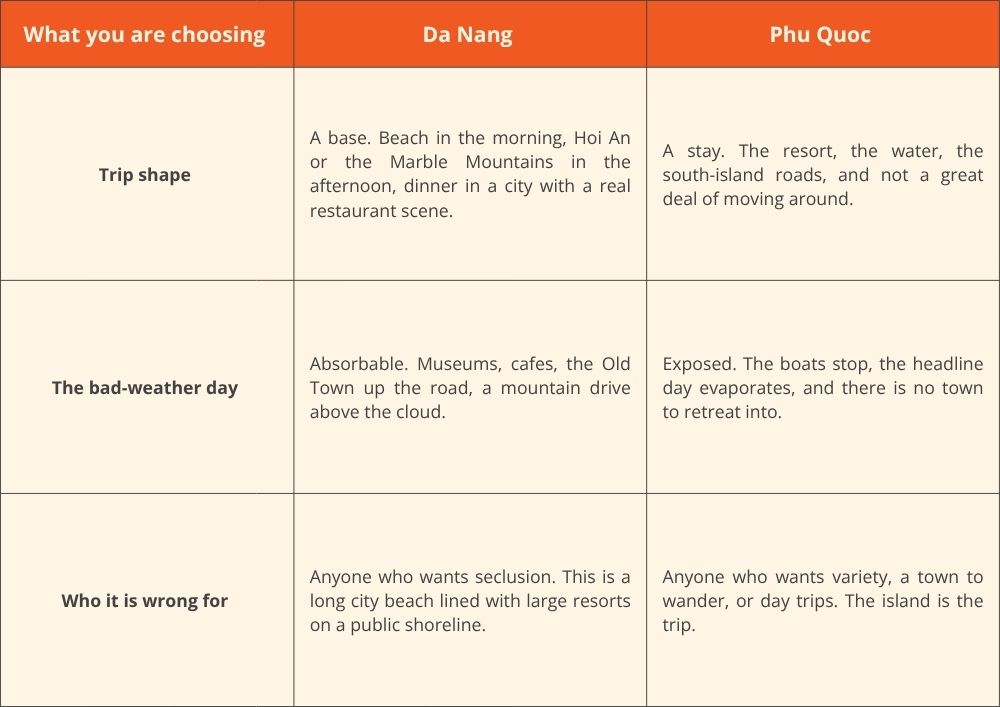
The short answer: Da Nang for a beach base with a city, mountains and Hoi An in reach. Phu Quoc for an island stay where the resort is most of the trip.
The month decides it: The calendars are inverted, and Phu Quoc's genuinely dry window is December to March, not November to April — per Kiên Giang provincial figures and a climate reference stating a 2000-2020 period.
The limit: Phu Quoc is not the escape from central Vietnam's October floods. October on the island runs 385 mm across 22 rain days, and November is poor in both places. The swap works from December.
The distance: Roughly 1,100 kilometers apart. Doing both is a domestic flight, not a transfer, and it costs most of a travel day each way.

Choose Da Nang for a beach with a real city behind it, mountains, food and Hoi An within a short drive. Choose Phu Quoc for an island resort stay where the property is most of the holiday. Your dates may overrule both, because the two coasts have opposite rainy seasons.
That last sentence is the whole argument of this page. Most comparisons of these two sort on temperament — secluded or sociable, resort or city. That is a reasonable way to choose if your calendar is open. If it is not, the month you are holding will decide this for you, and it will decide it more firmly than any preference, because one of these coasts is unbookable while the other is at its best.
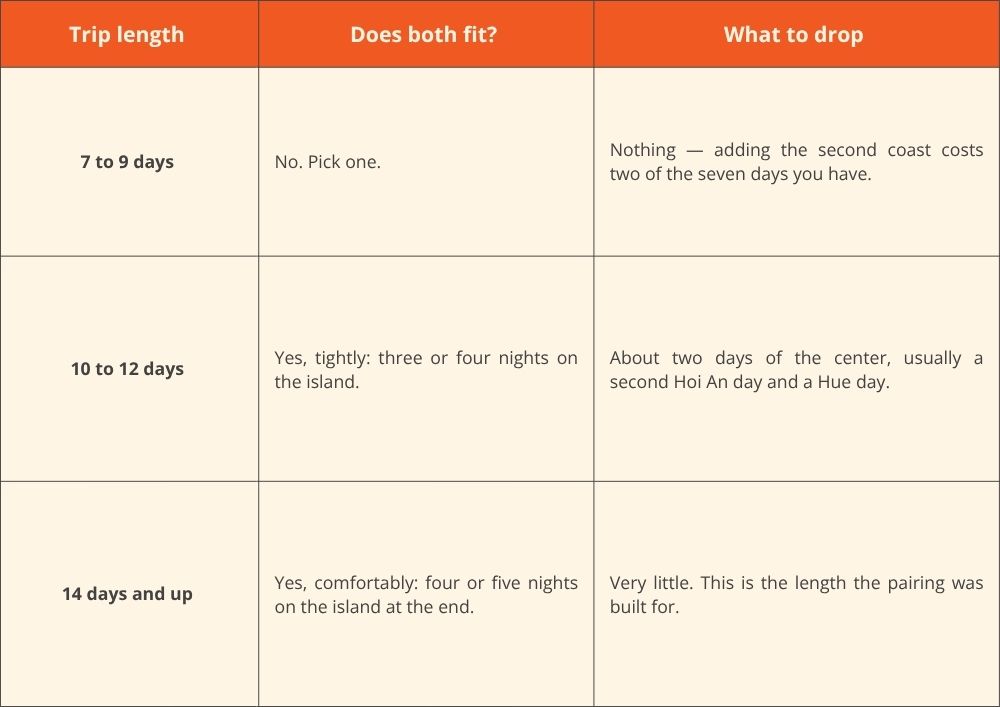
Not if the trip is long enough, and December to March is when both coasts work at once. But run the arithmetic before you assume it fits. They are roughly 1,100 kilometers apart, so this is a domestic flight rather than a transfer — about an hour and three quarters in the air on current schedules, though nonstop service and timings on this route shift with the season, so confirm the schedule for your dates. The flying time is not the cost. The cost is the transfer to the airport, the check-in margin, the flight, the transfer at the other end, and the fact that neither the departure morning nor the arrival afternoon is a day you spend on a beach. Most of a travel day in each direction, and two of them if you fly back out the way you came.
Our six-day Da Nang and Phu Quoc route is the version of this that already has the travel days priced into it — worth looking at if you want both coasts and do not want to work out where the lost half-days go.
Phu Quoc's dry season runs December to March and Da Nang's roughly February to August, so the two coasts are rarely good at once. November and April are sold as Phu Quoc dry season and are not: April averages 150 mm across 12 rain days, November 170 mm across 13.
Two sources with nothing to sell on the island put its dry window at December to March — the Kiên Giang provincial government's own description of the province's natural conditions, and the climate reference climatestotravel.com, which states a 2000-2020 period for its Phu Quoc averages. Every commercial page we checked says November to April instead. The Da Nang column below comes from the same compiler's Da Nang page, on a stated 1991-2020 period. Rain days move with the reference period and the station, so read this as the shape of the year rather than a forecast, and check the outlook close to your dates.
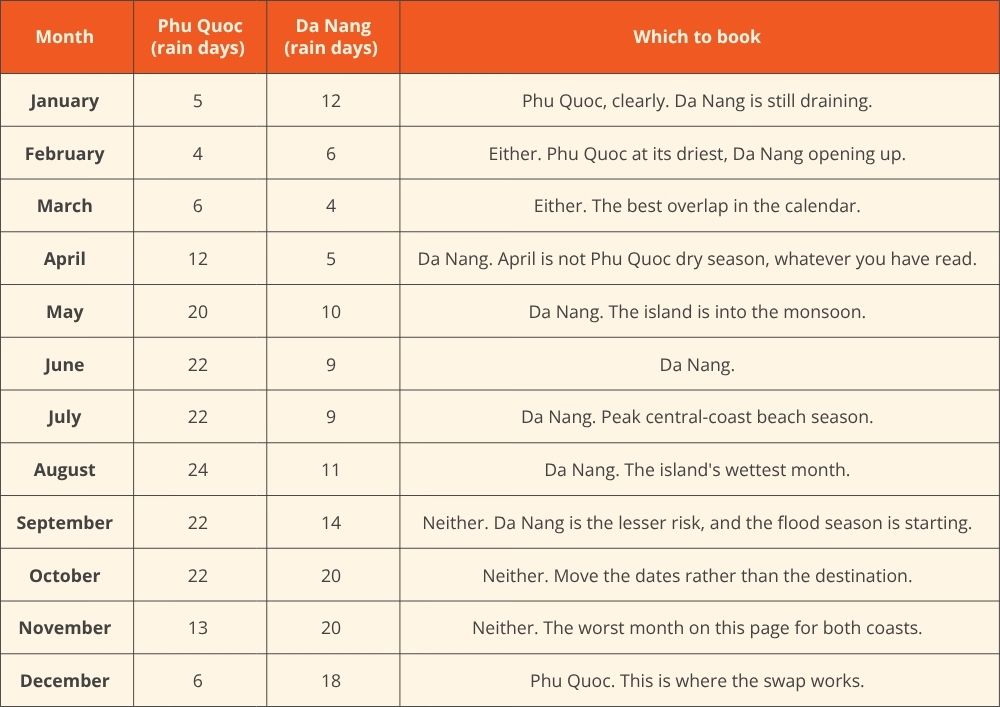
Twelve rain days in April and thirteen in November are not dry months by any reading, and the gap between those numbers and the November-to-April claim is a full month at each end of the season. It matters because an island holiday is sold on sea days, and a sea day needs the boats to run. Twelve rain days puts roughly one boat trip in three at risk, in a month the whole industry markets as safe. If you booked Phu Quoc for April because a page told you it was dry season, that is the sentence nobody wrote for you.

Because there is no Da Nang rainfall figure we are willing to print. Vietnam did not submit to the WMO 1991-2020 standard climate normals, so there is no authoritative station series to settle disputes, and the two commercial compilers that do publish a Da Nang series disagree about which month is wettest and by roughly 420 mm on the annual total — neither of them citing a source. Rain-day counts from a single compiler on a stated period are comparable between its own two pages, which is what the table needs. Millimeters are not. So the table is deliberately asymmetric: the Phu Quoc side has millimeter figures in the text above because two independent sources agree on the shape of that year, and the Da Nang side does not, and we would rather show you the seam than paper over it.
It is the only clean overlap in the year — six rain days on the island, four in Da Nang — and it is the answer if you want to do both and have a choice of dates. February is nearly as good. By late April the island has gone and by December Da Nang has, so the window for a two-coast trip is narrower than the brochures imply, and it is not the window most people are offered.
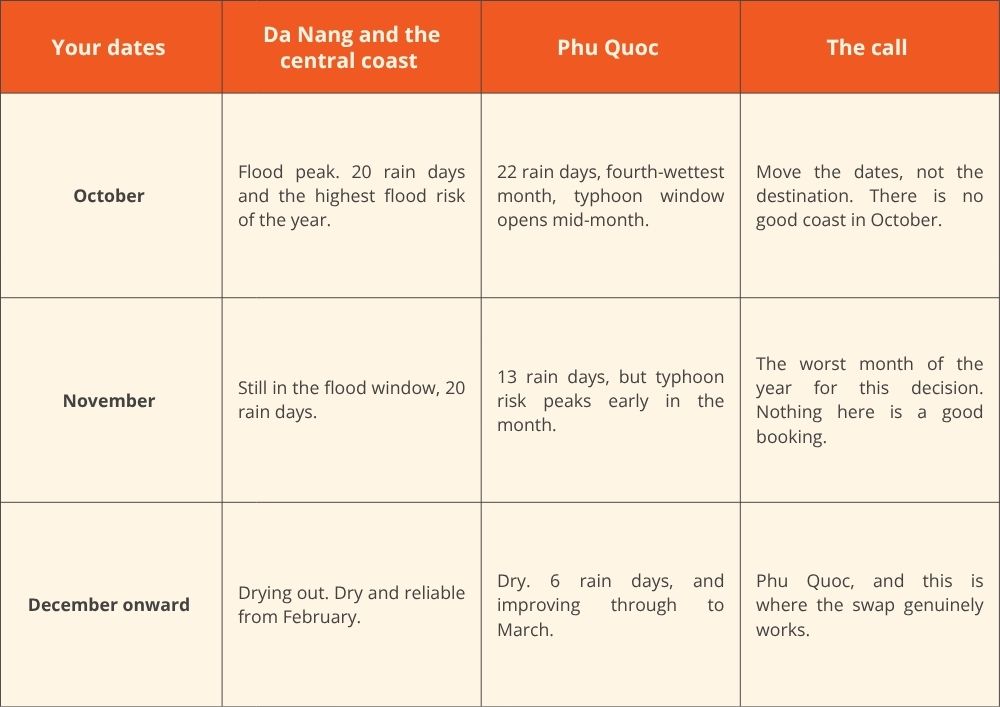
No — not in October. Phu Quoc averages 385 mm across 22 rain days that month, its fourth-wettest, so it is not an escape from central Vietnam's October floods. November is poor on both coasts. The switch works cleanly from December.
This is worth stating as a correction rather than leaving as an implication, because the inversion makes the opposite conclusion look obvious. Central Vietnam's flood peak is October and November: those two months alone carry 40 to 50% of the Vu Gia–Thu Bon basin's annual rainfall. So moving the trip 1,100 kilometers south reads like the fix. It is not. October on the island is 22 rain days, and the southern Vietnam typhoon window runs from around 15 October to 20 December with its maximum in early November — so the back half of October and the whole of November carry a risk on the island that the central coast does not. By the time Phu Quoc is genuinely good, in December, central Vietnam is drying out anyway.
If your dates are already fixed inside the central flood window, the useful question is not which coast but how the trip is built — our guide to Hoi An flooding covers which months, which streets go first, and what to do when the dates will not move.
Da Nang is wrong for travelers who want seclusion — it is a long city beach lined with large resorts on a public shoreline. Phu Quoc is wrong for travelers who want a town, variety and day trips, because the island is the trip.
And both are wrong in November. It is the month nobody sells honestly: 20 rain days in Da Nang with the flood window still open, 13 on the island with typhoon risk at its annual peak. If your dates are fixed in November, the honest advice is to spend them somewhere other than a beach.
It is a city that happens to have a very good beach, not a retreat. My Khe is a public shoreline with a road behind it, high-rises along the road, and other people on it, which is exactly what some travelers want and the opposite of what others are picturing when they book a Vietnamese beach. It is also wrong for anyone who wants to do very little: Da Nang rewards movement — the pass, the mountains, the river, Hoi An half an hour down the coast — and if you do not want to move, you are paying city prices for a sun lounger. If Da Nang does win, the next question is usually whether to sleep there or in Hoi An, and that one is a 30 kilometer decision rather than an 1,100 kilometer one.

It is wrong for anyone who gets restless. There is no old town to walk into after dinner, the island is under heavy construction in places, and the headline attractions — theme park, cable car, safari, water park — are substantially one company's venues, so a day spent on all of them is a day inside one operator's ecosystem rather than a day on Phu Quoc. It is also wrong for anyone traveling without flexible days, because the island's best days are sea days and the boats are called off on sea state rather than rainfall. If your plan has no spare day in it, you have no fallback when the water closes.
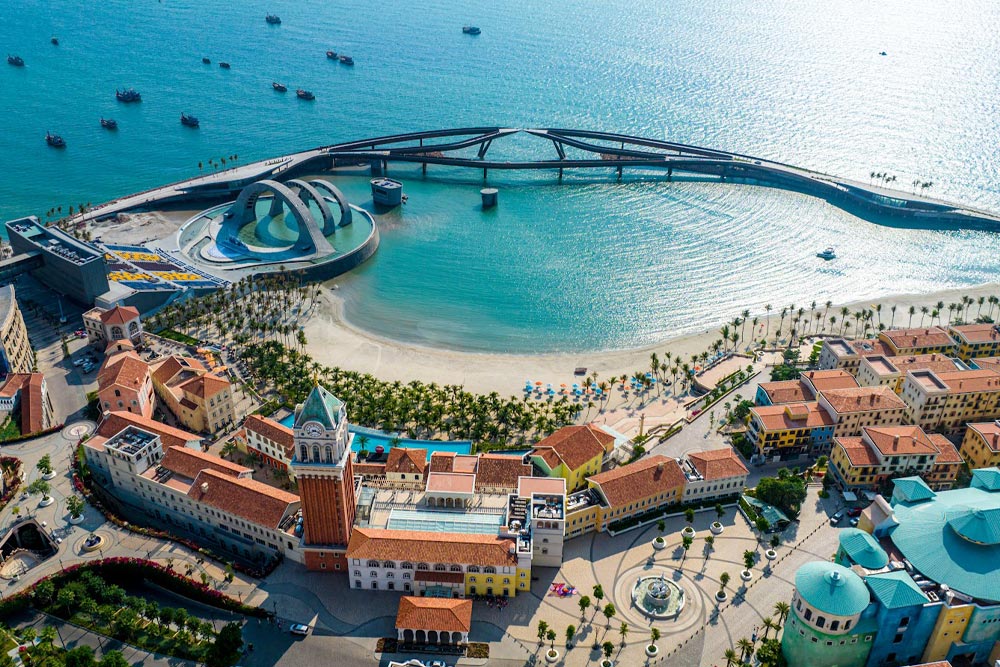
Every page ranking for this question makes its recommendation through seasonality, and does it on dates that two non-commercial sources contradict. Kiên Giang's provincial figures and a 2000-2020 climate reference both put Phu Quoc's dry season at December to March, not November to April. The inversion itself holds across the calendar — the island is at its best in the northern winter, when Hanoi is cold and grey and the center is recovering — which is genuinely useful, because it means a traveler holding December, January or February dates is being pointed at the wrong half of Vietnam by most itineraries. But the inversion fails in the two months travelers ask about most: October is 22 rain days on the island, and November is poor on both coasts with typhoon risk peaking. So the rule is not "go south when the center floods." It is "the island owns December to March, and nothing owns October and November."

"Do both" appears on every page that compares these two, and it reads as though it costs an afternoon. Roughly 1,100 kilometers apart means a domestic flight and most of a travel day in each direction, out of a trip that probably has fourteen days in it. The useful number is the trip length below which doing both costs more than it adds, and from the arithmetic above that line sits at around ten days: below it, the second coast eats two of your days and gives you three. Above fourteen, the pairing is comfortable. That is the call a consultant makes on a draft itinerary and it is the one a comparison page never makes, because the honest version of it is sometimes "drop the island." Our itineraries are built around what you want rather than off a shelf, which is the only reason we can afford to say so.
Da Nang for a beach base with a city, mountains and Hoi An nearby; Phu Quoc for an island resort stay. With fixed dates, the month decides it more than preference does.
Neither. Central Vietnam is in its flood peak and Phu Quoc averages 385 mm across 22 rain days, so October is a month to move rather than relocate.
Yes, and December to March is when both work. They are roughly 1,100 kilometers apart, so it is a domestic flight costing most of a travel day each way.
Phu Quoc for a pure island stay where the resort is the whole trip; Da Nang for a beach base with a town, mountains and Hoi An nearby. Our Da Nang honeymoon guide works through that version of the decision properly, including privacy and which months suit a short trip.
The order this page argued it in is the order to decide it in: month first, trip shape second. If you hold December to March, the island is the stronger answer and most itineraries will point you north instead. If you hold April to August, it is Da Nang, and the island's brochure dry season is not going to hold. If you hold October or November, neither coast is a good booking, and that is a dates problem rather than a destination problem.
Almost everyone does this the other way round. The coast gets chosen from photographs, and then the dates come out of the drawer and turn out to belong to the other one. November is the month that exposes it most completely: there is no version of this choice that works, at any price, and nobody selling either coast will tell you so.

Tell us the dates you are holding and what you want out of the trip, and we will come back with a route you can pull apart — including an honest answer about whether your dates point at the island, the central coast, or neither. If they are the problem, we will say so and say what moving them would buy. Free quote, no obligation, and a consultant rather than a booking form. Our six-day Da Nang and Phu Quoc route is the one that does both coasts with the travel days already accounted for, and it is somewhere to start rather than something to buy.
WhatsApp: (+84) 866.22.7878
Email: sales@asiamystika.com
Website: www.asiamystika.com
