
- SG$ Singapore Dollar
- A$ Australian Dollar
- £ British Pound Sterling
- C$ Canadian Dollar
- € Euro
- MYR Ringgit Malaysia
- US$ United States Dollar
- đ Vietnamese Dong




 About Us
 Destinations
 Travel Styles
 Travel Guide
 Blogs

Independence Palace hours, tickets and dress rule, checked on the palace's own site in November 2026, with its history in six dates and how long to allow.
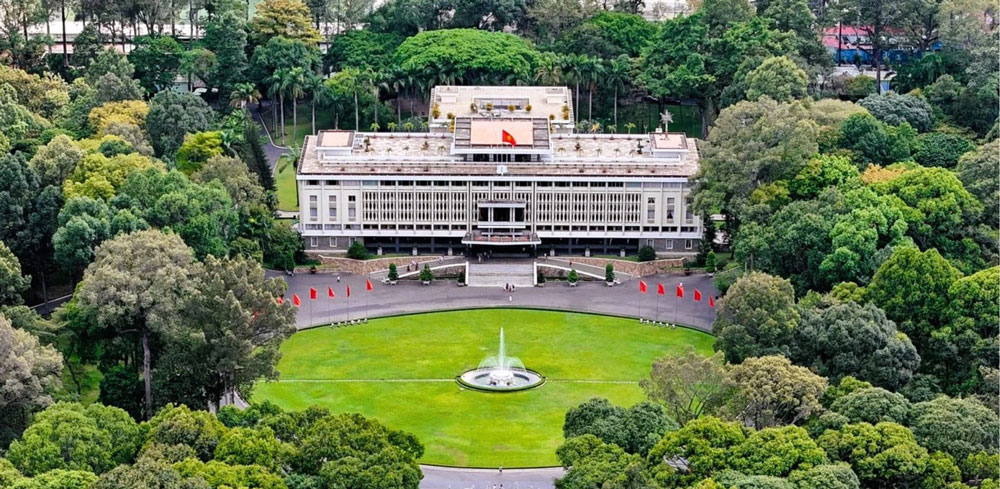
The Independence Palace is the former presidential palace in Ho Chi Minh City (Saigon) where the war ended on April 30, 1975, now a historic site open to visitors. The Reunification Palace is the same building. Its main gate is at 135 Nam Ky Khoi Nghia street.
The site's own English name is the Independence Palace (Dinh Doc Lap). After 1975 the building was renamed Reunification Hall (Hoi truong Thong Nhat), the body that still runs it, and English-language guides turned that into "Reunification Palace".
The Central Post Office, Notre Dame Cathedral and Ben Thanh Market are all a walk away.
| Fact | Detail |
| Also called | Reunification Palace; officially run as Reunification Hall |
| Main gate | 135 Nam Ky Khoi Nghia street, tickets sold all day |
| Second gate | 106 Nguyen Du street, shorter ticket hours |
The Independence Palace is open every day, including weekends and holidays, and the hours and prices below were checked on the palace's own site in November 2026. A general ticket covers the palace and its exhibition house. A palace-only ticket costs less.
Prices and categories have been reissued twice since 2025, so treat these as indicative and confirm on the official visiting-hours page before you go. The palace also closes for announced official events.
| Gate | Ticket sales | Visiting hours |
| 135 Nam Ky Khoi Nghia street (main gate) | 7:00 AM to 6:00 PM | 7:00 AM to 6:00 PM |
| 106 Nguyen Du street | 8:00 AM to 4:00 PM | 7:00 AM to 6:00 PM |
Checked: November 2026, on the palace's visiting-hours page, headed valid from May 1, 2026.
| Ticket | Adult | Reduced | Child |
| General admission (palace plus exhibition house) | 80,000 VND | 40,000 VND for seniors 60+ and Vietnamese university students | 20,000 VND |
| Palace only | 40,000 VND | 20,000 VND for Vietnamese university students | 10,000 VND |
| Electric car around the grounds | 25,000 VND per ride | None listed | None listed |
Checked: November 2026, same page.
The palace's own pages disagree on two points. The May 2026 page sets the child rate for ages 6 to under 16; its homepage and an August 2025 notice say 6 to 17. Its FAQ dates the 80,000 VND price from January 2025, the notice from August 2025. No page gives an under-six price, so ask at the counter, and do not count on a foreign student card: the reduced rate names Vietnamese students.
The Independence Palace dress code asks visitors to wear polite, respectful clothing, with no shorts and no sleeveless tops. Cover your shoulders and knees.
That is the palace's own rule, from its visitor FAQ, checked in November 2026. We found no source on how strictly it is enforced, so dress to the rule.
| Wear | Leave at the hotel |
| Trousers, or a skirt or dress that reaches the knee | Shorts |
| A T-shirt or shirt with sleeves | Tank tops and sleeveless shirts |
| A small day bag | Large bags and bulky items, which are banned |
Other rules at the gate:
The Independence Palace stands on the site of Norodom Palace, built by the French in 1868–1871. The current building replaced it between 1962 and 1966, and the war ended at its gates on April 30, 1975.
The bombing came first, then the rebuild, and President Ngo Dinh Diem was killed while it was still under way.
| Date | What happened | What you see today |
| 1868–1871 | Norodom Palace is built for the French Governor of Cochinchina; from 1887 it houses the Governors-General of Indochina | The exhibition house tells its story |
| 1954 | Handed to the State of Vietnam and renamed Independence Palace on September 8 | The site's name today |
| 1962 | Two pilots bomb the palace on February 27; Diem has it demolished and rebuilding starts July 1. Diem is killed in a coup on November 2, 1963 | Nothing of Norodom Palace stands |
| 1966 | The new palace opens on October 31; President Nguyen Van Thieu lives and works there from 1967 | The building you tour |
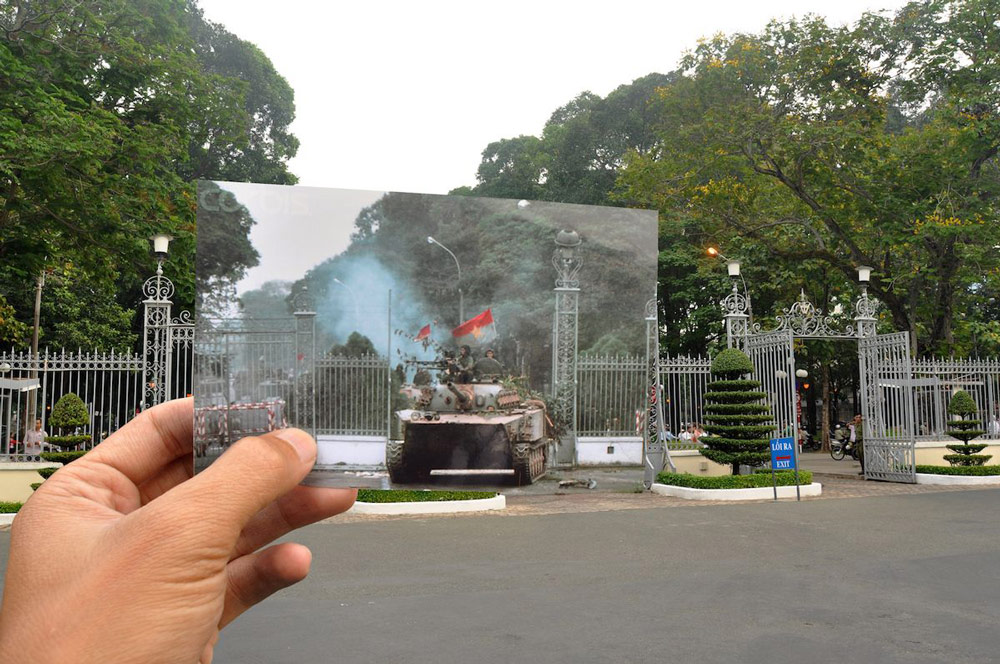
| April 30, 1975 | Tanks break through the gates, the last president of the Republic of Vietnam, Duong Van Minh, announces surrender, and the war ends. Known in English as the Fall of Saigon; April 30 is a public holiday in Vietnam | The main gate |
| 1976 | Listed as a national relic on June 25; Vietnam is formally reunified on July 2 | A protected site |
The architect, Ngo Viet Thu, laid the plan out to form the Chinese character 吉, good fortune, according to the palace's own notes. The stone screens around the second floor copy stylized bamboo from the doors of Hue's imperial palaces and filter the light.
Inside the Independence Palace you walk through the 1960s reception and cabinet rooms, the president's office and living quarters, and the basement command bunker. Outside, the grounds hold the gates the tanks came through.
The palace's own pages count the rooms two ways, nearly 100 on its architecture page and 150-plus on its homepage. Self-guided panels, which replaced the old group tours, set the route.
| Area | Where | What to look for |
| State rooms | Main building, around the Hall for the Presentation of Credentials | Reception and banquet rooms of the 1966 building |
| Cabinet room | Main building | The Cabinet Meeting Room, where the government's ministers met |
| President's office and quarters | Main building | The office and rooms where Thieu lived and worked from 1967 to 1975 |
| Basement bunker | Below the main building | Telegraph, radio and code rooms and an emergency office for the president, per a 2016 VnExpress report, which found parts still closed |
| Grounds and gates | The 12-hectare park | The main gate, which a tank broke through on April 30, 1975 |
| Norodom exhibition house | A separate building on the grounds | The site's story from 1868 to 1966. General ticket only |
A paid guide and an audio guide in 10 languages, including English, are available at the information desk. Neither fee is published, so ask on arrival.
Most visitors need a morning or an afternoon at the Independence Palace. It is worth it if you want to see where the war ended, but it is a building of offices and reception rooms, not a museum of the war itself.
In our judgment, plan on around two to three hours inside the gates, including the exhibition house. The grounds are mostly outdoors, so heat and rain decide the hour; see our guide to the best time to visit Ho Chi Minh City. The panels give the official Vietnamese account, so read a neutral overview first for the wider picture.
| If you have | Do this |
| One history day | Spend the morning at the Cu Chi Tunnels and the afternoon at the palace, entering by the main gate |
| A city day on foot | Start at the palace at opening, then walk to the post office and Ben Thanh Market before noon |
Most guides we checked skip the dress code, and our own old page said there was none. The palace's FAQ rules out shorts and sleeveless tops. Itineraries often pair the palace with Cu Chi, a shorts-and-sweat morning, so pack trousers and a sleeved shirt before you leave the hotel.
Most guides give one address and one set of hours. The Nguyen Du gate stops selling at 4:00 PM; the main gate sells until 6:00 PM. Back from Cu Chi late? Use 135 Nam Ky Khoi Nghia, and arrive by about 4:00 PM for two unhurried hours. Day 3 of our Southern Vietnam Discovery itinerary makes exactly this pairing: Cu Chi in the morning, the palace in the afternoon.
Respectful clothing, with no shorts and no sleeveless tops, per the palace's own visitor guidance. Cover your shoulders and knees.
As checked in November 2026, 7:00 AM to 6:00 PM every day, including holidays, unless the palace announces a closure.
As checked in November 2026, 80,000 VND for an adult general ticket, which includes the exhibition house, or 40,000 VND for the palace only.
Yes. They are two names for one building in Ho Chi Minh City, and the palace's own English site calls it the Independence Palace.
A morning or an afternoon is enough for most visitors, which leaves the other half of the day for Cu Chi or the War Remnants Museum.
Souvenir photos are allowed in designated areas, but filming is not. Professional shoots must register and pay.
Give it half a day, dress for the rule, and use the main gate if you arrive late. It is tempting to give the palace a trip of its own, but it works better as the second half of a Cu Chi day: the tunnels show you how the war was fought, and the palace shows you where it ended.
Day 3 of our four-day Southern Vietnam Discovery itinerary takes you through the Cu Chi Tunnels with a personal guide in the morning, then back to Saigon for the Independence Palace and the War Remnants Museum in the afternoon. We reshape it around your pace.
Tell us the dates you have in mind and what you want out of the trip, and we'll draft a route you can pull apart. Free quote, no obligation, and you can reach us on WhatsApp at +84 866227878.


