- SG$ Singapore Dollar
- A$ Australian Dollar
- £ British Pound Sterling
- C$ Canadian Dollar
- € Euro
- MYR Ringgit Malaysia
- US$ United States Dollar
- đ Vietnamese Dong


 About Us
 Destinations
 Travel Styles
 Travel Guide
 Blogs

The best time to visit Phu Quoc is December to March. April and November are sold as dry season and are not. Month-by-month rainfall, and when to go elsewhere.
The best time to visit Phu Quoc is December to March. Those four months carry 30 to 60 mm of rain each across four to six rain days, and January and February are the driest. The wet half of the year runs April to November, with May to October consistently above 300 mm a month.
Last checked 9 October 2026. The monthly figures below come from a climate reference that states a 2000-2020 period, and the season boundaries are corroborated by the Kiên Giang provincial government's own description of the province's natural conditions. Where we have no figure we would stand behind, this page says so instead of printing one.
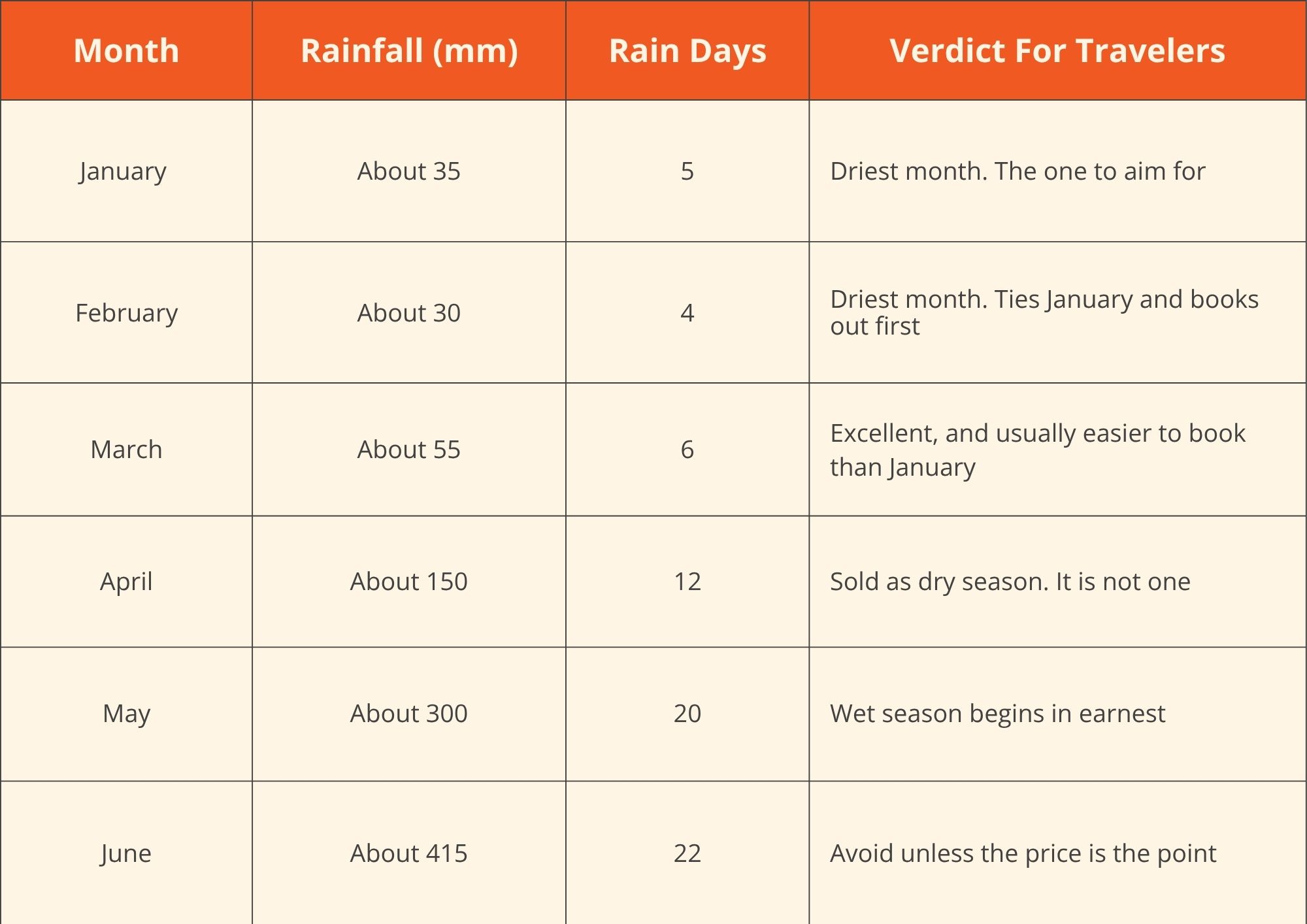
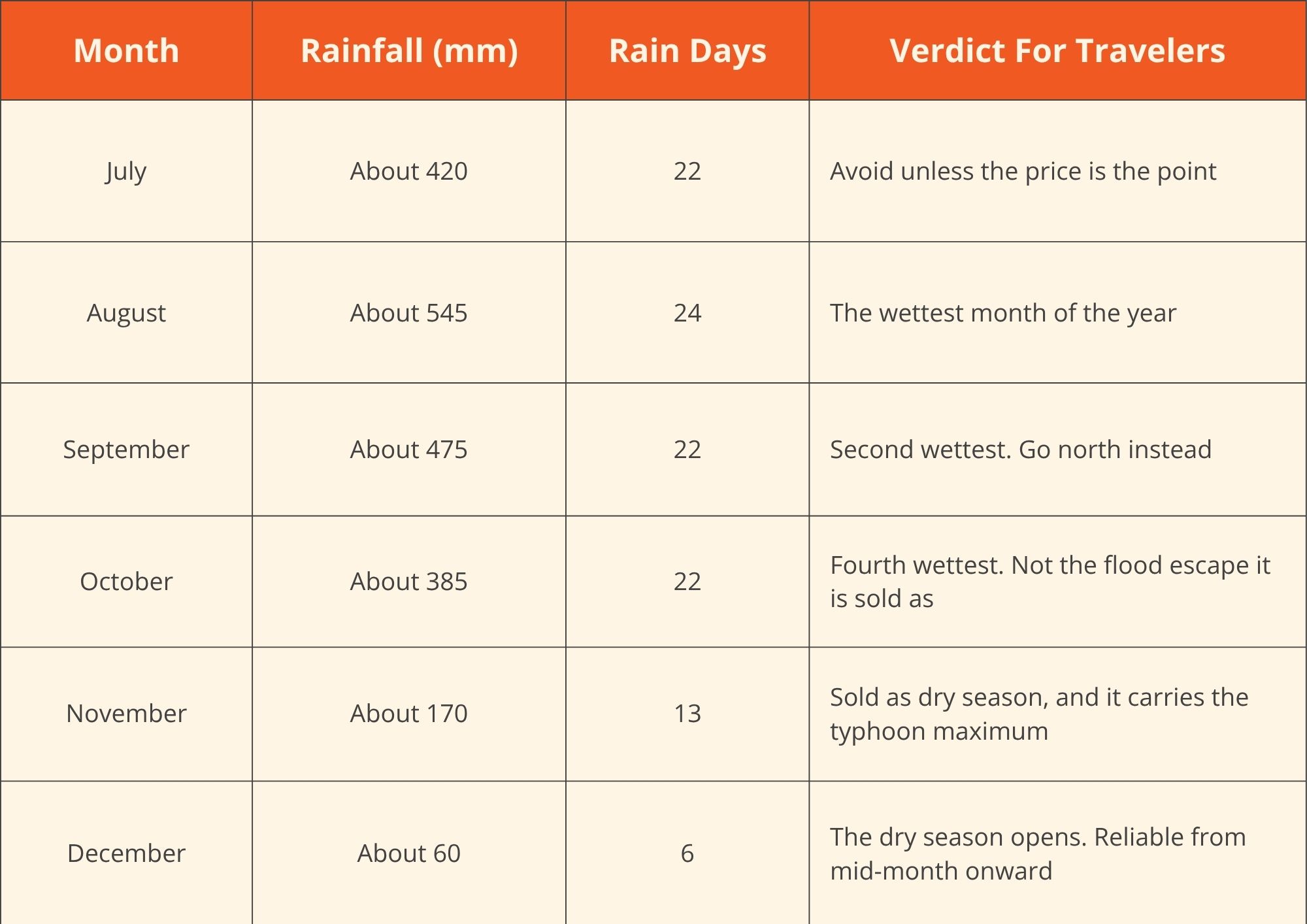
December, January, February and March are the window. The drop is steep rather than gradual: March sits at about 55 mm across six rain days and April jumps to about 150 mm across twelve. That is not a shoulder easing in, it is the wet season starting, and the jump is why the boundary matters more than it looks.
Within the window, January and February are the driest and the first to sell out. March is almost as good and is usually the easier booking. December works, though the first week or so still carries the tail of the typhoon window described in section 2, so we lean toward the second half of the month when the dates are flexible.
One thing worth saying plainly: these are the odds, not a forecast. A 30 mm month can still hand you a wet afternoon, and a 500 mm month can hand you four clear days in a row. What the record tells you is what you are accepting when you choose a month, which is the only part of this you control.
There is no annual rainfall total here. The published figures for Phu Quoc range from 2,400-2,800 mm through roughly 3,000 mm and 3,030 mm up to 4,000 mm claimed for the north of the island, and no compiler agrees with the next. The monthly shape and the season boundaries are consistent between our two non-commercial sources, so those are safe to plan against. The annual figure is not, so we have not printed one.
There is no temperature table here either, and that is deliberate. We hold no sourced monthly temperature or sea-temperature figures for Phu Quoc. Most pages ranking for this query carry a temperature column anyway, which is the easiest number in travel writing to generate and the hardest to source. We would rather have a page with a visible gap in it than a page with a number we made up, because the whole argument below rests on you being able to trust the figures we do publish.
What is worth knowing without a table: this is a tropical island sitting at roughly 10 degrees north, and it is warm enough to swim in every month of the year. Temperature is not the variable that decides your month. Rain is.
November to April is an industry convention, not a measurement. April carries about 150 mm of rain across 12 rain days and November about 170 mm across 13, so the published dry season overstates the real one by a month at each end. Southern Vietnam's typhoon season also runs from mid-October to late December, with its maximum in early November.
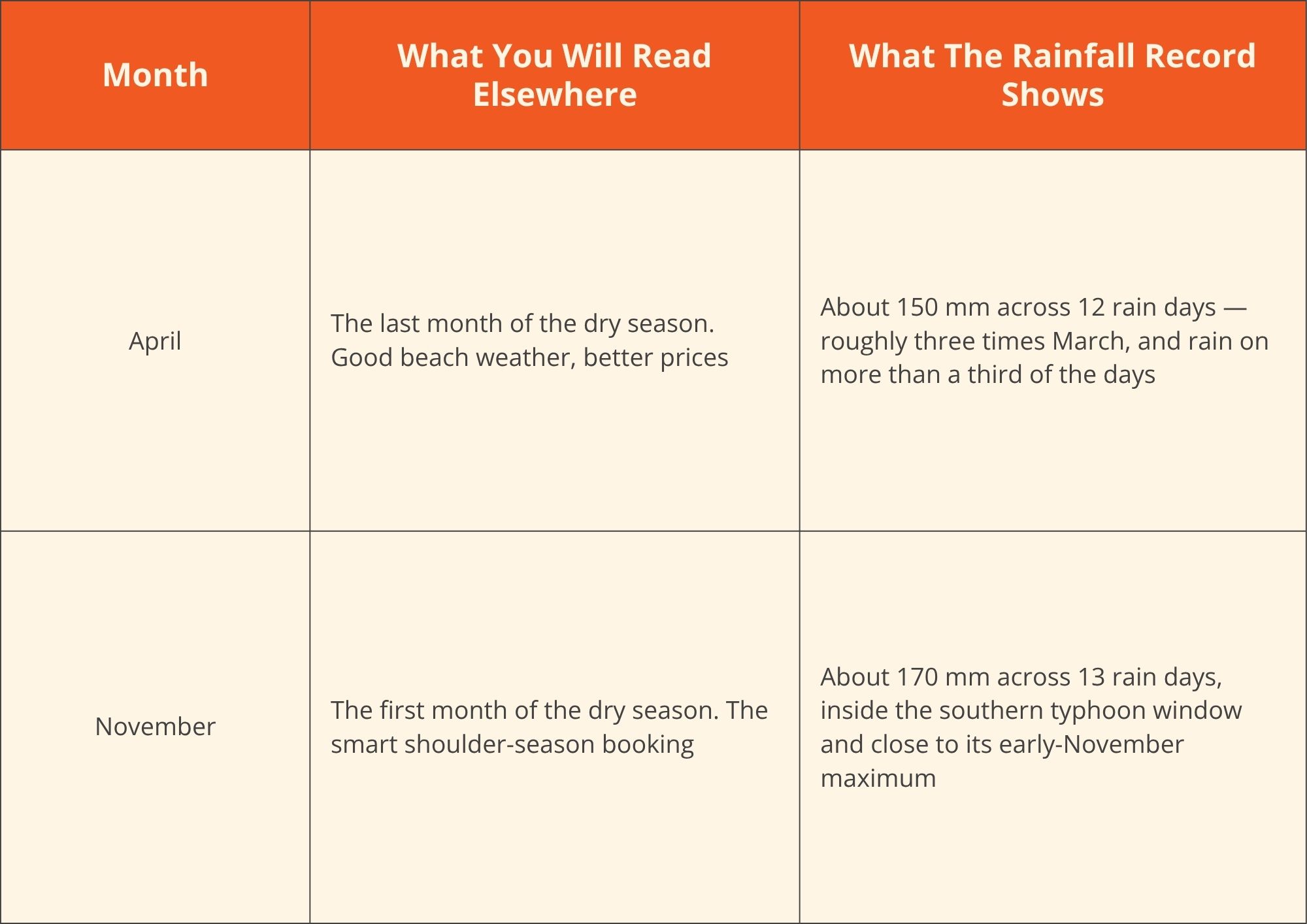
On one side of this are resort blogs, a property developer's site, expat blogs and small-operator pages — the pages that fill the captured search results for this question. On the other are two sources with nothing to sell: the Kiên Giang provincial government's description of the province's natural conditions, which puts the rainy season at April to November and the dry season at December to March, and the climate reference climatestotravel.com, which states a 2000-2020 reference period and publishes the monthly table above. They agree with each other on both boundaries.
This is not a case of opinions varying. One side is repeating a convenient round number for a six-month season; the other is reporting a measurement against a stated period. And it is fair to note that the better commercial pages are already drifting toward the data: one page in the same result set hedges to "mid-December through early March", which is closer to the record than the convention it replaced.
We are not pretending to be disinterested here. We sell trips to this island, and the honest version of this answer costs us April and November bookings. We are publishing it anyway, because a couple who booked April on our say-so and got twelve rain days costs us considerably more than a deferred booking does.
November gets sold as the clever shoulder-season booking: dry season starting, prices not yet at peak. The same climate reference that gives the monthly table also records that typhoons in southern Vietnam generally occur between 15 October and 20 December, with a maximum in early November. No page in the result set for this query puts those two facts next to each other.
It does not mean a storm is likely in your particular week. It does mean that the month being marketed to you as the safe early booking is the month carrying both the higher rainfall and the seasonal storm maximum, and that is worth knowing before you pay a deposit on it.
Phu Quoc's rainy season runs April to November and peaks in August at roughly 545 mm across 24 rain days. October, the month travelers ask about because central Vietnam is flooding, is Phu Quoc's fourth-wettest at about 385 mm across 22 rain days — so the island is not the escape. The seasonal swap works cleanly from December, by which point central Vietnam is drying out anyway.
The question arrives in our inbox most often in this shape: Hoi An is flooding in October, so should we move those nights to Phu Quoc. The answer is no, and it is one of the few genuinely counterintuitive things on this page a dedicated guide.
Central Vietnam's flood peak is October and November — a 2022 study of the Vu Gia-Thu Bon river basin published in the journal Water Supply found that those two months alone carry 40 to 50% of the basin's annual rainfall, and that is the source our own Hoi An flooding guide works from. But October on Phu Quoc is about 385 mm across 22 rain days, its fourth-wettest month. You would be swapping one wet place for another, paying for a flight to do it, and losing the thing you came to central Vietnam for.
November does not rescue the idea either. The island improves to about 170 mm across 13 rain days, central Vietnam is still inside its flood peak, and the southern typhoon maximum lands in early November. The swap works cleanly from December. By then central Vietnam is drying out on its own, which takes most of the force out of the "instead of" framing in the first place.
Rain days are not the whole of it. In the 20-plus rain-day months, boat trips and anything sea-based get canceled at short notice, and they get canceled on the morning rather than the day before, which is the part that ruins a plan. Sea conditions matter more than rainfall for those: a 415 mm month with a strong swell shuts the water down regardless of whether it is raining at your hotel.
What still works is the resort itself, the food, and the parts of the island you reach by road — what fills the days in any month is covered in. If your dates are locked inside the wet half and the island is non-negotiable, that is the trip to build — a resort you are happy not to leave, no sea-dependent bookings, and no expectation of a beach week. We will tell you that before you book rather than after.
On price: the wet months are cheaper, and we are not going to put a percentage on it, because we have no sourced figure for Phu Quoc discounting and a made-up number is worse than none. Ask us for live quotes on two sets of dates and you will see the real gap for your properties rather than an average that fits nobody.
April is the most common date mistake we see, and it comes straight from the November-to-April line. Couples reach us with April dates believing they booked the dry season, and April carries about twelve rain days.
What we tell them is one of two things. If the island is the point of the honeymoon, move to March — same trip, a third of the rain, and the booking is usually still available two or three months out. If the dates cannot move, keep April and go north instead: it is a genuinely good month in the north and the center, and a northern honeymoon in April beats an island honeymoon in April by a wide margin. No resort blog is going to tell a reader to change the month that fills its own shoulder season.
Phu Quoc gets recommended as a wet-weather bolt-hole for the wrong months. The real inversion is the calendar one: the island peaks December to March, which is exactly when northern Vietnam is cold and grey and central Vietnam is recovering from its floods.
So the routing insight runs the other way around from the one you will read. A traveler with fixed December-to-March dates should be pointed south, and told to shorten Sapa rather than extend it — those are the months when the far north gives you the least and the island gives you the most. A traveler with October dates should not be sent to Phu Quoc at all. That is a planning decision about the whole route, not a weather footnote, and it is the single most useful thing on this page if your dates are already fixed.
January and February are the driest months, at roughly 30 to 35 mm of rain across four to five rain days. December and March are almost as good and are usually easier to book.
The dry season on Phu Quoc runs December to March, according to the Kiên Giang provincial government and a climate record covering 2000 to 2020. Pages stating November to April are using an industry convention rather than the rainfall data.
April is a shoulder month rather than a dry one, carrying about 150 mm of rain across 12 rain days. If your dates are fixed in April, the north of Vietnam is the better choice.
August is the wettest, at roughly 545 mm across 24 rain days. May through October all sit above 300 mm.
No. October is central Vietnam's flood peak and also one of Phu Quoc's wettest months, at about 385 mm across 22 rain days. The island becomes the better option from December.
The window is four months, December to March, and it is four rather than six because two of the six are a convention rather than a measurement. March to April is a jump from about 55 mm to about 150 mm, and November sits at about 170 mm inside the southern typhoon window. That is the whole argument, and two sources with nothing to sell you are behind it.
Here is the tension this page creates on purpose: the dates most pages call dry season are the dates we would ask you to change. The month is also the one decision no amount of money fixes afterward — you can upgrade the room, move the hotel, rebuild the itinerary and add a guide, but you cannot buy your way out of twelve rain days. So pick the month first, and let the rest of the trip arrange itself around it.
If your dates land inside the December-to-March window, the next decision is where on the island to base yourself, which matters more than most people expect:. For the island itself — what it is, what it is not, and whether it earns a place in your route at all — start with our honest overview of Phu Quoc.
Send us the dates you already have, not the dates you think we want to hear, and we will say plainly whether Phu Quoc suits them or whether the trip should go north instead. If the answer is to move your month, we will say so and tell you what moving it costs you. A consultant works through it with you and keeps adjusting until the route fits. Free quote, no obligation.
Our southern Vietnam and Phu Quoc beach holiday is the route these four months suit best — the Mekong Delta before the island, which works precisely when the north is at its coldest. It is a starting point to pull apart rather than a package to buy.
WhatsApp: (+84) 866.22.7878
Email: sales@asiamystika.com
Website: www.asiamystika.com