- SG$ Singapore Dollar
- A$ Australian Dollar
- £ British Pound Sterling
- C$ Canadian Dollar
- € Euro
- MYR Ringgit Malaysia
- US$ United States Dollar
- đ Vietnamese Dong


 About Us
 Destinations
 Travel Styles
 Travel Guide
 Blogs

Where to stay in Phu Quoc, area by area. Duong Dong, Long Beach, Ong Lang and An Thoi compared on what each is like, who it suits, and what you give up.
Stay in Duong Dong or at the northern end of Long Beach if you want to walk to dinner and keep transfers short, and in Ong Lang or the north if quiet matters more than convenience. Phu Quoc really divides in two — the developed west-coast strip where restaurants are within walking distance, and everywhere else, where your hotel is the only place you can reach on foot.
That is the answer. The rest of this page is who each area is wrong for.
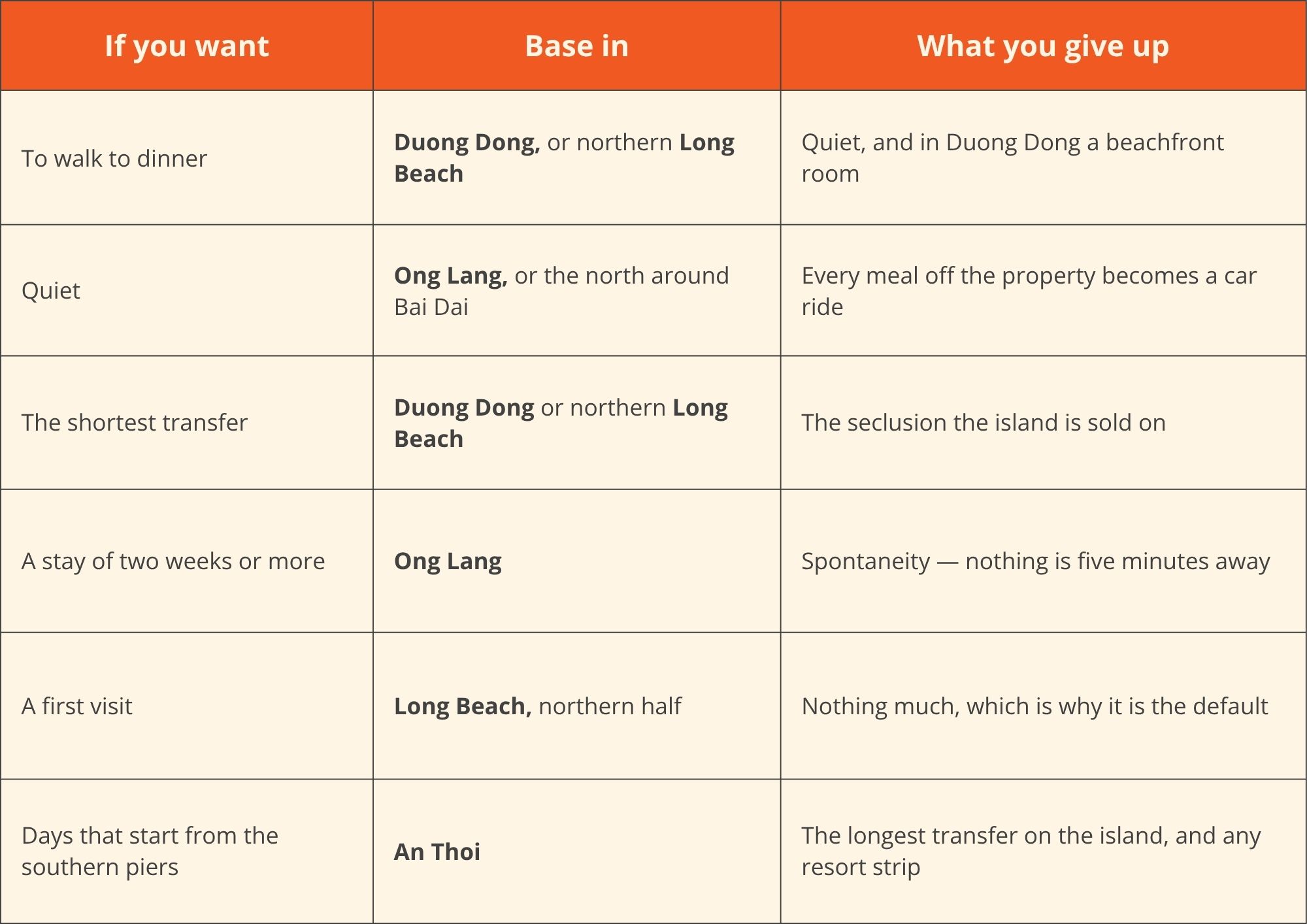
Three nights or fewer: base near Duong Dong or on the northern half of Long Beach, and do not book an isolated resort. Four to six nights: northern Long Beach is the safe default, Ong Lang the better call if you already know you want quiet. A week or more: Ong Lang or the north earns the drives back. What matters is not how far anything is — it is how many of your evenings a thirty-minute drive is allowed to cost, and on three nights that is all of them.
Between roughly April and November the beachfront premium buys a view and a wet beach, so if your dates are not fixed, settle those first: our month-by-month guide has the rainfall and rain-day counts, and it will tell you the dry season is shorter than the brochures say. For the wider picture, start with our Phu Quoc island guide and what the island is actually like.
Phu Quoc is hosting the APEC Economic Leaders' Week in November 2027 and is being rebuilt for it. Viet Nam News reported in October 2026 that twenty-one key projects must be substantially complete and in trial operation by 31 May 2027: an airport expansion across roughly 1,050 hectares with a second 3,300-meter runway, a provincial road from the airport to the south, an urban railway, two reservoirs, and the conference complex on reclaimed land at Bai Dat Do.
The works are concentrated rather than everywhere, so this is not a reason to stay away. It is a reason to ask what is on the other side of the hedge before you pay a premium for a room. Right now that is the most common gap between a Phu Quoc photograph and a Phu Quoc morning, and no area guide ranking for this question mentions it.
Duong Dong is the island's working town and the best base for food, Long Beach is the resort strip and the default for first-time visitors, Ong Lang is the quiet west-coast alternative, and An Thoi is the southern port town. Each is actively wrong for someone, and this section says who.
Same five lines for each. We name no individual property: we arrange rooms through hotel partners, we own nothing on this island, and naming four buildings would date the page inside a season.
What it is. The island's main town and its working heart — a fishing harbor, markets, banks, pharmacies, fish-sauce distilleries, and the night market. The airport sits just south of it, roughly ten kilometers away and twenty to thirty minutes by road; sources disagree on the distance by several kilometers, so use the drive time rather than the odometer.
Landmarks. The Dinh Cau rock shrine at the harbor mouth, the fishing harbor on the Duong Dong river, and the night market on Bach Dang.
Right for. Travelers who came for food. The night market runs roughly six until around eleven with over a hundred stalls, busiest between about half past six and nine — hours vary by source, so confirm on the day. Also short stays, anyone who wants a pharmacy and a cash machine within walking distance, and solo travelers who would rather not eat every dinner in a resort.
What the photographs don't show. This is a working port town. The harbor is full of fishing boats, which is the point of it and also means the water in front of town is not where you swim. Photographs of Duong Dong are the night market after dark and the harbor at sunset — both accurate, neither a beach.
Wrong for. Honeymoon couples. Anyone whose picture of this trip is waking up over sand. Light sleepers who end up on the market side of town. Anyone who wants the island to be quiet, because this is the part of it that is not.
What it is. The resort strip, and the default answer to this question. Roughly twenty kilometers of west-facing sand running south from Duong Dong, with paved promenade sections, beachfront restaurants and a line of bars that run live music in season.
Landmarks. The coast road south out of Duong Dong, the promenade sections, and the sunset itself — this is the west coast, so the sun goes into the sea in front of you rather than behind you.
Right for. First-time visitors, families, and anyone who wants a beach in the morning and a walkable dinner in the evening. The northern end, closest to Duong Dong, is the strongest compromise on the island: sand out front, the town a walk or a short ride away, the shortest transfer from the airport.
What the photographs don't show. That Long Beach is twenty kilometers long. A photograph of one resort's slice tells you nothing about what is walkable from another, and a room twelve kilometers south of town is as isolated as anything in the north — just isolated on a coast road rather than in the trees. Before you book anything sold as Long Beach, find out which kilometer it is on. Second: the southwest monsoon runs roughly May to September and puts the rougher water on this coast, while the northeast monsoon from roughly November to March is when the west side is calm.
Wrong for. Anyone who came for seclusion — this is the busy coast, and in high season it is busy. Anyone booking at the southern end while imagining the northern end's restaurants.
What it is. The quieter west coast, north of Duong Dong — roughly ten to twenty minutes from town and twenty-five to forty from the airport, depending where on the stretch your property sits. Low-rise resorts set back in the trees rather than a strip.
Landmarks. The rocky headlands between the sandy bays, and the Cua Duong area inland behind it.
Right for. Long stays. Couples who want privacy and have the nights to pay for the drives. Repeat visitors who have done the island's attractions and would rather not do them again.
What the photographs don't show. The rock. Ong Lang is not one continuous beach — the area guides describe small sandy bays broken by rocky outcrops, so your swimming depends on which cove your property happens to have. Public infrastructure is minimal: one guide reports no public toilets and no cash machines at the beach itself. And whether you can walk to a restaurant here is genuinely contested — one area guide says there are no markets, bar streets or street-food stands within walking distance, while a guest review of a resort area says there are several. We will not settle that by picking the answer we prefer. Treat walkable dinner at Ong Lang as a question about your property rather than a fact about the area, and ask the property directly.
Wrong for. Three-night stays, flatly. Anyone unwilling to be driven everywhere. Families with teenagers who want something to do after dark. And anyone who will be annoyed that the sand ends in rock twenty meters from their towel.
What it is. The island's southern port town, roughly twenty-eight kilometers south of Duong Dong — a working harbor with real streets and real prices, now beside a large purpose-built waterfront development at the southwestern tip.
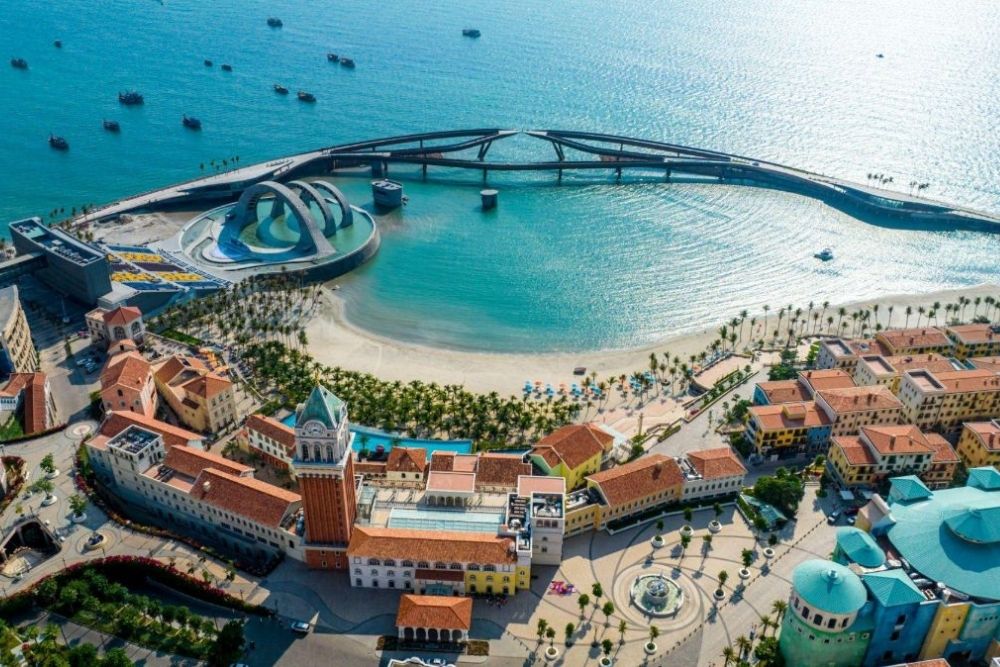
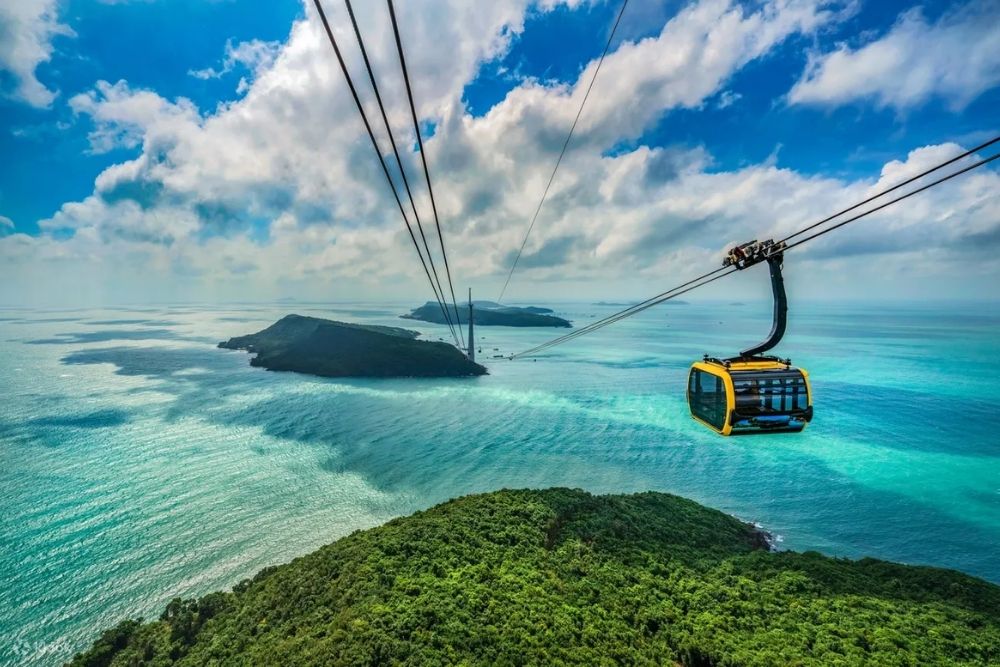
Landmarks. The harbor, the cable-car station at the tip, and the Mediterranean-styled waterfront quarter with its clock tower and pier.
Right for. Travelers who want a town rather than a strip at the far end of the island, and who like eating where the island eats. Also right if your days start from the southern piers — though where you sleep and what you do with your days are two questions, and this page answers the first.
What the photographs don't show. That An Thoi is a port and a construction zone at once. It is on the APEC project list for putting its power and telecommunications cables underground, and the roughly twenty-kilometer DT.975 provincial road linking the airport to the south was reported at around half complete in the autumn 2026 progress updates. That road is also your transfer. And no source we could find gives a consistent airport drive time to An Thoi — we will not invent one, so budget generously and confirm it with whoever is driving you.
Wrong for. Honeymoons. A beach-first first visit. Anyone with an early flight, until that road is finished. And anyone who wanted the island's resort coast, which is twenty-eight kilometers back the way they came.
The north-west around Bai Dai holds the island's largest integrated resort complexes, and the logic there is different: you are not choosing an area, you are choosing a property large enough to be its own area. Nothing is walkable outside the gate, by design. It suits long stays and people who want one decision rather than seven, and it is the worst choice on the island for a short trip. Bai Sao, on the south-east coast, is the opposite problem — a short, well-known bay with very little to sleep in, so most people should visit rather than base there. Sea conditions on the two coasts swap with the monsoon, and one south-east guide recommends November to April there and says to avoid July and August. For the island's days rather than its beds, what there is to do covers that.
Families do best on Long Beach, where a pool and a walkable dinner sit in the same place. Couples wanting privacy belong in Ong Lang or the north, couples who want to walk to dinner belong on Long Beach, first-timers on three or four nights belong near Duong Dong, and anyone staying two weeks or more belongs in Ong Lang.
Every row is a trade, not a mood. If a row does not cost you something, we have described it badly.
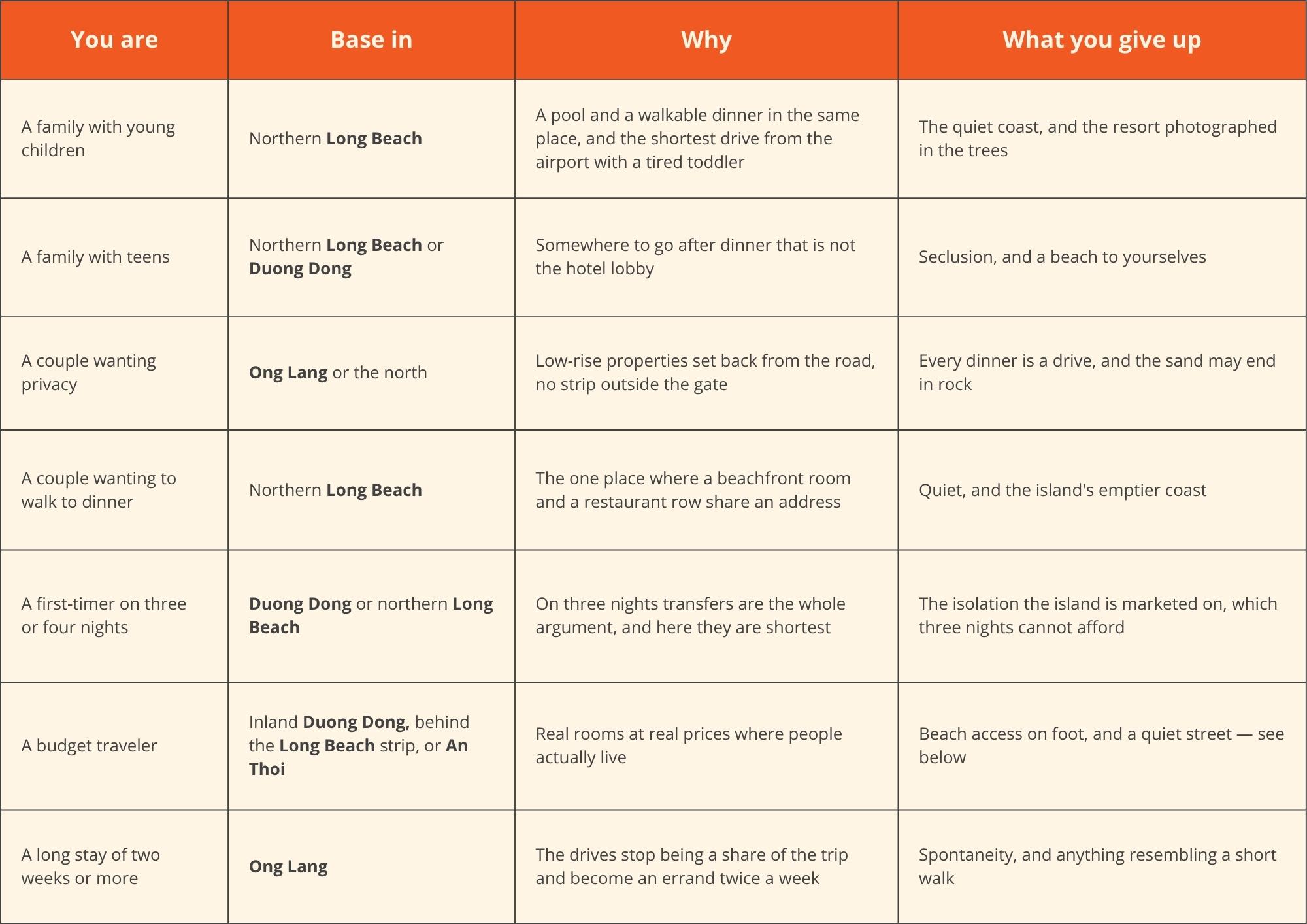
The low-cost rooms are inland: behind Duong Dong, in the blocks set back from the Long Beach strip, and down in An Thoi. They are genuinely inexpensive and often genuinely fine. What is wrong with them is specific. You lose beach access on foot, so you pay part of the saving back in rides — on a short stay, all of it. The inland blocks in Duong Dong sit near the market and the main road, so the saving buys traffic noise instead of surf noise. And with the island on a May 2027 construction deadline, the least expensive inland rooms are the ones most likely to be next to a site, because that is where the sites are. If budget is the constraint, shorten the trip rather than move inland: three nights on the northern Long Beach strip beats six nights behind it.
If five days is the shape you have in mind, our five-day Phu Quoc itinerary is roughly the stay these areas are written for, and a starting point to argue with rather than a product to buy.
Area guides present the areas as equal choices and let you pick on photographs. The booking we most often argue against is an isolated resort on a short stay. Three nights in the north means the transfer, a supermarket run and two dinners all happen in a car — and the quiet you paid for is exactly why there is nowhere to eat. The isolation is not a flaw in those properties; it is the product. It just needs five nights or more before it pays you back. On three nights, book near town and save the isolation for the trip where you have a week. We would rather lose the upgrade than have you spend a honeymoon in a taxi.
Every property here photographs as though it were built for you. Most were built around one guest — a family, a couples retreat, a tour-group volume hotel — and bolted a package on for everyone else. Three questions reveal it before you pay. Is the main pool the family pool? One pool plus a children's club means yes, whatever the honeymoon page says. Is there a second restaurant? One restaurant is fine for three nights and grim for seven, and it is the best single predictor of how a long stay feels. Is the quiet wing the one being sold to you? Properties know which building is quiet, and it is not always the one in the photograph. Ask which block the room is in, what is above and behind it, and — this year and next — what is being built next door.
Long Beach, also called Bai Truong, is the best area for most first-time visitors, because it combines beach access with restaurants you can reach on foot. Duong Dong is better if food and markets matter most, and Ong Lang is better if quiet does.
Long Beach, where a resort pool and a walkable dinner can be found in the same place. Isolated northern resorts work for families only on longer stays, because everything off the property needs a car.
Ong Lang is quieter and less developed, and Long Beach has more restaurants and a shorter transfer. Ong Lang is the better choice on a stay of a week or more and the worse one on three nights.
Duong Dong suits travelers who came for food, the night market and daily convenience rather than a beachfront room. It is the wrong base if waking up over the sand is the point of the trip.
Three nights is the practical minimum, and on three nights stay near Duong Dong or Long Beach. Isolated resorts in the north and the far south only pay off from about five nights.
One decision drives the rest: walkable town or isolated resort. The honest answer comes from how many nights you have, not from which photograph you liked. Three nights and you want to be near town. A week or more and the quiet coast starts earning the drives.
That is the trade: the quiet that makes Phu Quoc worth the flight is the same quiet that strands a short stay in a car. Nothing here makes that go away. What it can do is stop you paying a premium for isolation your dates cannot use — and, this year and next, for a view of a construction site.
If Phu Quoc is one leg of a longer trip, the paired southern Vietnam and Phu Quoc route is how that usually gets built. If the trip is a honeymoon, the property question outranks the area question, and that is a different page:
Send us your dates and how long the Phu Quoc leg is, and we will tell you which area fits and what kind of property to look at inside it — through our hotel partners, with the trade stated out loud, including the times we think you should spend less. If three nights in the north is what you had in mind, we will say why we would change it and what changing it costs you. Free quote, no obligation, and you can reach a person rather than a form.
WhatsApp: (+84) 866.22.7878
Email: sales@asiamystika.com
Website: www.asiamystika.com