
- SG$ Singapore Dollar
- A$ Australian Dollar
- £ British Pound Sterling
- C$ Canadian Dollar
- € Euro
- MYR Ringgit Malaysia
- US$ United States Dollar
- đ Vietnamese Dong


 About Us
 Destinations
 Travel Styles
 Travel Guide
 Blogs

The best time to visit Hoi An is February to May. Here is what every other month actually looks like, when Hoi An floods, and the two months we would ask you to move.
The best time to visit Hoi An is February to May, and March and April are the best months of that stretch. If your dates are fixed, most Hoi An months are workable — October and November are the two we would ask you to move.
If your dates are open: come between February and May. The rain has stopped, the heat has not arrived, and the three things people come to Hoi An for are all available on the same day — the Old Town on foot in the morning, An Bang or Cua Dai in the afternoon, and the rice country and Tra Que herb gardens on a bicycle in between. March and April are the strongest two. February can still carry grey days left over from the tail of the cool season, and by late May the humidity has started to decide the shape of your afternoon.
If your dates are fixed: this is the larger group, and almost nobody writing about Hoi An writes for you. The honest answer is that nine or ten of the twelve months are workable with a sensible itinerary, and October and November are the two where we will say out loud that moving is worth real money to you. If you cannot move them, the trip changes shape rather than falling over. Section 4 is written for exactly that case.
The rainy season runs September to December and the flood risk concentrates in October and November. That is whole-month resolution, which is as far as the published record goes. If you want the question of what happens inside December — where exactly the risk stops being worth planning around — section 3 answers it as honestly as it can be answered, which is that no published source resolves it.
Window last checked 9 October 2026. No October 2026 flood event had been reported in Hoi An at that date; the most recent events on the record are October and November 2025.
February to May in Hoi An is warm and mostly dry, June to August is hot and humid, September opens the rainy season, October and November carry the heaviest rain and the flood risk, and December is cooler with the rain easing but still inside the flood season.
Before the table, the thing it cannot show. There is no rainfall figure and no temperature figure anywhere on this page, and that is deliberate — section 3.3 explains why in three sentences. What the table gives you instead is what each month does to a day in Hoi An, which is the thing you are actually trying to decide.
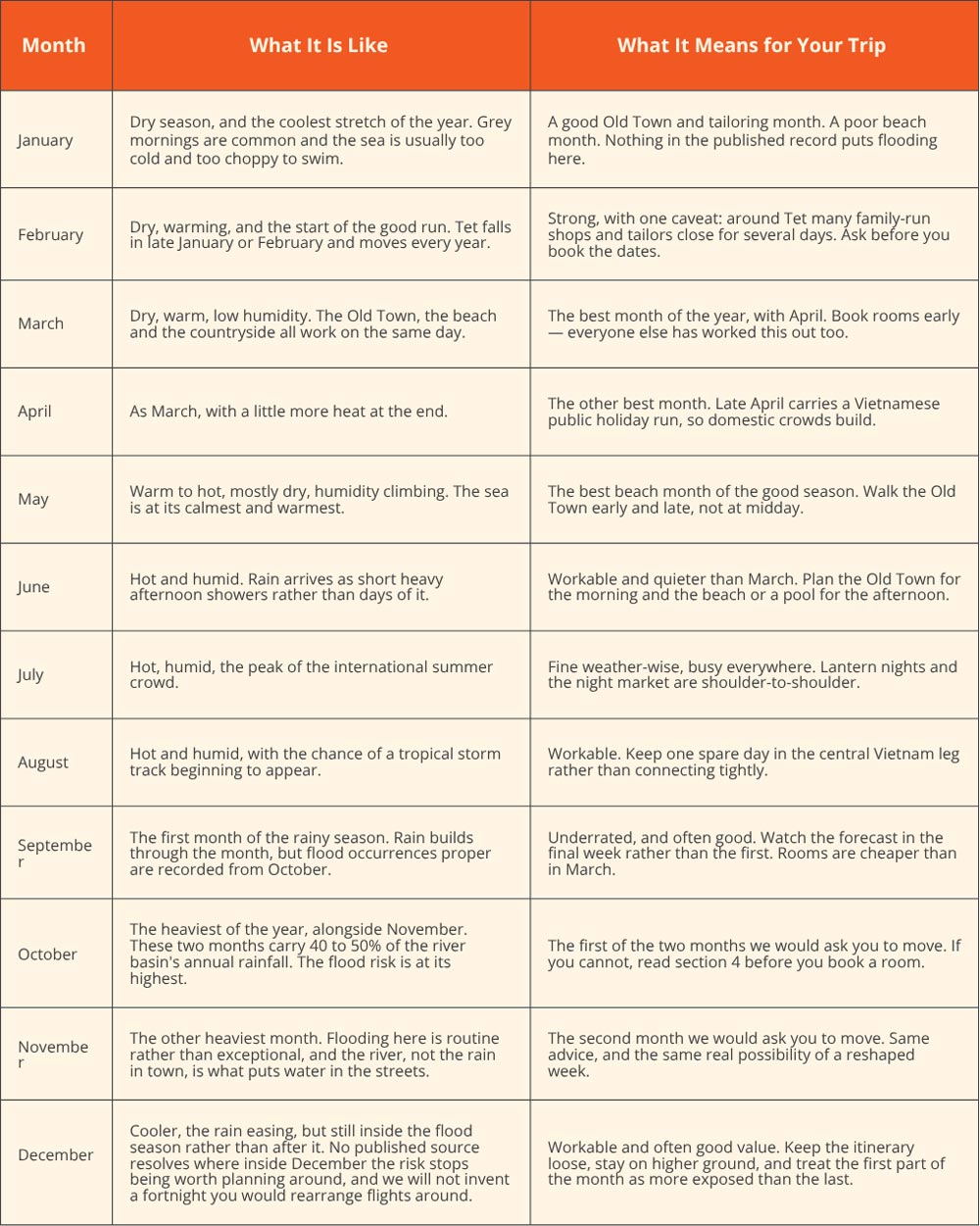
This is the part the monthly averages hide. Hoi An is not a town with an indoor alternative. The reason to be there is a dense grid of two-story merchant houses you see on foot, between a river and a market, and a wet afternoon removes the activity rather than relocating it. In Hue you can spend a rained-out day inside the citadel museums; in Da Nang you can drive somewhere. In Hoi An the thing itself is the street.
That is why the two difficult months are more expensive to get wrong here than almost anywhere else on a Vietnam route. If you want the detail on what the Old Town actually is before you weigh a month against it, the Hoi An Ancient Town guide covers the ticket, the houses worth the time and the walk itself.
The Old Town is lantern-lit every evening of the year, and the bigger full moon lantern night falls once a lunar month — which means it lands in October and November as reliably as it lands in March. If a particular lantern night is the reason for your dates, that changes the calculation in section 1, because it is one of very few genuinely fixed points a central Vietnam route has.
Evenings are also the part of a Hoi An day that an afternoon of rain damages least. Which of your nights is a lantern night is a separate question from which month to come in, and that page answers it with dated conversions rather than a moon-phase calendar.
If you are having clothes made, the month matters more than most people expect. A Hoi An tailoring order is a two-or-three-fitting process over two or three days, and a flooded or heavily rained-out stretch does not just make the walk between fittings unpleasant — it closes shops on the affected streets, and it can push a delivery past your departure. Build a day of slack into the stay if a suit or a dress is part of why you are going, and see the Hoi An tailors guide for how long an order realistically takes.
Hoi An's rainy season runs from September to December and the floods peak in October and November. Those two months carry 40 to 50% of the Vu Gia–Thu Bon basin's annual rainfall, flood occurrences proper are recorded from October to December, and nothing in the record puts flooding in January.
That is a correction, and it is worth being direct about it. This page previously gave the window as September to January. That upper end is not supported. Every source that names a season closes it in December, and the same basin literature places January inside the dry season, which carries only 20 to 35% of the annual rainfall across January to August. If you have read September to January anywhere — including on an older version of this page — September to December is the window to plan against.
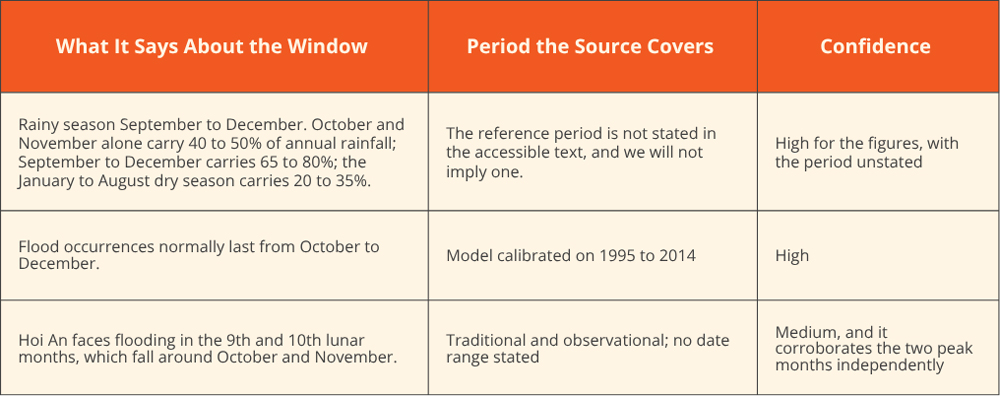
This is the single most useful thing to understand about Hoi An in autumn, and it explains why the forecast on your weather app is a poor guide. Hoi An sits on the Hoai, a distributary of the Thu Bon, at the bottom of the Vu Gia–Thu Bon basin. The water that floods the Old Town mostly fell in the mountains inland, not on the street outside your hotel.
The practical consequence is that you can get a flooded Old Town on a day it is not raining in Hoi An, and a heavy afternoon downpour that does nothing at all. The signal to watch is the upstream river gauges — at Nong Son and Cau Lau, which rise before Hoi An does — rather than the local rain. It also explains the geography of it: the riverside goes first, and Bach Dang is the first street to flood, taking roughly 0.4 to 0.5 meters more than the inner streets in the same event.
In late October 2025 the basin broke records. The Cau Lau gauge upstream peaked at 5.62 m at 02:00 on 30 October, 14 cm above the 1964 record of 5.48 m — the highest in roughly 60 years — and 35 people died across central Vietnam. The Hoi An gauge itself, though, reached 3.39 m, one centimeter below its own 1964 mark of 3.40 m. The record broke upstream, not in the town, and almost every outlet ran the two figures together as one.
We are not turning a single exceptional year into a planning number. One record October does not give you a flood frequency, a typical depth or a typical duration, and we publish none of those. For the street-by-street detail — what floods first, how deep, and what stops working — see the Hoi An flooding guide, which is where that belongs. This page stops at which month to pick.
Vietnam did not submit to the WMO 1991–2020 Climatological Standard Normals, so no authoritative monthly station series for Da Nang is publicly available — we checked the NOAA archive index directly and there is no Vietnam folder in it, alongside 28 others including Thailand, Laos and Myanmar. The two commercial compilers that do publish a Da Nang series disagree with each other about which month is the wettest, and by roughly 420 mm on the annual total, and neither cites a source. Given that, a tidy millimeter table would look more authoritative than any available number deserves, so there is not one here, and the same gap is why there is no temperature figure either.
What we do publish is the share figure above, because it comes from peer-reviewed basin hydrology rather than from a compiler, and it answers the question you are actually asking: October and November are the two months to plan around. If you want the same question answered for the city an hour north, where the pattern is similar but the beach season differs, see the best time to go to Da Nang.
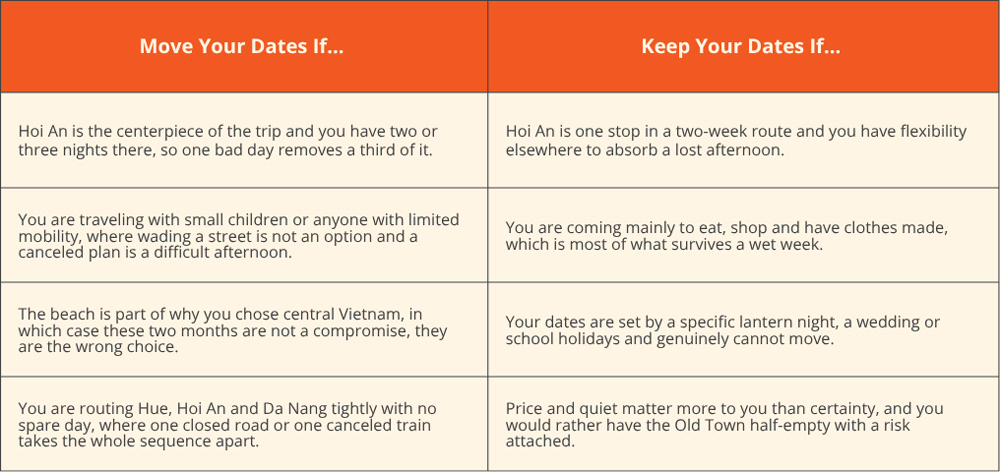
The worst time to visit Hoi An is October and November — not the whole wet season and not "autumn", but those two months. If the Old Town is the reason for your trip and your dates can move, move them out of those two months.
Saying this plainly costs us bookings, and that is precisely why nothing else on this search result says it. A hotel has rooms in November and a tour desk has tickets in November; a month is the only thing either of them has to sell. We are selling a route, and a route can go somewhere else.
In March the choice between a riverside hotel and one a few streets back is a view and a five-minute walk. In October and November it is the difference between a week that works and a week spent wading. Riverside streets take roughly half a meter more water than the inner streets in the same event, and a room on higher ground a short ride from the Old Town will often be dry on a day the riverfront is not. It is the single highest-leverage decision in an autumn Hoi An booking, and the Hoi An where-to-stay guide breaks the areas down by exactly this.
Nobody selling rooms or tickets will tell you a month is bad, because a month is all they have to sell. That asymmetry is the whole reason this page can say what the rest of the search result cannot, and it is worth naming plainly rather than leaving you to notice it.
We are not selling a month. We are building a route, and a route can go somewhere else or sit in a different week. So when a traveler's dates are genuinely movable and they land in October or November, we say move them — and that is the single most valuable conversation we have with clients in the autumn, measured in trips that worked rather than in anything we sold. It is also a conversation that occasionally ends with the client booking nothing at all, which is the cost of having it, and we would rather carry that than hand someone a flooded week they paid for.
This is the larger group, and the advice is not "cancel" and not "cut Hoi An short". A reshaped autumn week in Hoi An is a genuinely good trip; an unreshaped one is a gamble.
Four things change. We base the stay on higher ground rather than on the river, for the reason in section 4.4. We move the fixed outdoor days — the cycling, the beach, My Son — into the middle of the stay where they can be swapped for each other rather than lost. We put slack around the two travel days either side, because a closed road or a canceled train on an autumn arrival day is what actually breaks an itinerary, not the rain. And we weight the days toward what works wet: the cooking class, the crafts, the fittings, the evenings.
The honest close on this: moving dates is easy for us to say and sometimes impossible for you. If your dates are fixed, the earlier you tell us, the more of the trip we build around that fact rather than apologize for afterward.
March or April. Warm, dry, low humidity, and the Old Town, the beach and the countryside all work on the same day.
September to December, peaking in October and November. Nothing in the published record puts flooding in January.
Often yes, and it is underrated. September is the first month of the rainy season but flood occurrences proper are recorded from October, so watch the forecast in the final week rather than the first.
October and November. Those two months carry 40 to 50% of the river basin's annual rainfall and the highest flood risk.
Workable and often good value, with the rain easing — but still inside the flood season, so keep the itinerary loose and stay on higher ground.
Two answers, and this page has been holding them apart on purpose. If your dates are open, come between February and May, and March or April if you can choose freely. If your dates are not open, you are not choosing a month at all — you are choosing what to do about the one you have, and that is a different and more useful conversation.
Which leaves the thing worth sitting with. The difference between a good autumn week in Hoi An and a bad one is almost entirely what you booked, not what fell out of the sky — which room, which side of the river, how much slack around the travel days, which afternoons could be swapped for each other. The weather is not the variable you control. The itinerary is.
Send us the dates you have in mind and say whether they are fixed, because the answer changes completely between those two cases. If they land in October or November and they can move, we will tell you so — plainly, and before you have paid for anything. If they cannot move, we will build the week around that instead, and it will be a better week for having been built that way.
Hoi An also sits inside a longer route, and the order matters: see Best of Central Vietnam for how the Old Town, Da Nang and the countryside fit into one leg, and Discover Hue and Hoi An for the sequencing when Hue is in the plan and the train or the pass is part of the point. Free quote, no obligation, and you can pull the draft itinerary apart as much as you like.
WhatsApp: (+84) 866.22.7878
Email: sales@asiamystika.com
Website: www.asiamystika.com


