
- SG$ Singapore Dollar
- A$ Australian Dollar
- £ British Pound Sterling
- C$ Canadian Dollar
- € Euro
- MYR Ringgit Malaysia
- US$ United States Dollar
- đ Vietnamese Dong




 About Us
 Destinations
 Travel Styles
 Travel Guide
 Blogs
Blogs

What Da Nang is really like from September to December — how much it rains, what still works, what to avoid and whether to change your dates.
QUICK ANSWER:
Da Nang's wet season runs roughly September to December, peaking in October and November. Rain typically arrives in heavy bursts rather than all-day drizzle, so most days still have usable hours. What changes is the sea: swimming is unsafe for much of the period. Ba Na Hills is frequently fogged and Cham Island boats often stop running.
If your trip is built around food, culture, and indoor activities, the wet season is genuinely fine and considerably cheaper. If it is built around the beach, move your dates.
Central Vietnam's wet season runs roughly September to December, which is later than northern and southern Vietnam and catches out travellers planning a multi-region trip.
The Da Nang rainy season does not arrive with the same intensity every month.
September – Transition point: Wetter weather starts becoming more noticeable but there can still be long stretches of usable daylight.
October & November – The most rainy months: Heavier downpours, rougher seas and occasional flooding are more likely, so outdoor plans need a little more flexibility.
December – Rain slowdown: Rainfall starts to ease as Da Nang moves toward its drier months.
October and November are typically the peak of the Da Nang wet season, when rainfall is heavier and weather disruptions are more likely. That does not mean every day is washed out, but it does mean you should avoid building an itinerary where every activity depends on outdoor sighting.
September and December are shoulder points, when the conditions usually begin to improve. If you are travelling around Christmas or New Year, it is still sensible to keep a rain jacket handy and leave some room in your schedule, but the weather is often more manageable than during the October - November peak.
If your dates are still flexible, compare the wet season with the rest of the year in our Best Time to Visit Da Nang: Weather by Month (2026) guide before choosing your travel window.

The Da Nang typhoon season also overlaps with this wetter period, particularly from around September to November. Tropical storms do not affect the city constantly, but when one approaches Central Vietnam, it can temporarily disrupt flights, boat trips, beaches and road travel. The best approach is not to worry months in advance, but to check reliable forecasts and local safety updates a few days before any weather-sensitive activity.
This later rainfall pattern is one of the reasons Vietnam's weather can surprise first-time visitors. Hanoi and northern Vietnam usually receive much of their rain earlier in the year, while Ho Chi Minh City and the south follow a different tropical wet-season cycle. Da Nang sits in Central Vietnam, where regional geography push the wetter period later. As a result, you can have pleasant autumn weather in Hanoi while experiencing the Da Nang monsoon on the same trip.
Wet-season rain in Da Nang typically comes in short heavy bursts rather than continuous drizzle, which means most days still have several usable hours.
If you happened to be planning around the Da Nang rainy season, this actually is good news! A wet forecast does not automatically mean spending the entire day indoors. A shower may arrive quickly, become intense for an hour or two, and then ease enough for sightseeing to continue.
Another good news is that Da Nang monsoon weather is generally NOT the kind of freezing rain that makes being outside miserable. Typical rainy-season daytime temperatures are at around 24 – 28°C, although evenings can fall to roughly 18 – 22°C. Lightweight, quick-drying clothes are usually more useful than heavy cold-weather gear, and a thin jacket may come in handy on cooler December evenings.

THE WORST SCENARIO: While planning a trip, it’s always wise to prepare for the worst. A really bad rainy-season day in Da Nang would look different from an ordinary shower. During stormy days, visibility drops, roads become slippery, the sea turns rough, and higher areas such as Son Tra or Bana Hills can develop dense fog and less safe driving conditions. When these days, unfortunately, do come on your trip, we suggest you don't force the original itinerary. Switch to museums, local restaurants, cafés, spas or other indoor experiences. Save beaches and mountain roads for a better weather window.
So, is Da Nang worth visiting in rainy season? In September or December, absolutely — as long as you stay flexible. Sudden showers often pass quickly, leaving enough time to continue sightseeing later in the day. October and November deserve more careful consideration, as these are usually the peak months for heavier rain.
The sea, the mountain and the islands are the three things the wet season reliably takes away, and travellers who planned around them are the ones who end up disappointed.
SWIMMING - My Khe Beach can still have calm, swimmable days even in November, but when bad weather arrives, strong waves and dangerous sea conditions can put swimming off limits. In other words, you can still enjoy the beach for a walk or coffee during the Da Nang wet season, but you should not build an October or November holiday around guaranteed daily swimming.
If beach time matters to your trip, read our Da Nang beaches and My Khe guide to understand where to swim, which stretches suit different travellers and when sea conditions are at their best.
BA NA HILLS - The same uncertainty applies to the mountains. Ba Na Hills normally remains open, but at nearly 1,500 metres above sea level, cloud and mist can completely hide the views you came for, including the Golden Bridge.
CHAM ISLAND - Cham Island is more vulnerable because getting there depends on sea conditions. Boats operate most reliably from March to August; from September onward, rough seas can make services irregular or lead authorities to suspend them altogether. If Cham Island is a must-do rather than a nice extra, the peak Da Nang monsoon months are therefore a poor time to depend on it.
HAI VAN PASS - Hai Van Pass is generally accessible year-round, but rainy season can bring slippery roads, fog and poor visibility, and recommends avoiding the route during storms. Heavy rain can also trigger rockfalls and landslides around the Hai Van area. So if the coastal panorama is the reason you are going, a grey, fog-covered day is usually a good reason to postpone rather than force the trip.
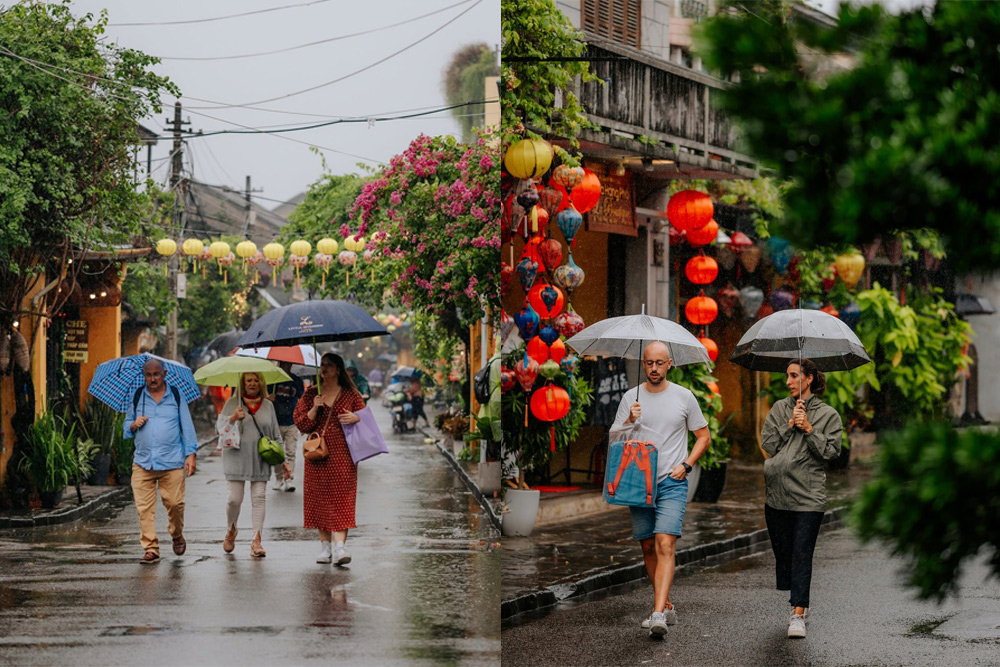
HOI AN ANCIENT TOWN – Light rain can make the Ancient Town wonderfully atmospheric, but flooding is a genuine issue in the old town, particularly around October and November. Hoi An's official heritage portal identifies these as especially flood-prone months, and past heavy-rain events have put riverside streets such as Bach Dang and Nguyen Phuc Chu under significant water
FLIGHTS - The biggest disruption comes when the Da Nang typhoon season produces an actual tropical storm. Severe weather can affect not only sightseeing but also the journey itself. In September 2025, for example, Typhoon Bualoi forced Da Nang International Airport to suspend operations temporarily, with flights cancelled, delayed or rescheduled. If you are travelling during the storm-prone months, avoid placing an international connection immediately after a weather-sensitive Central Vietnam itinerary and check your flight status directly with your airline before heading to the airport.
The practical rule is simple:
During October and November, treat beaches, islands, mountain viewpoints and scenic passes as weather-dependent bonuses rather than fixed promises.
Keep one or two flexible days in your itinerary, and you are far less likely to feel that the rain has ruined the trip.
Food, culture and the Da Nang – Hoi An corridor are largely unaffected by rain, and several experiences are actively better in the cooler, quieter wet months.
FOOD - If you are wondering what to do in Da Nang when it rains, start with experiences that do not depend on blue skies. Food is one of the easiest reasons to enjoy the Da Nang wet season. Cooking classes and food tours can continue through ordinary showers, and cooler evenings make hot dishes such as mì Quảng, bún chả cá and seafood especially appealing.
MUSEUM OF CHAM SCULPTURE - The Museum of Cham Sculpture is one of the easiest indoor stops during the Da Nang rainy season. Located in the city centre, it gives you a dry, cultural break while introducing the history and art of the ancient Champa civilisation.
SPA AND WELLNESS DAYS – This is another strong rainy-day option. A massage, herbal treatment or longer spa session can turn a wet afternoon into genuine downtime, especially after several busy sightseeing days.
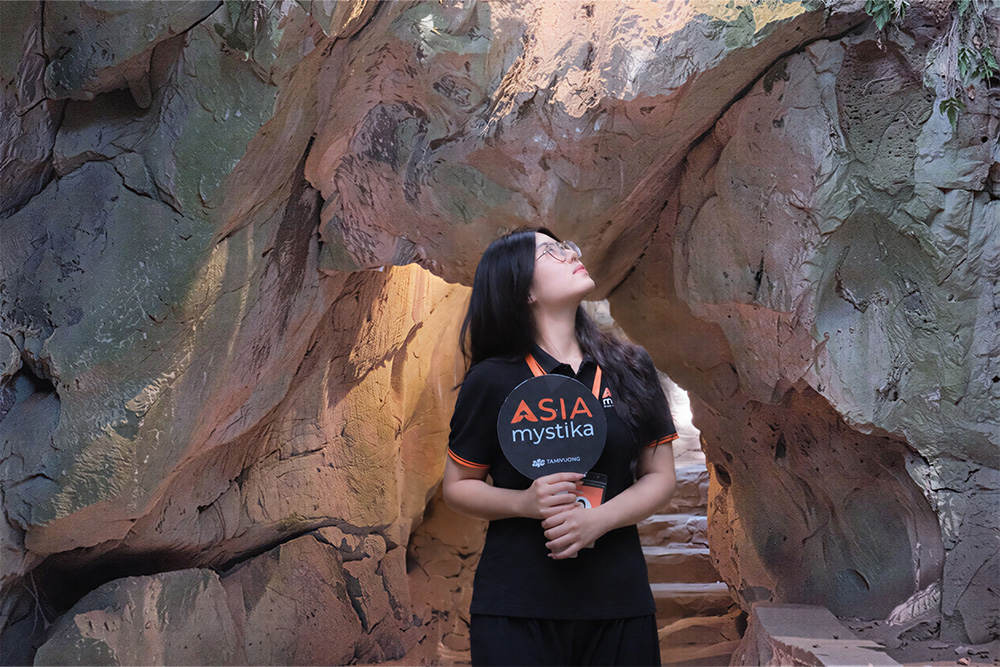
MARBLE MOUNTAIN CAVES - Marble Mountains also remain possible on many rainy days, although they need a little more judgment. Much of the appeal comes from caves such as Huyen Khong and Am Phu, which naturally provide shelter once you are inside. The official site lists nine caves on Thuy Son alone. However, the connecting stone steps are outdoors and can become slippery when wet, so this works best during light rain or between showers rather than during a heavy downpour.
BANA HILLS FANTASY PARK - Ba Na Hills is similar: poor visibility may take away the panoramic views and Golden Bridge photos, but it does not necessarily make the entire day unusable. Fantasy Park is a 21,000-square-metre indoor entertainment area with more than 100 games, giving families a substantial weatherproof option. If the Golden Bridge is your main reason for going, check our Ba Na Hills & Golden Bridge guide before deciding which day to go.
There is also a practical upside to travelling during the Da Nang rainy season: fewer people and potentially better accommodation value. Rates still vary by hotel, weekend and holiday, so treat lower prices as a useful possibility rather than a guarantee.
So the Da Nang monsoon does not remove the destination; it changes what makes the trip rewarding. If you are happy trading some beach hours for better food weather, quieter heritage sites, spa time and a slower pace between Da Nang and Hoi An, there is still plenty worth travelling for.
The single most useful wet-season decision is building in an extra day so weather-dependent excursions can move rather than be lost.
That extra day gives you room to shift places such as Ba Na Hills, Cham Island or Hai Van Pass when the forecast turns against you. Instead of forcing a mountain trip into fog or losing an island excursion completely, you can move it to the clearest day and use the wetter one for food, museums, cafés or a spa. During the Da Nang rainy season, flexibility is often more valuable than having every hour planned in advance.
For the same reason, avoid locking every weather-sensitive excursion to a fixed date too early where possible. Choose flexible or changeable bookings, and check the forecast again once you are in Da Nang. If Tuesday looks stormy but Thursday improves, reorder the itinerary rather than cancel the experience altogether.

Packing for that flexibility matters too. A lightweight rain jacket, compact umbrella, quick-dry clothing, shoes with good grip and a waterproof pouch for your phone will cover most ordinary wet-season days.
Travel insurance becomes more important if you are visiting during the Da Nang typhoon season, particularly if your itinerary includes prepaid flights, hotels or excursions. Look specifically for cover relating to natural disasters, trip interruption, delays and cancellations rather than assuming every policy includes them. Coverage varies significantly, and events that were already publicly known when you bought the policy may be excluded, so purchasing insurance early and reading the policy wording carefully matters.
Once you are travelling, use official warnings rather than relying only on a phone weather app. Vietnam's National Center for Hydro-Meteorological Forecasting publishes forecasts and severe-weather alerts, while airlines and local authorities provide operational updates when storms affect transport. Current international travel guidance also recommends monitoring official forecasts and being prepared to alter plans at short notice during tropical-cyclone conditions.
The goal is not to predict the weather perfectly. It is to build a trip that still works when the forecast changes.
Need a local to help you plan around the weather? Plan Your Da Nang Trip with Asia Mystika and we will give you the best timing, flexible daily plans and reliable backup experiences, so you can make the most of your stay whatever the forecast brings.
The answer depends entirely on whether the beach is the point of your trip — for a culture and food trip the wet season is a reasonable trade, and for a beach holiday it is not.
The easiest way to decide is to look at what you would be most disappointed to lose. During the Da Nang rainy season, restaurants, cafés, museums, spas and most cultural experiences remain easy to enjoy, while beaches, islands, golf and clear mountain views depend much more heavily on the weather. Da Nang’s official tourism guidance similarly recommends matching the season to the experience you actually want rather than treating any month as universally good or bad.
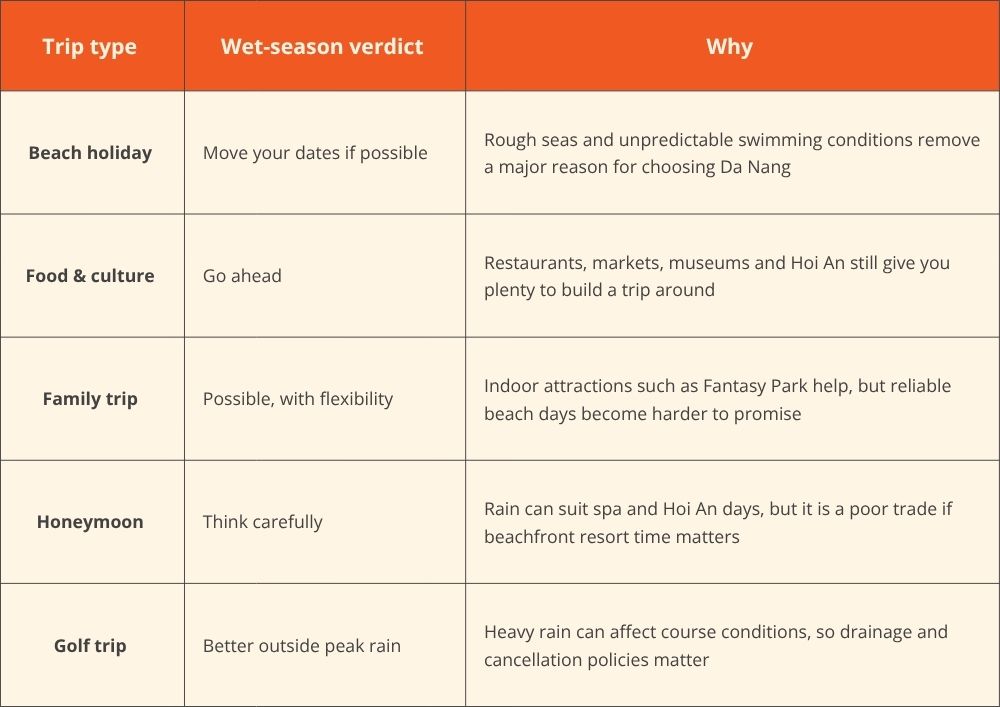
For a beach-led trip, especially one built around swimming, sunbathing and resort days, October and November are difficult to justify if you have control over your dates. Moving to the drier months gives you a much better chance of enjoying Da Nang for the reason you booked it. A culture-and-food itinerary still gives the trip plenty of substance, so accepting occasional rain can be a worthwhile trade for a quieter experience.
Family trips sit somewhere in the middle. Ba Na Hills' indoor Fantasy Park gives you a substantial backup option, and there are enough food and cultural activities to fill wet periods. But if the children are expecting a week of beach and pool time, the Da Nang wet season can feel limiting. For further tips & information, check out our Da Nang with Kids guide, covers child-friendly attractions, realistic pacing and rainy-day backups.
Golfers also have more reason to be selective. Wet weather does not automatically mean courses close, but prolonged rain can affect playability and schedules, so check drainage, weather policies and cancellation terms with the course before committing to several fixed rounds.
If you cannot travel in the main dry season, the shoulder periods can offer a better compromise. September can still provide usable stretches before the wetter October–November peak, while December gradually moves toward cooler and more settled conditions. For travellers with greater date flexibility, February to May is the strongest all-round window, combining drier weather, calmer seas and comfortable sightseeing conditions.
So before changing your flights, ask one question: what would make Da Nang worth the journey for you? If the answer is the beach, move the dates if you can. If it is food, Hoi An, culture and a slower Central Vietnam trip, the rain does not have to be a deal-breaker.
“I would rather a guest come in October knowing what October is than come in October expecting May. The city is quieter, the food tastes better when it is cool, and you can have the Marble Mountains almost to yourself. But if you booked for the beach, I will tell you honestly to move.”
— Asia Mystika Guide.

The Da Nang rainy season runs roughly from September to December, with rainfall typically highest in October and November. Official Da Nang climate data shows these two months receive the heaviest average rainfall of the year.
Yes, especially if your trip focuses on food, culture, Hoi An and indoor experiences rather than the beach. Rain often comes in bursts, so flexible travellers can still find useful sightseeing windows during the Da Nang wet season.
Sometimes, but only when sea conditions and local safety warnings allow it. Rougher monsoon seas are more common in the wet months, so always follow lifeguards, beach flags and official advice rather than assuming swimming is safe.
Not every day, but October is the wettest month and prolonged rain is more possible than in September or December. Short heavy showers are common, but stronger weather systems can also produce several hours or even a full day of rain.
The main Da Nang typhoon season overlaps with the wet season, from roughly July to November and travellers paying particular attention from September onward. Always check the latest National Center for Hydro-Meteorological Forecasting warnings close to your travel date.
If you're wondering what to do in Da Nang when it rains, good options include cooking classes, the Museum of Cham Sculpture, Marble Mountains during safer weather gaps, spa days and Ba Na Hills' indoor Fantasy Park.
The Da Nang rainy season does not automatically mean cancelling your trip. September and December can still offer plenty of good sightseeing hours if you stay flexible, while October and November require more caution because heavier rain and storm disruption are more likely. The key is simple: don't build a wet-season itinerary that depends on perfect beach, mountain or island weather every day.
Wet-season travel needs a little give in the plan. Asia Mystika’s local team knows what works in Da Nang when the forecast changes and can build an itinerary that moves with the weather instead of breaking against it.
Tell us your travel dates, and we’ll help you plan Da Nang for the best experience the season can offer.
