
- SG$ Singapore Dollar
- A$ Australian Dollar
- £ British Pound Sterling
- C$ Canadian Dollar
- € Euro
- MYR Ringgit Malaysia
- US$ United States Dollar
- đ Vietnamese Dong


 About Us
 Destinations
 Travel Styles
 Travel Guide
 Blogs

What Hoi An's day market is actually like, when to go so it is still a working market, what to eat there, and the parts worth walking past. From an operator.
Yes — Hoi An Central Market is a working day market inside the Old Town, on the same bank as the pedestrian streets with the Thu Bon River on one side of it. It is where a large part of the town buys its vegetables, fish and herbs, and that trade runs whether or not anyone photographs it.
If you are after the evening one, that is the separate night market across the river, and what time it starts — a different place, a different reason to go, and a different page.
The distinction worth holding onto is that this is a working market rather than a tourist market with some produce in it. Visitors are welcome and nobody minds you being there, but you are a guest at someone's trading morning rather than the reason it is happening. That is the whole appeal, and it is why the hour you pick matters so much.
We are not giving you a street address or a walking time from the Japanese Bridge, because we have not measured either and an invented distance is worse than none. The market sits inside the Old Town rather than outside it, on the river side, and if you are working through the old merchant streets on foot you will pass it. What there is to see in Hoi An Ancient Town covers what surrounds it — the market is one block inside that morning, not a separate expedition. There are smaller day markets elsewhere in town, but the Central Market is the one people mean.

Hoi An Central Market runs from early morning and winds down through the afternoon, and the hour you choose matters more than the opening time. Early morning is the visit — the produce trade is still running and the food stalls are serving breakfast at the same time.
We do not have a current, dated source for the exact opening and closing times, so we are not publishing one. This is the detail on this page where a plausible-looking number would do real damage: you would build a morning around it, arrive at the time we printed, and find either an empty hall or a trade that finished an hour ago.
Confirm the day's hours at your hotel front desk, or walk past the evening before and look. Both take two minutes and both beat any page, ours included. Hours move with the day of the week and with holidays, which is exactly what a published time cannot carry.
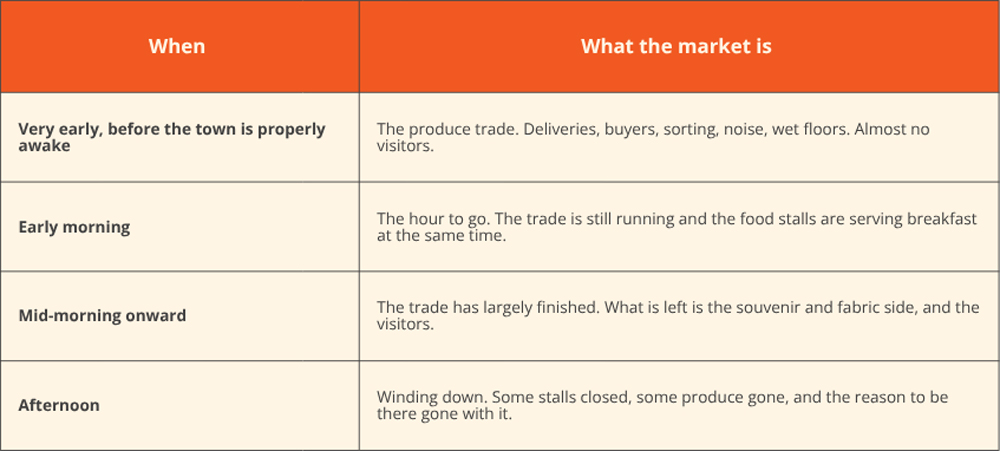
Go early or do not particularly bother. That is the whole planning instruction on this page. A working market at the wrong hour is a souvenir aisle with a roof on it — and a reader who arrives at eleven and finds it underwhelming was wrong about the hour, not about the market.
The useful consequence is that breakfast and the trade line up: the food stalls are cooking while the buying and sorting goes on around them, so one early visit gets you both.
The market is riverside and in the low ground, which is the part of Hoi An that floods. The wet window runs September to December and peaks hard in October and November — those two months take 40 to 50 percent of the Vu Gia–Thu Bon basin's annual rainfall. A market morning planned into late October is a morning that may not happen.
In heavy rain the market keeps trading and the visit stops being enjoyable: wet floors, tarpaulins, nobody lingering. In an actual flood the riverside streets go first, and the market is on them. If your trip falls in that window, read what happens when Hoi An floods, and which areas stay dry before you fix your arrival date, and which months actually work in Hoi An for the month-by-month picture.

The produce, seafood and meat side is the real market and the reason to come; the souvenir and handicraft stalls are the part to skip. The fabric and ready-to-wear section is a different proposition from a tailor's shop and should not be where a garment order starts.
Vegetables and herbs in quantity, river and sea fish, cuts of meat, eggs, rice, dried goods, spices. This is the half that justifies the early alarm, and it is a better introduction to Vietnamese food than any menu — you can see what is in season and what the cooking starts from. If you are doing a cooking class in Hoi An, this is very often where the ingredient run happens, which is worth knowing before you book the market and the class as two separate mornings.
The fabric and ready-to-wear stalls are a distinct section, and they raise a bigger question than they answer. A market stall is not the same proposition as a tailor's shop, and having something made in Hoi An is a decision with its own timeline — fittings, days, and a collection that has to happen before your transfer. How tailoring in Hoi An actually works is the page for that. Do not start it at a fabric stall on your last morning, which is the single most common way the order goes wrong.
The souvenir and handicraft stalls are the least rewarding part of the morning. Much of what is sold there is the same set of items repeated across four or five stalls in a row, and a significant share of it is not made in Hoi An at all: magnets, printed bags, the same prints, mass-produced silk. If souvenirs are what you came for, the night market has more of them, later, and you will not be walking through a fish section to reach them.
Lanterns are sold in both markets. Which nights are a lantern festival rather than ordinary evening lighting is a separate question with a separate answer, and the full-moon lantern nights and when they fall is where it is answered properly.
Cao lầu is the dish to order at Hoi An market — thick noodles, pork, herbs, greens and very little broth, specific to Hoi An in a way almost nothing else in Vietnamese food is. Mì Quảng is regional to Quang Nam rather than to Hoi An, and bánh mì is national: excellent here, but not a reason to travel.
For most visitors the food is the actual reason to come. The stalls cook a small number of things well, for people who eat there regularly. Graded by how local each dish really is:
This works better than people expect, and it is the thing first-time visitors are quietly anxious about. Point at what someone else is eating — that is normal here and nobody minds. Hold up fingers for how many. Have small notes ready. Sit down at the stall rather than hovering; if there is a stool, it is for you.
The honest limit: if you have a serious allergy, or you do not eat pork, or you are strictly vegetarian, that conversation is very hard to have accurately across a language gap at a stall where the fish sauce is already in the bowl. That is a real reason to do a market breakfast with a guide rather than alone, and it is the kind of thing our consultants build into a day rather than leave you to negotiate at seven in the morning.
Eat where there is turnover. A stall with a queue of local customers is cooking fresh and selling fast; a stall with food sitting out and nobody buying is the one to walk past. That is the rule in full, and it is the same rule everywhere in Vietnam.

Food at Hoi An market is priced and haggling over it is not done; souvenirs, fabric and handicrafts are not priced, and the first number is an opening position. Bring cash and small notes, because that is the practical way a market morning goes wrong.
We are not publishing stall prices. We have no current, dated check from the ground, and an out-of-date figure is worse than none because you would plan against it and then argue with a vendor about it. How the pricing works is more useful than a number anyway, and it does not go stale.
At the food stalls there is a price, it is the price, and haggling over it is not done and does not go well. On souvenirs, fabric and handicrafts the first number is an opening position rather than a price, and nobody expects you simply to accept it. The gap between the opening number and the real one is much wider on souvenirs than on anything else here — another reason that aisle is the weakest part of the morning.
Stay friendly and stay relaxed. Tone matters more than technique, and a hard-edged negotiation over a small sum reads badly to everyone watching, including the people you will buy breakfast from. Ask, listen, name something lower, settle somewhere between.
If you are not happy with where it lands, say thank you and walk away. That is normal, it is not rude, and it is not a tactic — it is simply what happens when two people do not agree on a price. You may well be called back. If you are not, nothing has gone wrong.
Bring cash, in small notes. Plan on stalls not taking cards; whether any individual stall does is worth asking before you choose what to buy rather than at the point of paying, and it is not something we are going to state for you from a page.

Every Hoi An market page tells you what is on the stalls. None of them tells you where the visit belongs in the day.
We treat the market as a block in a day plan rather than as a destination. When we build a Hoi An day it is built around the Old Town, the tailors and the river, and the market fits one specific slot — the first one, before anything else opens — or it does not really fit at all. If your morning already has a cooking class or a bike ride in it, the market is probably already inside one of them, and booking it separately buys you the same hour twice.
The corollary we would say out loud: skip the souvenir aisle entirely. Not soften it, skip it. Forty minutes there is forty minutes not spent in the Old Town itself, and everything on those stalls is either available later at the night market or available in better versions elsewhere in Vietnam.
When there is only time for one market, every other page answers on atmosphere. It is not a taste question. It is a routing question.
A visitor with an afternoon train or an early transfer out of Hoi An is better served by the day market, because the night one requires still being in town after dark — and if the night market is the one you want, the night before is the only night you have. Settling that before the itinerary is booked is far cheaper than settling it on the morning, when it costs you one of the two. Our Best of Central Vietnam route is the Hue–Da Nang–Hoi An shape most of these conversations end up at, and the place to see how the Hoi An nights are actually allocated.

Yes — Hoi An Central Market (Chợ Hội An) is the main day market, inside the Old Town on the river side, and there is a separate night market across the river.
It runs from early morning and winds down through the afternoon. Confirm the day's hours locally, and go early regardless, because the early hour is the visit.
No — different market, different side of the river, different time of day and different things on the stalls.
Food to eat there, and ingredients if you are cooking; herbs and spices travel well. Skip the souvenirs, and do not start a tailoring order at a fabric stall.
Plan on cash and bring small notes. Whether any stall takes cards is worth confirming on the day rather than at the counter.
Whether the market falls inside the ticketed zone is worth confirming on arrival rather than from any page, ours included — ticket arrangements in Hoi An are exactly the detail that goes stale.

A market morning only works at the right hour: before the Old Town fills up, on a day you are not also catching a train, in a month the river is not in the streets. Get any one of those three wrong and you have walked through a souvenir aisle.
So it is not a destination you add to a Hoi An day. It is a slot you either protect or lose, and almost nobody loses it on purpose.
Send us your dates and we will shape the Hoi An days around what you want to be doing in the morning — built with you rather than sold off a shelf, and adjusted until the order of the days actually works. If you have an allergy, a diet or someone in the group who will not be eating at a stall, tell us and we will handle it before you are standing in front of a pot at seven in the morning. Free quote, no obligation. Our Best of Central Vietnam route is where most of these conversations start.
WhatsApp: (+84) 866.22.7878
Email: sales@asiamystika.com
Website: www.asiamystika.com


