
- SG$ Singapore Dollar
- A$ Australian Dollar
- £ British Pound Sterling
- C$ Canadian Dollar
- € Euro
- MYR Ringgit Malaysia
- US$ United States Dollar
- đ Vietnamese Dong


 About Us
 Destinations
 Travel Styles
 Travel Guide
 Blogs

Hoi An's lanterns are lit every night of the year. The full moon festival is a different evening — when it falls, how to check your own nights, and whether to plan around it.
Yes — Hoi An's Old Town is lantern-lit every evening of the year. The lanterns are switched on at dusk as routine, not as an event, and the full moon lantern festival is a separate and much busier night on top of that. If you have three nights in Hoi An, all three will be lantern nights.
This matters because of what people arrive expecting. The photographs that sell Hoi An mix two different evenings — an ordinary Tuesday, where the streets and the riverfront glow and you can walk at your own pace, and a festival night, where the crowd is the dominant fact and the river is full of floating candles. Both are real. They are not the same experience, and the quiet one is available on any date you choose.
So the honest version of the planning question is not "how do I catch the lanterns". It is "do I want the festival night as well, and is it worth bending a route for". Sections 2 and 6 answer that.
The Hoi An lantern festival falls on the 14th day of each lunar month, which is why its Gregorian date moves every year. It is not the full moon — the full moon falls close to the 14th lunar day but is not the same marker, and a moon-phase calendar will put you on the wrong night.
That correction is the whole reason this section exists. An earlier version of this page said the festival was held monthly on the full moon. It is not: it is the 14th lunar day, the night before the full moon. The difference is usually one night, and one night is enough to miss it. If you have read "full moon" anywhere — including on an older version of this page — the rule to plan against is the 14th day of the lunar month.
The rule is the durable answer. The table is the convenience, and it has a shelf life.
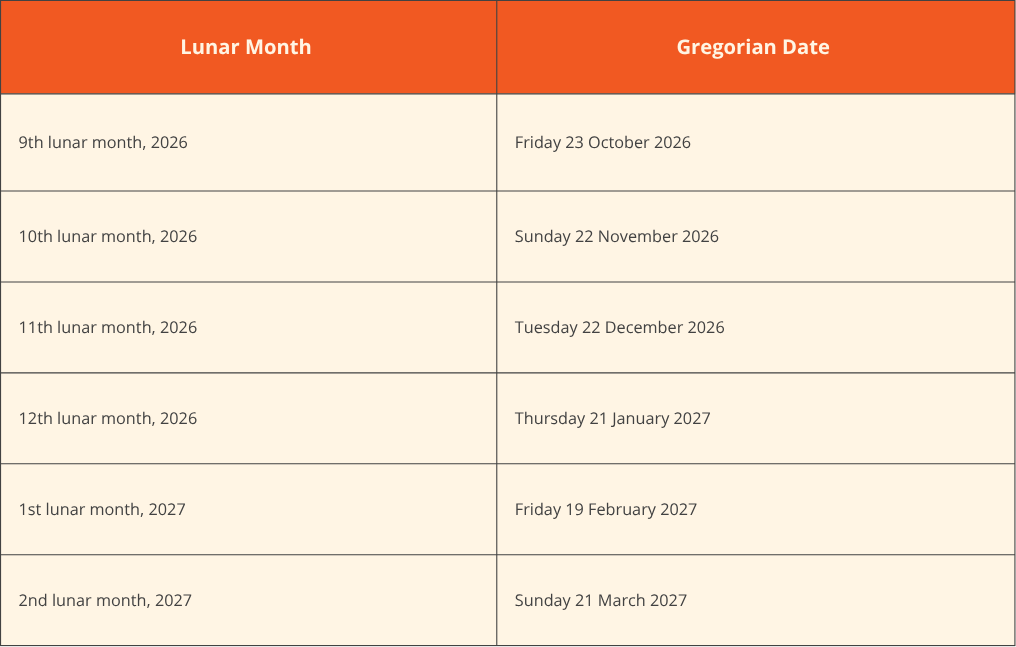
Six nights, and we stop there deliberately. A twelve-month list is a longer thing to go wrong, and every row above is a date arrived at by arithmetic rather than a date the town has announced. Read the "Confirmed by" column literally: it says the calendar puts the 14th lunar day on that evening, and it does not say the event ran. Section 6.2 explains why that distinction is not pedantry.
If your dates are not in the table, you can do this yourself in two minutes, and it is worth knowing how because the answer for any future year works the same way.
Find a Vietnamese lunar calendar — Âm lịch — and look up the 14th day of the lunar month that your nights fall in. Hồ Ngọc Đức's Vietnamese lunar calendar is the standard algorithmic reference and is the one we use. Two cautions. First, do not use a moon-phase or full-moon calendar: it will give you the astronomical full moon, which is a different marker and usually a different night. Second, do not use a Chinese lunar calendar: Vietnam computes its calendar on its own time zone and the two diverge on some dates, which is exactly the kind of error that costs you the evening you flew for.
Then treat the result as a candidate and confirm it close to the day — with your hotel, or with us if we are running your route.
On a Hoi An full moon night the Old Town does considerably more than switch the lights on, and it is the busiest night of the lunar month in a town that is already crowded.
Lead with the crowd, because nothing with something to sell will. The Old Town is a small grid of narrow streets with a river down one side, and on a festival night it absorbs a large additional number of people with nowhere for them to spread out. Expect to move at the pace of the person in front of you on the riverfront and across the An Hoi bridge, and expect the hour either side of full dark to be the densest. Electric lighting is reduced and the river fills with small floating candles, which is genuinely striking and also the reason everyone is standing where you want to stand.
We are not going to publish a program. The closures, what is lit, and what performs are set by the town and change; we would rather tell you the shape of the night and have you confirm the details on the day than hand you a schedule that was true last year. The shape is: quieter and walkable in the late afternoon, dense from dusk, thinning after the first couple of hours. If you are traveling with small children or anyone who finds a crowd difficult, the practical answer is to be in the Old Town early, see it, eat, and be out before the peak rather than to skip the night. One more thing worth separating out: the ticketed Hoi An Memories show is a large commercial production on a separate island site, and it is not the festival night — do not book one expecting the other.
Where you sleep changes how a festival night feels more than anything else you can decide, because being able to walk back in ten minutes rather than queue for a ride is the whole difference. The Hoi An where-to-stay guide breaks the areas down by walking distance to the Old Town.
Paper river lanterns are sold along the Hoi An riverbank and from boats, and releasing one is a matter of taste rather than a tradition you are obliged to join. The candles go out and the paper and wax stay in the water — on a busy night, a great many of them.
We would rather you knew that before you are standing on the bank being handed one, which is the moment it becomes awkward to decline. Declining is completely normal and nobody will think anything of it. We are not going to tell you that releasing one is forbidden or that it is sanctioned — that is for the town to say, not us — and we are not going to tell you it is wrong. We are telling you what happens to the lantern after it drifts out of your photograph.
Reasons to do it:
Reasons not to:
We are not publishing a price, and we want to be straightforward about why. The figures in public circulation for one small paper river lantern span roughly an eightfold range, none of them carries a source, and none of them carries a date — and we found the same spread for silk lanterns to take home. A price we picked out of that range would look more reliable than it is, and you would be the one holding the wrong expectation on the riverbank. Earlier versions of this page carried four such figures with no date on any of them. They are gone rather than restamped.
Here is what is true and useful instead. A paper river lantern is small money — the kind of purchase where the difference between a good price and a bad one is not going to change your day, but where the asking price on the embankment itself, on a festival night, is a multiple of what the same lantern costs from a stall one street back. A silk lantern you fold flat and take home is a different purchase, and the price follows the frame, not the fabric: a collapsible bamboo frame with properly finished ribs costs real money and lasts; a wire frame with the silk glued on is cheap and will not survive the flight. Ask the price before you take the lantern in your hand, on the river and in the shops, and check the folded size against your luggage before you buy the big one.
Bargaining is its own subject and the answer differs between the riverbank, the day market and the night market. The Hoi An night market guide and the Hoi An market guide cover where it is expected, where it is not, and what the lantern stalls are actually like once you are in among them.
The Hoi An lantern nights fall inside the autumn flood window, and that is a trade-off rather than a reason to stay away. Evenings are the part of a Hoi An trip least affected by an afternoon of rain, and autumn is quieter and easier for rooms than spring.
The window is September to December, peaking in October and November — those two months carry 40 to 50% of the Vu Gia–Thu Bon basin's annual rainfall, according to peer-reviewed basin hydrology published in 2022, whose own reference period is not stated in the text we can read, so we are not implying one. Note where that window closes: December, not January — January sits inside the dry season, and nothing in the published record puts flooding in it, whatever a widely circulated longer window suggests. Three of the six nights in the table above fall inside the peak. That is normal and it is not a reason to move them.
What it is a reason to do is decide honestly whether autumn suits you. It suits a traveler who wants the Old Town quiet, rooms cheap and the evenings intact, and who can lose an afternoon without losing the trip. It does not suit someone whose main reason for coming to central Vietnam is the beach, someone traveling with small children for whom a flooded street is not an option, or anyone routing Hue, Hoi An and Da Nang tightly with no spare day. If water is actually in the streets the evening does not happen at all, and that is the risk you are accepting. For which month to choose in the first place, see the best time to visit Hoi An, which takes all twelve months in order. For what a flood actually does street by street, see the Hoi An flooding guide.
Hoi An was one of Southeast Asia's major international trading ports from roughly the sixteenth to the eighteenth centuries, and the two-story merchant houses that carry the lanterns today are what that trade built — which is why the Old Town is a UNESCO World Heritage Site. The monthly lantern night, by contrast, is a modern event the town runs, not an unbroken old custom, and it is administered, scheduled and occasionally moved like any other civic event. We publish no founding year for it, because the dates in circulation disagree with each other and none of them is sourced. We also publish nothing about what the colors or the shapes are supposed to mean, for the same reason — the version you will read elsewhere is unsourced, and a nice story is not a fact. If you want the architecture and the ticket properly explained, that is the Hoi An Ancient Town guide.
Every lantern page writes about the evening. Almost none of them writes about what the evening does to the trip, which is the only part that costs you anything to get wrong.
Here is the asymmetry nobody points out. Hue can move. Da Nang can shorten. The sleeper train can shift a day, the pass can be driven in either direction, a cooking class can be any afternoon. A full moon night cannot move, because the calendar is not negotiating. So if the festival night is genuinely part of why you are going, it is not one item on the itinerary — it is the fixed point, and the order of the whole central Vietnam leg should be built outward from it rather than fitted around it at the end. We settle that date first with clients who want the night, then sequence Hue, the coast and the countryside around it. See Best of Central Vietnam for how the leg fits together, and Discover Hue and Hoi An for the version where Hue and the pass are part of the point.
Every calendar on this search result treats the date as a fact about the moon. It is not. It is a fact about arithmetic plus a decision by the town.
The 14th lunar day is arithmetic, and we will happily give you the arithmetic for any year you like. The festival is an event the town schedules, and it has been moved and canceled before — for weather, for mourning periods, for reasons that were not announced in English. So a conversion gives you the candidate night and nothing more; it does not confirm the night ran. The practical version of that: take the date from the table, build the route around it, and then confirm close to the day rather than assuming. And if your dates miss a festival night by a day or two, give the Old Town two ordinary evenings instead of one — you will see the thing you came for, with room to walk.
Yes — every evening, all year, along the Old Town streets and riverfront. The full moon festival is a separate, much busier night on top of that.
It falls on the 14th day of each lunar month, so the date moves every year; the table in section 2 gives the next nights with their source and check date.
Not exactly — it falls on the 14th day of the lunar month, close to the full moon but not the same marker, so a moon-phase calendar can put you on the wrong night.
Not to walk lantern-lit streets. Whether the Old Town ticket is enforced on a given evening is worth confirming on arrival rather than from any page, ours included.
Around dusk, and the streets fill through the evening. We publish no clock time because sunset moves through the year — plan around sunset on the day.
Two branches, and they lead to different trips. If you want the look of the place — the streets glowing, the river carrying the reflection, the photograph — that is already yours on any date you choose, and nothing about your planning needs to change. If you want the festival night, you are no longer choosing an evening. You are choosing the pivot the rest of the central Vietnam leg turns on.
That is the part worth sitting with before you book anything. Hue can move, Da Nang can shorten, the train can shift a day, the cooking class can be Thursday instead of Tuesday. The 14th of the lunar month cannot. Everything else in the trip is negotiable, and this one thing is not.
Send us the dates you are holding and we will tell you what falls where — which of your evenings is the 14th lunar day, whether it is worth shifting a night to catch one, and how the rest of the central Vietnam leg should sit around it. If your dates miss one, we will say that too, rather than selling you an ordinary Tuesday as an event. Free quote, no obligation, and the route comes back as a draft you can pull apart.
WhatsApp: (+84) 866.22.7878
Email: sales@asiamystika.com
Website: www.asiamystika.com


