 Hotline: +84 866 227 878
- SG$ Singapore Dollar
- A$ Australian Dollar
- £ British Pound Sterling
- C$ Canadian Dollar
- € Euro
- MYR Ringgit Malaysia
- US$ United States Dollar
- đ Vietnamese Dong


 Hotline/Whatsapp: +84 86 622 7878
 Email: sales@asiamystika.com
 About Us
 Destinations
 Travel Styles
 Travel Guide
 Blogs
Blogs

Da Nang to Hoi An is about 30 km. A car — private transfer, metered taxi or Grab — takes roughly 30 minutes outside rush hour. Public Bus Line 1 takes about an hour for a fraction of the price. Fares are in the table in section 2, with the date they were checked. The ones we could not verify are marked, not guessed.
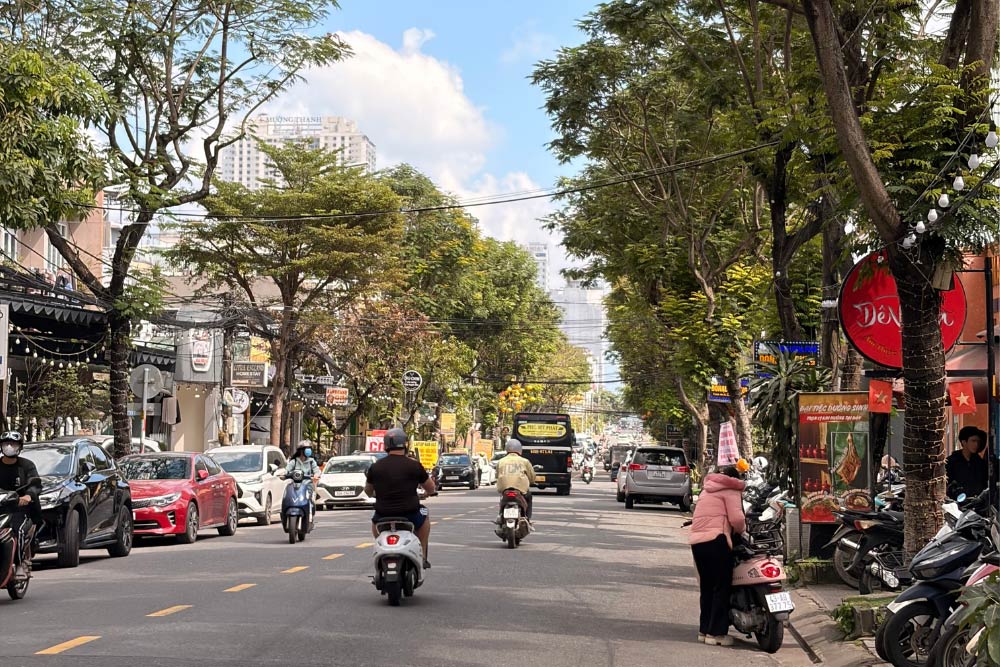
About 30 km, and about 30 minutes by road on a clear run. That is short enough that the two towns work as one base — you do not have to choose, and most travelers should not try to.
The 30 minutes is a good-conditions figure. It stretches in the late afternoon, when the resort strip and the school run overlap, and it stretches again in heavy rain, which in central Vietnam means October to mid-December. Add real slack to any time-critical run; section 5 covers the airport case specifically.
There are two ways to make the trip, and almost every driver defaults to the first without asking.
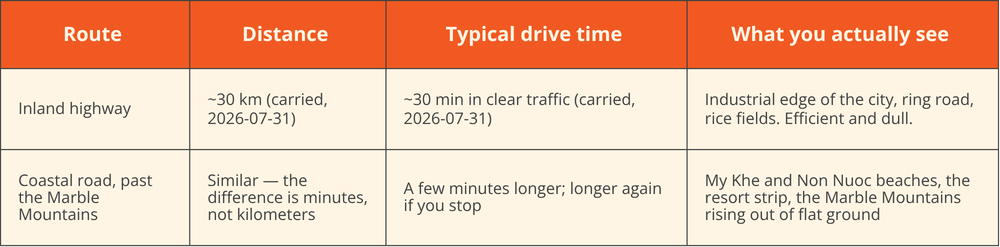
The coastal road costs nothing extra and takes a handful of minutes more. If you are paying for a car anyway, it is the better version of the same journey, and it turns a transfer into the first thing you saw in Vietnam. The Marble Mountains guide covers stopping properly rather than photographing them through a window — worth an hour if you are not landing tired.
This is the decision sitting underneath the transfer question, and 30 minutes is short enough that people agonize over it unnecessarily. Broadly: Da Nang gives you a beach city with an airport, real restaurants and hotel supply at every price; Hoi An gives you the old town at night, which is the thing people remember. Plenty of travelers split the stay.
We have written that comparison out properly in Da Nang vs Hoi An. For orientation on the city itself — districts, beaches, where the airport sits relative to everything — see our Da Nang destination guide, and for the accommodation side, Da Nang hotels and resorts.
Here is every mode, side by side.
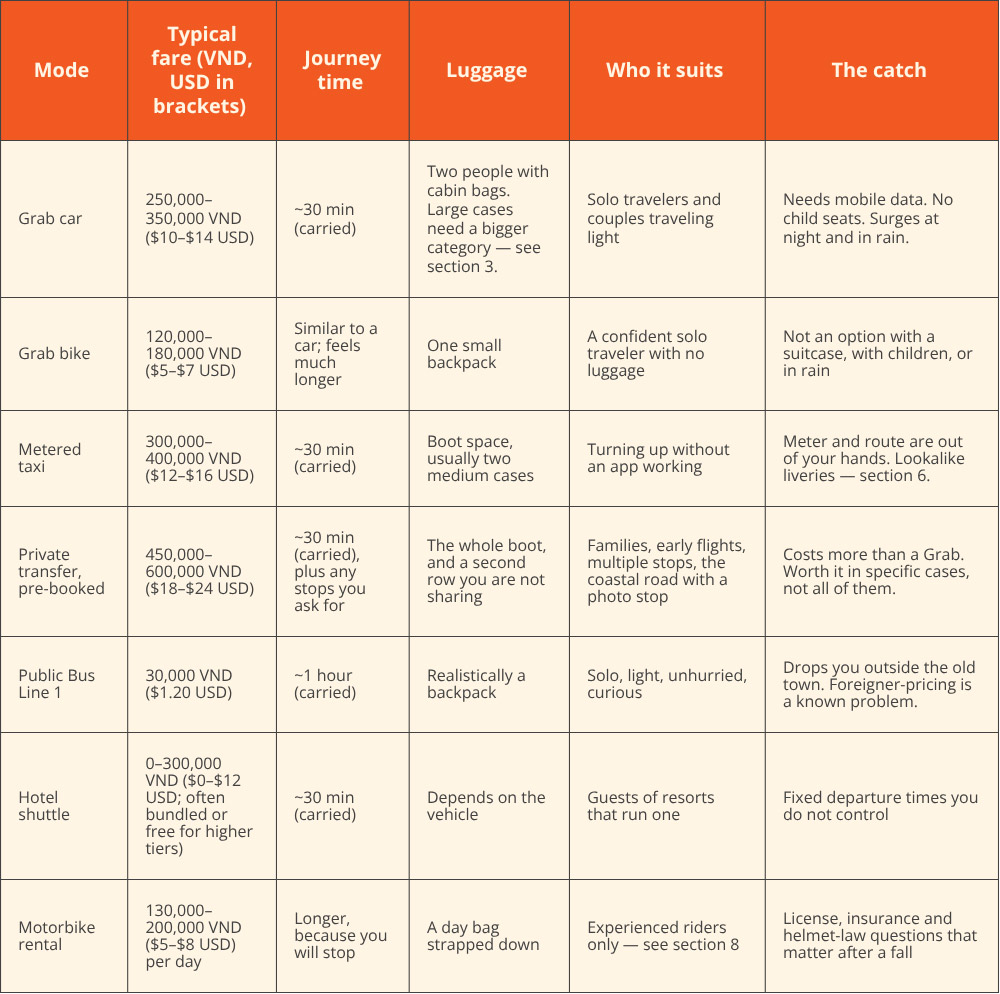
Fares move. Check the app for a live quote before you agree a price with anyone, and treat the numbers above as a range to argue from, not a fixed rate. Every figure here is Vietnamese dong first, because dong is what appears on the meter and in the app. The dollar figure in brackets is a conversion for reference only.
An airport pickup is not always priced like a city pickup. Some operators add an airport access charge, and some quote a higher rate on a run that will bring them back empty. Ask whether the quoted price is all-in before you get in, and if you are booking a transfer in advance, ask specifically whether tolls, parking and waiting time are included.
Current airport surcharge position:
10,000 to 30,000 VND (~$0.40–$1.20 USD) standard terminal access or parking fee, which is routinely added separately to app-hail bookings like Grab (paid directly in cash to the driver or automatically bundled), whereas private pre-booked transfers generally include it in the quoted all-in rate.
Two things push the price up predictably. The app surges when demand spikes — end of the evening in the old town, and the first ten minutes of heavy rain. And a driver approached in the street at 11pm knows you have fewer options than you did at 2pm, and will quote accordingly. Neither is a scam; both are avoidable by booking before you need the ride rather than at the moment you need it.

Yes, for most people. Grab quotes the run like any other trip: the price is fixed and shown before you accept, there is no negotiation at a curb, and there is a record of the journey. What it costs for this route is in the table above.
Setting the app up is not a route question, and it is a job to do before you fly rather than at arrivals — install it, register while your home number can still receive an SMS code, and sort an eSIM, because Grab needs data. The full sequence, including choosing a vehicle category, fixing a pickup pin the app has dropped where no car can stop, and what to do when the eSIM has not activated at the curb, is set out step by step in getting around Da Nang, along with city fares, bike rental and the car-with-driver question. If you have not sorted arrival logistics yet, our guide to flights into Da Nang covers the airport end, including connectivity on arrival.
3.1. When Grab is the wrong tool for this run
Every guide tells you to use Grab. Very few tell you when it will fail you on a 30 km trip between two towns, which is the half that ruins a day. The general failures — no data, no child seats, a motorbike taxi with a suitcase — apply anywhere in Da Nang and are covered on the city transport page, where the fallbacks are spelled out. These four are specific to this route.
We would rather be straight about this than sell it into every situation. A pre-booked car earns its higher price when: you are a family with cases and no interest in negotiating at a curb; you have a flight before dawn; you want to stop at the Marble Mountains or a beach on the way; someone in the party has limited mobility and needs a door-to-door with a driver who will wait; or you want the coastal road and a driver who understands "no rush" as an instruction rather than a problem.
For a couple with two cabin bags on a clear afternoon, a Grab is the right answer and we will say so.
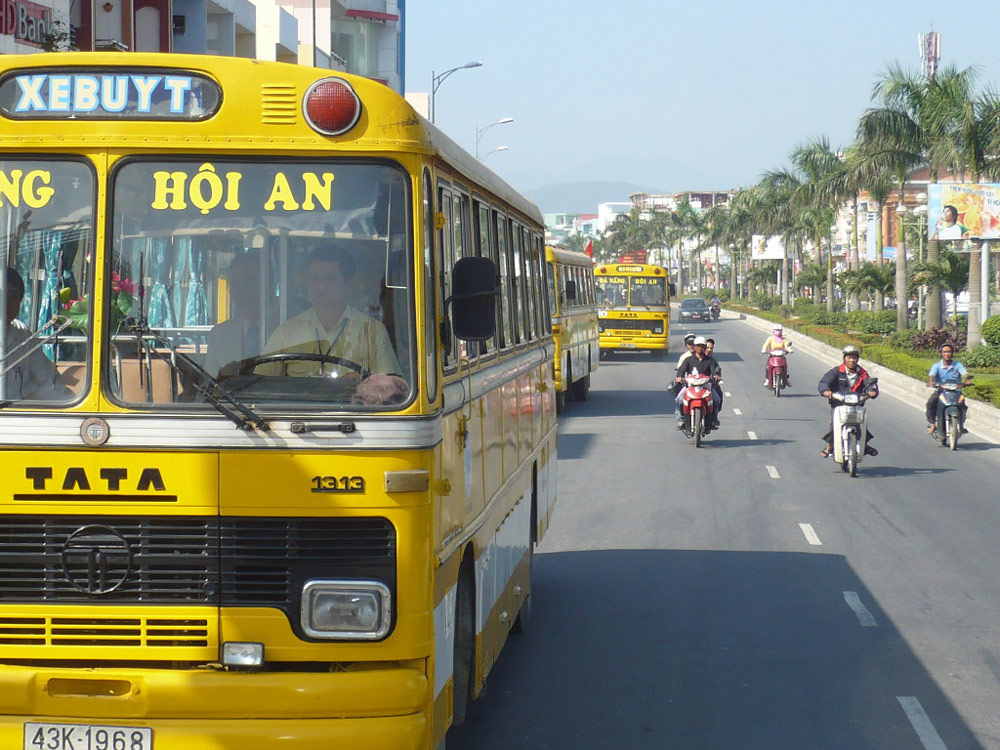
Yes, and for some people it is genuinely the right choice — but the honest version of the bus is not the version most guides publish.
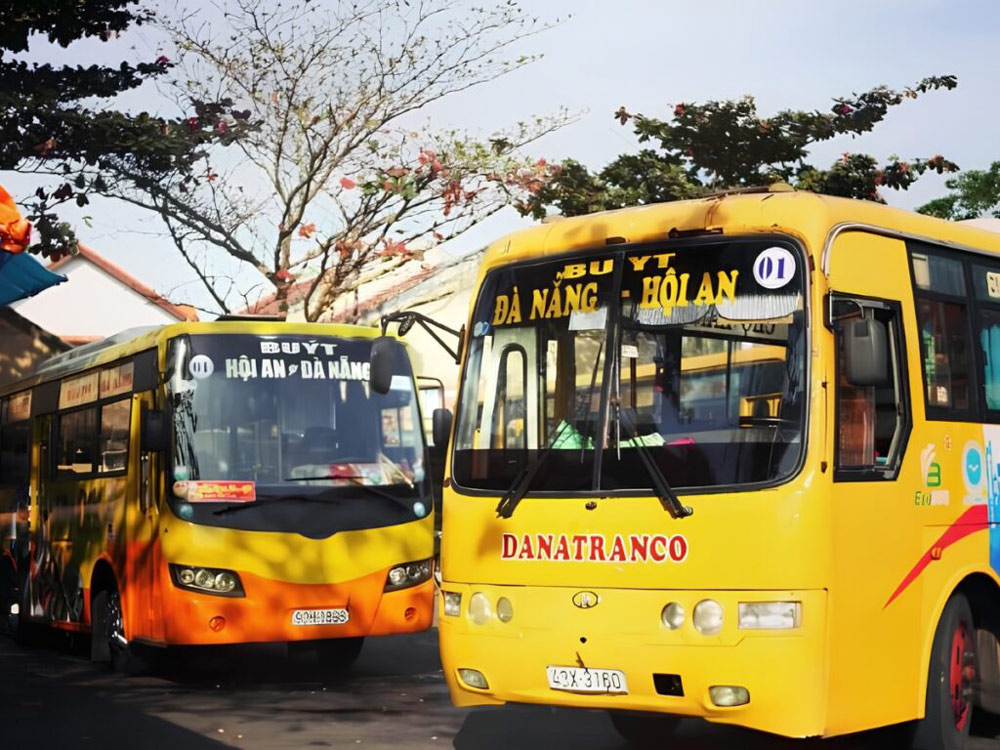
Public Bus Line 1 runs between Da Nang and Hoi An. The essentials, all of which need verifying with a date before you rely on them:
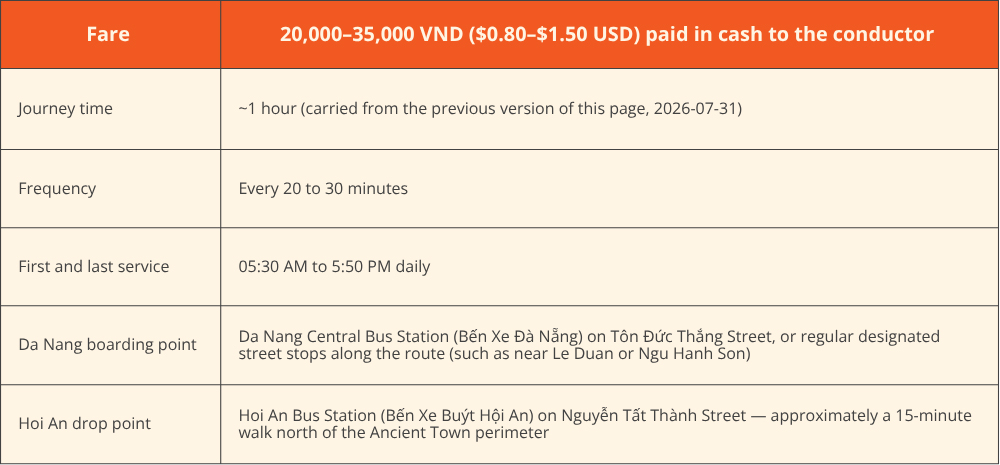
We are not publishing a timetable we have not checked. A wrong departure time on a page like this costs someone a morning.
The catch, said plainly. Three things, and all three are real. The bus takes roughly twice as long as a car, so you are trading an hour of your day for the saving. It drops you outside the ancient town rather than at your hotel door, which is a walk with luggage in heat. And the practice of quoting foreign passengers a higher fare than local passengers on this route is well documented — if it happens, the amount involved is small, the correct response is to state the fare you expect and pay it, and it is not worth a confrontation.
Who it genuinely suits: solo travelers with a backpack, no fixed schedule, and an appetite for the ordinary version of the country. Who should not attempt it: anyone with a case and a child, anyone arriving late, and anyone with a connection to make.
The return leg is not just the outbound leg reversed. It has its own failure modes, and they cluster around two things: where a vehicle can physically collect you in Hoi An, and how much time you left yourself.
This is the most common way this goes wrong, and it goes wrong the same way every time: someone plans to hail a car at 5am for a 7am flight, no driver accepts, and the twenty minutes spent refreshing the app is exactly the twenty minutes that was the buffer. Book a car the day before. It is a small cost against a missed flight, and it is the single reason most of our guests take a pre-booked transfer on the way out and a Grab on the way in.
Line 1 can get you toward Da Nang, but it does not deliver you to the terminal, and the connection at the far end adds time and uncertainty you do not want before a flight. It works if you are unhurried and your flight is in the afternoon. Fare and last-service time: 20,000–35,000 VND ($0.80–$1.50 USD) and approximately 5:50 PM daily.
Two of them are specific to this journey, and both work for the same reason: 30 km is a large enough fare to be worth inflating, and you have no idea what it should cost. Knowing the mechanism turns each one into a mild annoyance.
The rest of the repertoire is not specific to this road: the lookalike liveries, the driver who asks you to cancel the Grab and pay cash, the banknote switch between the similarly colored notes, the "your hotel has closed" redirect to a commission property, the arrivals tout, the rental shop that holds your passport, and the transfer that diverts to a workshop nobody asked to visit. Each one is set out with its defense in getting around Da Nang — worth reading before your first taxi rather than after it.
None of this should make you nervous about getting into a car in Da Nang. The realistic worst case in almost every scenario above is an overpaid fare and a story.

Short version, because each of these has its own guide.
Hue — the coastal train takes roughly 2.5–3 hours over the Hai Van Pass and is one of the best rail rides in the country; a private car over the pass lets you stop. Full detail in our Da Nang to Hue guide.
Sapa — there is no quick way; it means flying or taking the train to Hanoi and then continuing overland. Plan it as a travel day, and read Da Nang to Sapa before committing to it in a short itinerary.
Ho Chi Minh City — fly. The Reunification Express hugs the coast beautifully and takes around 16 hours, which is a choice rather than a transport decision; Da Nang to Ho Chi Minh City by train sets out whether it is worth it.
Hanoi and everywhere else — fly. Our flights to Da Nang guide covers routes into the city, which is the same question in reverse.

Three things we would tell you across a table, which do not appear on the pages currently ranking for this question.
Install Grab and sort an eSIM before you fly, and every other decision on this page becomes trivial — you land, you open an app, you get in a car with a price already agreed. That is the standard advice, and it is right. The part nobody adds is what to do when it does not work, because sometimes the eSIM does not activate at the curb. So have the fallback ready before you need it: the official rank inside the terminal, your hotel address screenshotted in Vietnamese, and small notes in your pocket. The people who have a bad first hour in Vietnam are almost never the ones who chose the wrong mode. They are the ones who had exactly one plan.
When we transfer guests to Hoi An we offer the coastal road past the Marble Mountains rather than the inland highway. It takes a few minutes longer, costs nothing extra, and you get the beach, the resort strip and a natural photo stop instead of a ring road. Most drivers default to the fast road unless you ask — not out of laziness, but because speed is what they assume you want. Five words fix it: coastal road, please, no rush. If you take one thing from this page and the fares are not it, take this.
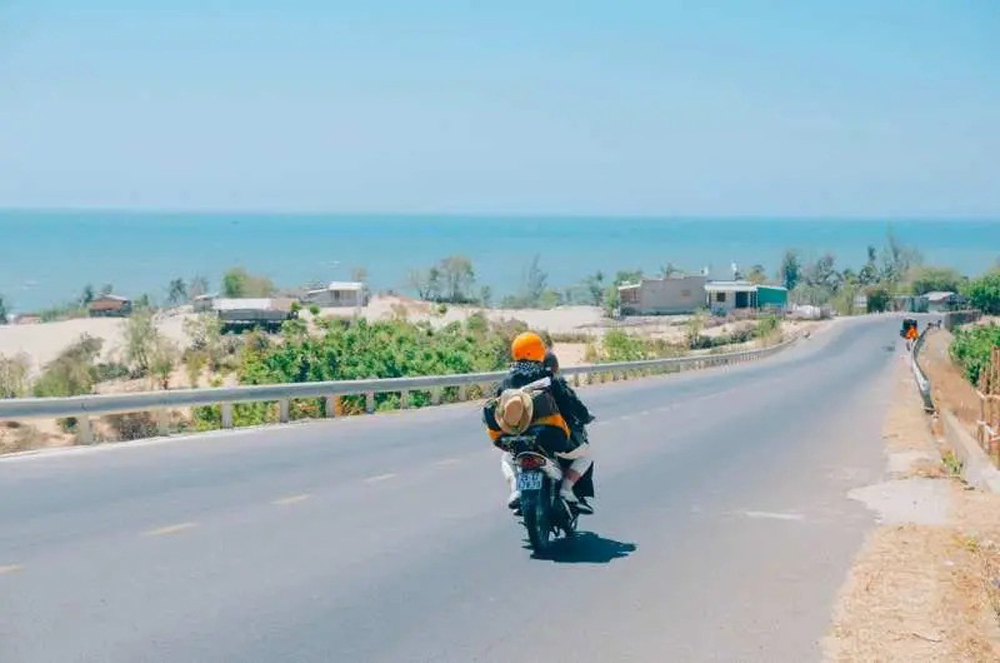
Not unless you already ride at home, on real roads, regularly — this is a 30 km road you have never seen, taken jetlagged on an unfamiliar bike, and it is the wrong place to learn a traffic convention that is not the one you know. Ride it later in the trip instead, once you have watched the traffic for a few days; the coastal stretch is the good half. The general case — how the traffic actually works, and the license and insurance position, which is the part people find out about after a collision rather than before one — is in getting around Da Nang, and the insurance half is worth reading before you sign a rental agreement anywhere in the country. Take a car on day one.
We say this because our guides live in the regions they work in — around 95% of them are local to where they guide — and the Da Nang–Hoi An road is one they drive constantly. It is also why, when something goes sideways mid-trip, there is someone on WhatsApp who knows the road you are standing on.

300,000–400,000 VND (approximately $12–$16 USD) for a metered taxi or a Grab car, checked September 2026. Fares move; always take a live quote in the app before agreeing a price.
Yes — Grab quotes the full 30 km run, in both directions, with a fixed price shown before you accept. It needs working mobile data, so install the app and sort an eSIM before you fly. For using Grab inside Da Nang itself.
By car — private transfer, taxi or Grab — in about 30 minutes over roughly 30 km, or on public Bus Line 1 in about an hour for much less. Ask for the coastal road if you are in a car.
Not a direct airport service. Public Bus Line 1 runs between Da Nang and Hoi An but starts in the city rather than at the terminal, so it means a connection with your bags. Fare and timings: 20,000–35,000 VND ($0.80–$1.50 USD) for the ticket (plus a nominal luggage fee if applicable), running daily from approximately 5:30 AM to 5:50 PM with departures every 20 to 30 minutes, though requiring a local transit connection from the airport to the city-center bus lines.
The drive is about 30 minutes in clear traffic, but that is not the number to plan against. Allow a real buffer for traffic, rain and airport processing — our scheduled allowance is 2 hours for domestic flights and 3 hours for international departures, plus a 45-minute baseline road and weather buffer — and book the car the night before if you are flying early.
Yes, and it is generally the safer option precisely because the price is fixed, the driver and plate are shown to you in advance and the trip is recorded. The one rule: do not cancel the booking and pay cash when a driver asks you to. Section 6 covers the rest.

Getting from Da Nang to Hoi An is a solved problem, and you now have the whole of it: the modes, what each one costs, what each one costs you when it goes wrong, and the handful of situations where the cheap answer is the wrong one.
If you would rather not solve transport at all, that is what we do. Tell us the dates you have in mind and what you want out of the trip, and a consultant will draft a route you can pull apart — private car where it earns its place, the coastal road with a stop if you want it, a driver who is expecting you at 5am, and someone reachable on WhatsApp while you are here. Free quote, no obligation.
Our Best of Vietnam tour is the usual starting point for a first trip taking in the center, and every itinerary we build gets rearranged from there — that is the point of it. If you are still filling in the Da Nang end of the plan, things to do in Da Nang is the next thing to read.
WhatsApp +84 866227878 · sales@asiamystika.com
Asia Mystika designs private, tailor-made trips through Vietnam, Laos and Cambodia. Founded in 2020, we have arranged travel for more than 25,000 individual customers. International Tour Operator License No. 01-536/2021/TCDL-GP LHQT.
