
- SG$ Singapore Dollar
- A$ Australian Dollar
- £ British Pound Sterling
- C$ Canadian Dollar
- € Euro
- MYR Ringgit Malaysia
- US$ United States Dollar
- đ Vietnamese Dong


 About Us
 Destinations
 Travel Styles
 Travel Guide
 Blogs

Where to stay in Hoi An, area by area — Ancient Town, Tan An, Cam Nam, An Bang, Cua Dai and the rice fields. Who each suits, who each is wrong for, and which ones flood.
Stay on the Ancient Town edge or in Tan An for a first visit of three or four nights, in An Bang for beach mornings and quiet evenings, and in Cua Dai for a resort if you accept a shuttle. If your dates fall in October or November, stay off the riverfront.
"Where to stay in Hoi An" and "Hoi An where to stay" are the same question, and this is the one page we answer it on.
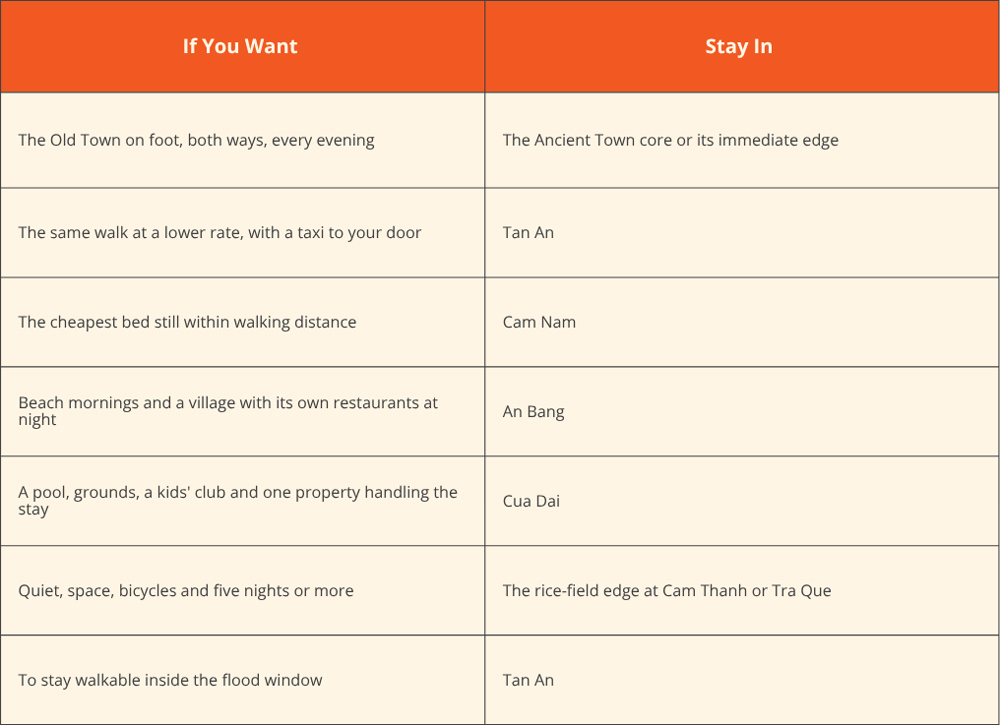
Override one: your dates. Hoi An floods, on a season rather than on a day, and the ground your hotel stands on decides what that means for you. If you are traveling in October or November, read section 3 before you read anything else here, because it reorders the table above. Nobody who has paid for a riverside view in November is pleased to discover the room was the first one affected.
Override two: your number of nights. Three nights and the Old Town is the point of the stay, so you sleep in it or beside it. Seven nights and the Old Town becomes one of the things you do, so the beach or the rice-field lanes start to make sense. The most common mistake we see is a three-night first visit booked into a lodge 6 km out because the photographs were better.
One practical note on arriving: Da Nang airport is about 30 km away by road, and that transfer, not the flight, is the part travelers under-plan. We are not publishing a drive time, because the honest one moves with the hour, the road and the pedestrian blocks in the core, and we hold no timed figure we can put a date on. What the options cost you in time is in our guide to the 30 km transfer from Da Nang. This page was rewritten in October 2026, and every figure on it either carries its source or is openly left out.
Hoi An has six places to sleep: the Ancient Town core and edge, Tan An, Cam Nam, An Bang, Cua Dai, and the rice-field edge at Cam Thanh and Tra Que. Tan An is the right answer for more people than the internet suggests, and almost no guide names it.
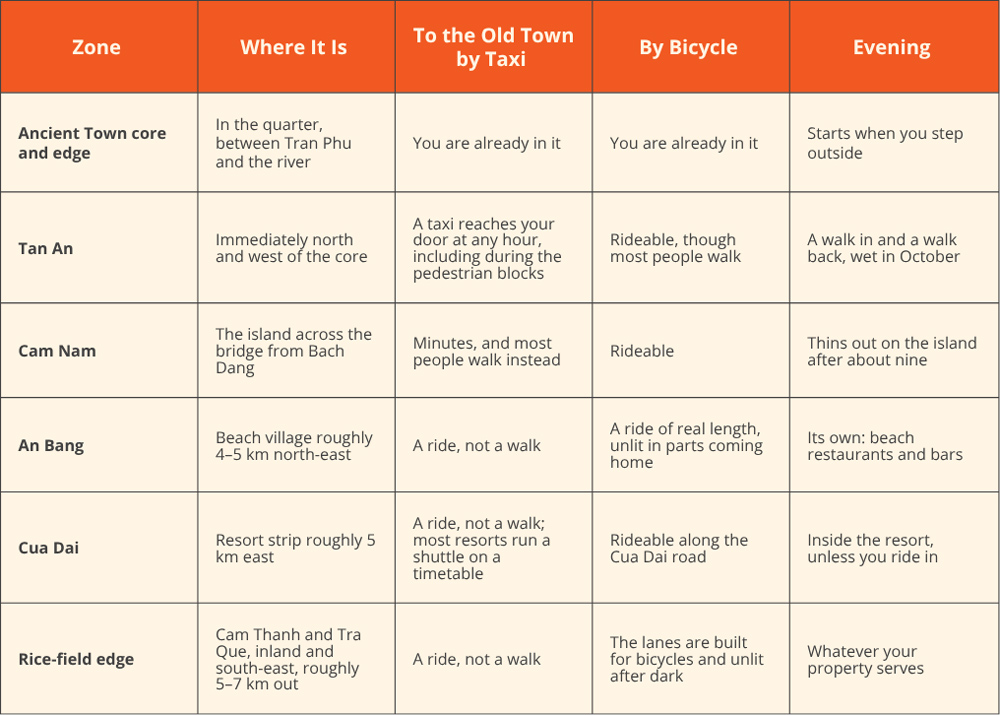
Each area below is set out the same way, so you can read them against each other. The landmarks are there to place each one without opening a map, and each ends with who should not book it, because that is the line that actually helps.
What it is. The heritage quarter: two-story shophouses, tiled roofs, tailors, lanterns strung across the lanes, the river along the south side. Room stock is small hotels, boutique conversions and family homestays, not resorts.
Landmarks: the Japanese Covered Bridge at the west end of Tran Phu, the An Hoi footbridge across to the night market, and the riverfront along Bach Dang.
Right for: first-timers on a short stay. Couples who want the evening to begin at the door. Anyone who came for the tailors, because the shops are here and a fitting schedule runs over several days — how that works is in our guide to Hoi An's tailors.
What the photographs do not show. A heritage building is a pleasure to look at and can be a hard place to sleep: dark, because the windows are small and the buildings deep; sometimes damp, because the walls are old and the river is close; and stair-heavy, because a converted shophouse rarely has an elevator. Noise splits by street rather than by area — the lanes nearest the river and the bars run late, two streets back it is quiet — so ask which street and which side of the building, not which area. Pools, where they exist, are small.
The quarter also runs a ticket system for the heritage houses and assembly halls, and the ticket is an itinerary decision rather than a cost decision; what it admits you to is on our Hoi An Ancient Town page. Trust a dated price over an undated one, because plenty of pages ranking for that question are still quoting last year's.
Wrong for: light sleepers who book blind. Anyone with mobility limits, a stroller, or a knee that dislikes stairs. Anyone whose picture of this trip includes an afternoon by a pool. And anyone traveling in October or November, because this is the ground that floods first. Section 3.
What it is. The ward immediately outside the Old Town core: a working residential neighborhood, walking distance in, with normal vehicle access at all hours and rates below the heritage streets. Most guides to this question do not name it at all, which is strange, because it is the answer for a large share of the people asking it.
Landmarks: just north and west of the core. The Old Town is the far edge of a short walk.
Right for: anyone who wants the Old Town on foot but wants a taxi to reach the door, daylight in the room, and a rate that is not a heritage rate. Families getting a stroller or a tired child home without arranging a ride. Longer stays, where the walk becomes routine instead of an outing.
What the photographs do not show. It looks like nowhere in a listing photograph, because it is a residential ward rather than a set. It only becomes atmospheric once you have walked ten minutes. If the area itself is part of what you are buying, this is not it.
Wrong for: anyone who wanted to open the door into the lanterns, because the walk is short but it is a walk, and in October rain it is a wet one. Also wrong for a one-night stop, where the walk eats the only evening you have.
What it is. The island across the bridge from the southern edge of the Old Town. Minutes on foot, noticeably cheaper, quieter and more residential, with small homestays and guesthouses rather than hotels.
Landmarks: straight across the Cam Nam bridge from Bach Dang and the riverfront.
Right for: travelers on a budget who still want to walk into the Old Town. Longer stays. Anyone who would rather sleep in a neighborhood than inside the attraction.
What the photographs do not show. Restaurant choice on the island thins after about nine in the evening, so a late dinner means crossing back over. And then the deciding fact: Cam Nam is low-lying river land, and the flood-depth mapping of this basin puts it among the high and very-high areas. That is not a caveat on an autumn booking. For autumn dates it is the answer, and it is section 3.
Wrong for: a stay between September and December. Anyone who wants restaurant choice on their own side of the bridge at nine at night. Anyone who wants a hotel rather than a homestay.
What it is. The beach village north-east of Cua Dai: a strip of sand, a row of beach restaurants and bars, and a lane of villas, boutiques and homestays behind it. It is the stronger of the two coastal options for one reason — An Bang has its own evening. You can eat and drink well here without going into town at all.
Landmarks: the beach road ends at the sand, and the Old Town is roughly 4–5 km to the south-west.
Right for: couples who want quiet nights. Second visits, where the Old Town is no longer the whole point. Stays of a week or more, where a beach morning and a town evening become a rhythm rather than a commute. Families who want sand without a resort around it.
What the photographs do not show. Room stock is small and individual rather than towers — a virtue for atmosphere, a limitation if you need connecting rooms, an elevator or a large pool. The ride into the Old Town is a ride and not a walk, in both directions, every evening you eat in town, and we are not going to put a figure on it that we cannot date.
Wrong for: anyone doing the Old Town every evening on a short stay, because you pay that round trip nightly and it mounts up faster than people expect. And anyone booking a September-to-December beach holiday on the strength of a summer photograph. The sea in those months is a different sea.
What it is. The large-resort strip east of town. Pools, grounds, kids' clubs, spas, and shuttles into the Old Town on a timetable. If the trip is built around a resort, this is where the resorts are.
Landmarks: roughly 5 km east of the Old Town along the Cua Dai road, with An Bang up the coast to the north.
Right for: families who want a pool and space more than a walkable dinner. Anyone using Hoi An as the rest at the end of a long route. Travelers who want one property to handle the whole stay.
What the photographs do not show. Cua Dai's shoreline has had coastal erosion and engineered defenses for years — sea walls, breakwater structures, sand replenishment. The beach in front of a given resort is therefore not reliably the beach in its own photographs, and it is not uniform along the strip: two neighboring properties can have very different frontage. We will not describe the current state of any particular stretch, because a condition we cannot date is worth nothing to you. Confirm the current frontage with the property, or with us, before you pay a beachfront premium. A hotel that answers that question plainly is telling you something; one that sends you a rendering is telling you something else.
Wrong for: anyone who specifically wants swimming off the doorstep and has not checked. Anyone who wants to walk to dinner, because you will not. Anyone on three nights who came for the Old Town, because the shuttle timetable will shape every evening of the stay.
What it is. Working farmland between the town and the coast. Cam Thanh is the water coconut palm area on the tidal channels, where the basket-boat trips run and the lanes are made for bicycles. Tra Que is a market-garden village supplying a large share of the town's restaurants with herbs, and visitors who want to can join a session of the actual work and a cooking class after it. Accommodation is eco-lodges, garden villas and homestays, usually with a pool and a bicycle rack.
Landmarks: inland and south-east of the Old Town, roughly 5–7 km out depending on the lane.
Right for: a second or third visit. Stays of five nights and up. Cyclists. Families with young children who want space, a pool and quiet, and who are content that dinner is on site or a ride away.
What the photographs do not show. The distance is real, the lanes are unlit, and the ride back in the dark is not something everyone enjoys on a bicycle. Restaurant choice on site is whatever your property has, every night. This is also low-lying ground close to the river system, and southern Cam Thanh appears in the flood-depth mapping among the high and very-high areas — a fact absent from every accommodation guide to this town, including our own until now. Ask the property directly, and read section 3.
Wrong for: a two- or three-night stay, without exception. Anyone without a bicycle habit or a standing car budget. Anyone arriving late in the day, when the last part of the transfer is unlit lanes.
The fourth column is the one usually missing, and it is the one worth reading. Every area costs you something.
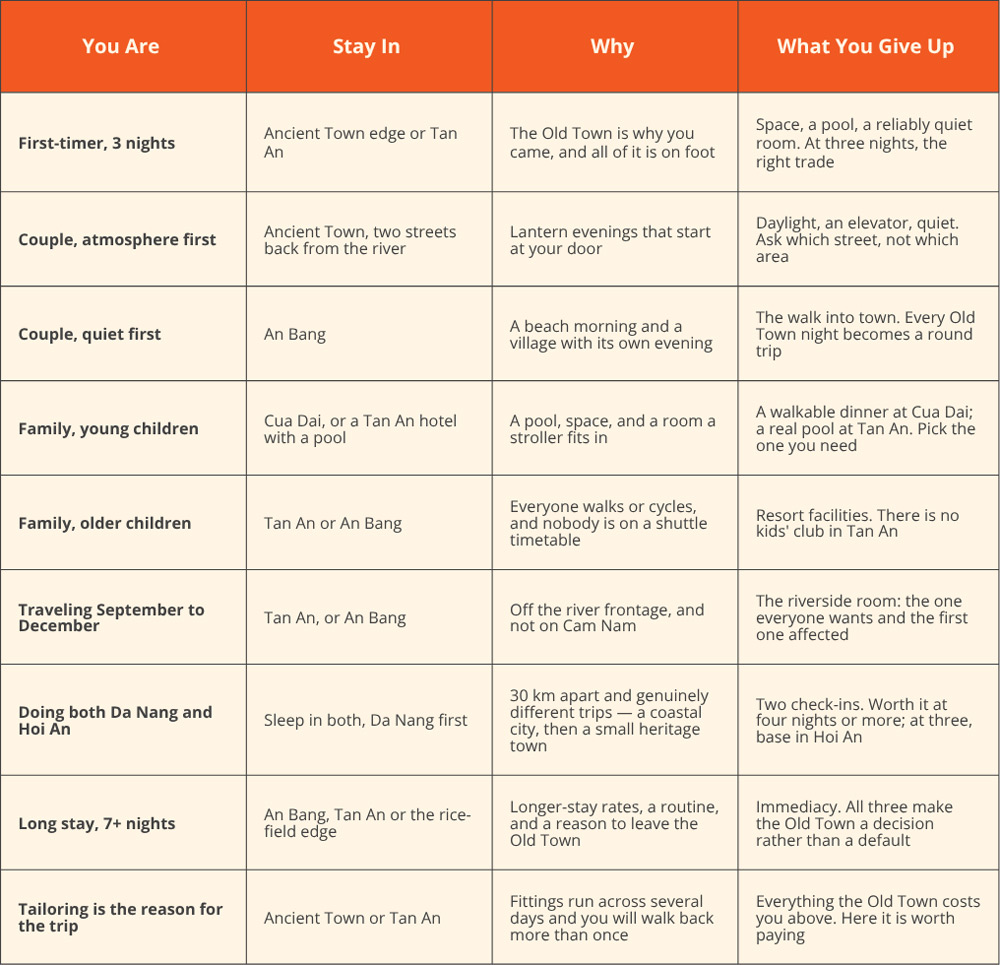
On doing both towns. This is the question behind "where to stay, Da Nang or Hoi An", and the answer is not "it depends". With four nights or more in central Vietnam, split them: Da Nang for the beach, the food streets and the day trips, Hoi An for the Old Town. With three, base in Hoi An, because the Old Town after dark is the thing that does not survive being a day trip and Da Nang survives being one. Our where to stay in Da Nang guide handles that city the same way, area by area with a "wrong for" on each, and Da Nang or Hoi An takes the choice itself apart if you only have room for one.
If Hoi An is three or four nights inside a longer route, the area question is really a routing question. Our Best of Central Vietnam route shows where those nights usually sit and what they connect to on either side — useful before you book an area, because the night you arrive and the night you leave decide more than the view does.
In the Hoi An flood window, stay in Tan An or out on the beach strip and avoid the riverfront and Cam Nam. Hoi An floods from September to December, peaking in October and November, and Bach Dang is the first street in Hoi An to go under.
Every guide to this question organizes Hoi An by area. None of them tells you which of those areas floods. That is what this section is, and it is the reason the page was rewritten.
The window, and one source for it. The basin study published in IWA Water Supply 22(4) in 2022 puts the flood season across the Vu Gia–Thu Bon system at September to December, with October and November carrying 40–50% of the basin's annual rainfall between them and September to December carrying 65–80%. The study does not state the reference period for those figures in its accessible text, and we are not going to imply one. The modeling in Nguyen et al. 2020, calibrated on 1995 to 2014, puts flood occurrences proper in October to December. Nothing we found puts flooding in January, and the same basin literature places January in the dry season. One window, then: September to December, peaking October and November. Earlier versions of our own pages hedged it between September to December, September to January and September to mid-December. All three framings are retired.
Which street goes first. Bach Dang, along the river, is the first street in Hoi An to flood, together with Cong Nu Ngoc Hoa and Nguyen Phuc Chu — that is the Hoi An Heritage Conservation Centre's own ordering, reported via Vietnamnet on 31 January 2016 and consistent with the street-by-street reporting of the November 2025 event. The inner streets, Tran Phu and Nguyen Thi Minh Khai among them, go later and shallower. The flood-depth mapping of the basin, built on 2021 Sentinel-2 imagery, puts Cam Nam, the old quarter and southern Cam Thanh among the high and very-high areas.
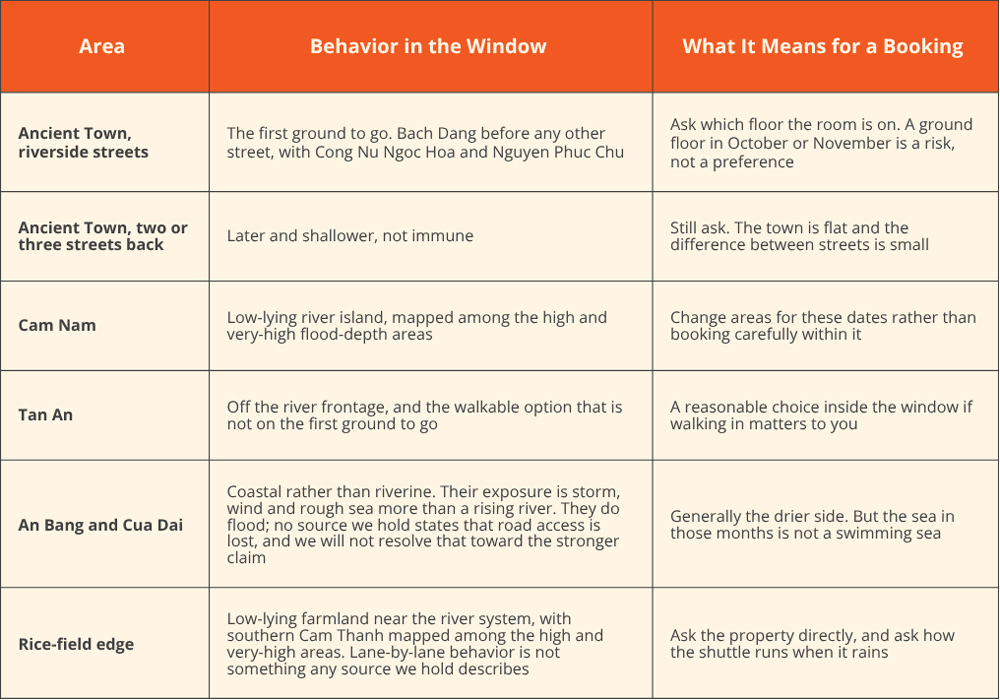
What flooding actually does to a stay you have already paid for. Most trips inside the window are unaffected. When it does happen, streets stop being walkable and movement through the lowest of them can be by boat, which is not a photo opportunity with a suitcase in it. Ground floors go out of use — lobbies, restaurants, ground-floor rooms, reception itself — and a well-run Old Town property has a routine for this and moves you upstairs. Reaching a property by car can stop even when the property itself is fine, which is the version that ruins an arrival day. Restaurants and the tailors close, which matters if a fitting schedule is the reason for the trip. And the airport transfer is the part that breaks a wider itinerary: a flooded road to Da Nang does not cost you a morning in Hoi An, it costs you the flight at the other end of it and the hotel after that.
We are not giving you a depth, a duration, a frequency or a rainfall total. The flood-frequency figure in general circulation traces back to an uncredited sentence in one newspaper story from October 2025, and the monthly rainfall figures published for Hoi An come from commercial compilers who disagree with each other by roughly 420 mm on the annual total and on which month is wettest — Vietnam did not submit to the WMO's 1991–2020 Standard Normals, so there is no authoritative set to check them against. An undated number gets acted on, which is why there is none here.
The booking consequence, which is what this section is for. If your dates fall in October or November and you can move them, move them. If you cannot — and most people asking cannot, because the flights are already booked — then do not book Cam Nam, and do not book a ground-floor room on the riverside streets. Take Tan An if walking in is the point, An Bang if it is not. Tan An costs you the step-outside-the-door evening, which in heavy rain you would not have used anyway. An Bang costs you the walk into town, replaced by a ride, on a beach you will not swim from. Both are better trades than a flooded lobby.
Three questions to ask an Old Town property before you pay for autumn dates:
A hotel that has been on that street for years answers all three without hesitating. One that treats the question as unusual is answering it too.
The street-by-street mechanics, and the should-I-move-my-dates question, are in which streets in Hoi An flood and when. The decision one step upstream — which month to pick in the first place — is the best time to visit Hoi An.
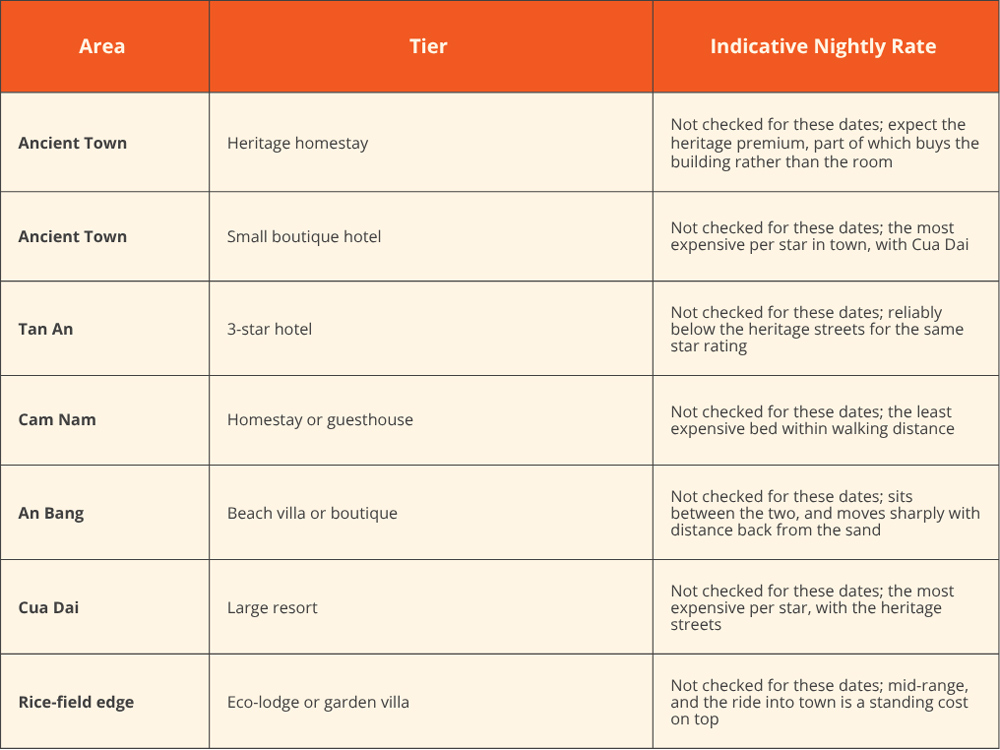
Cam Nam and Tan An are the least expensive places to sleep within walking distance of Hoi An Ancient Town. The heritage streets and the Cua Dai resort strip cost the most per star, and much of that money buys the setting rather than the room.
Rates move constantly, and we would rather leave a cell open than put a number in it you budget around and that turns out to be two years old. No dated rate check was obtainable for this update, so the table publishes the one thing that is stable — the relationship between the areas — and says plainly where a figure is missing.
Worth two minutes on a satellite map before you book An Bang in particular: the difference between a lane one row back from the sand and a lane four rows back is visible, and so is the difference in rate.
Three things push prices up, and all three are predictable.
The full-moon lantern nights. Once a lunar month the Old Town turns off its electric lights for the evening, and rooms in and around the quarter tighten. The dates move against the Western calendar every year, so check them for your month — the full-moon lantern nights has the pattern and what the evening is actually like.
The October-to-December festival season. The awkward one, worth naming because nobody else does: Hoi An's festival season overlaps its flood season. The same weeks that fill the town are the weeks the river is highest. That is not a reason to avoid the period. It is a reason to book off the river frontage rather than on it, and to read section 3 before paying a premium for a riverside view.
Vietnamese public holidays and the domestic summer, which fill the coastal properties first and the Old Town second.
We are not quoting a percentage premium for any of the three. There is no dated Hoi An figure for it, and the one that circulates in our own internal work is a Da Nang number that has not been re-checked in its own city, let alone moved to this one. Confirm against actual rates for your dates. If those dates are flexible by a week and you are not coming for the lanterns, moving them is usually the single most effective change you can make to this budget, and which week to move to is answered in the best time to visit Hoi An.
Booking pages recommend an area without knowing how long you are staying or why you came, which is how a three-night first visit ends up in a rice-field lodge 6 km out with a bicycle and good intentions. For the travelers we design routes for, Hoi An is two to four nights inside a ten-to-fifteen-day Vietnam itinerary, and we are the ones who take the phone call afterward when the area was wrong.
Settle two questions before you look at a single property: how many nights Hoi An gets, and whether the Old Town is the point of the stay or its backdrop. Those two answers decide the area, and the area decides more than the room does. A good room in the wrong area is a worse stay than an ordinary room in the right one, and that is the opposite of how accommodation is usually sold.
Ask us for the Old Town in April and you get the Old Town. Ask for late October and you get Tan An, An Bang, or the Old Town with an instruction about which floor. The request did not change; the ground did.
The reason is the ground rather than the forecast. The room that photographs best is the one nearest the water, which is also the first one affected, and a forecast three months out tells you nothing while the river's season tells you a great deal. So ask any property three things for autumn dates: which floor the room is on, whether the shuttle runs in the wet season, and what they do when the river comes up. A property that has been there for years answers all three without pausing. That is the whole test, and it costs you one message.
The Ancient Town edge, or Tan An immediately outside it. Tan An costs less, has normal vehicle access at all hours, and is still walking distance in.
The Old Town for a first visit of three nights, because everything you came for is on foot. An Bang for a longer stay — and in October and November the beach side is the drier side.
The riverfront Old Town streets go first, Bach Dang before any other, along with Cam Nam and southern Cam Thanh. Tan An and the beach strip are the drier ground.
Not comfortably. At roughly 4–5 km it is a bicycle ride or a taxi, both ways, every evening you eat in town.
So: Ancient Town edge or Tan An on a short first visit. An Bang or Tan An on a longer stay, or on any stay inside October and November. Cua Dai if the resort is the trip and the shuttle is acceptable. Cam Nam if the budget decides and the dates are outside the window. The rice-field edge at five nights and up, with a bicycle habit and no illusions about unlit lanes.
The tension on this page is the whole point of it. Almost everyone picks a hotel and then discovers the area. In Hoi An the area is decided first, whether you meant to decide it or not, and it matters more than the room — because it sets how your evenings work, what the walk home is, and whether the river reaches your lobby.
Tell us the dates you have in mind, how many nights central Vietnam gets, and what you want out of the trip, and we will draft a route you can pull apart — including which area of Hoi An those nights should sit in and why. If your dates fall inside the flood window, we will say so before you pay for a riverside room, rather than after. Our consultants build these routes for a living, around 95% of our guides are local to the region they work in, and we are reachable while you are traveling, not just while you are booking.
The route we run most often is the Best of Central Vietnam route — private, and drafted with you rather than taken off a shelf. If Hoi An is one stop in a bigger plan, Vietnam as a whole is the place to start.
WhatsApp: (+84) 866.22.7878
Email: sales@asiamystika.com
Website: www.asiamystika.com


