 Hotline: +84 866 227 878
- SG$ Singapore Dollar
- A$ Australian Dollar
- £ British Pound Sterling
- C$ Canadian Dollar
- € Euro
- MYR Ringgit Malaysia
- US$ United States Dollar
- đ Vietnamese Dong


 Hotline/Whatsapp: +84 86 622 7878
 Email: sales@asiamystika.com
 About Us
 Destinations
 Travel Styles
 Travel Guide
 Blogs
Blogs

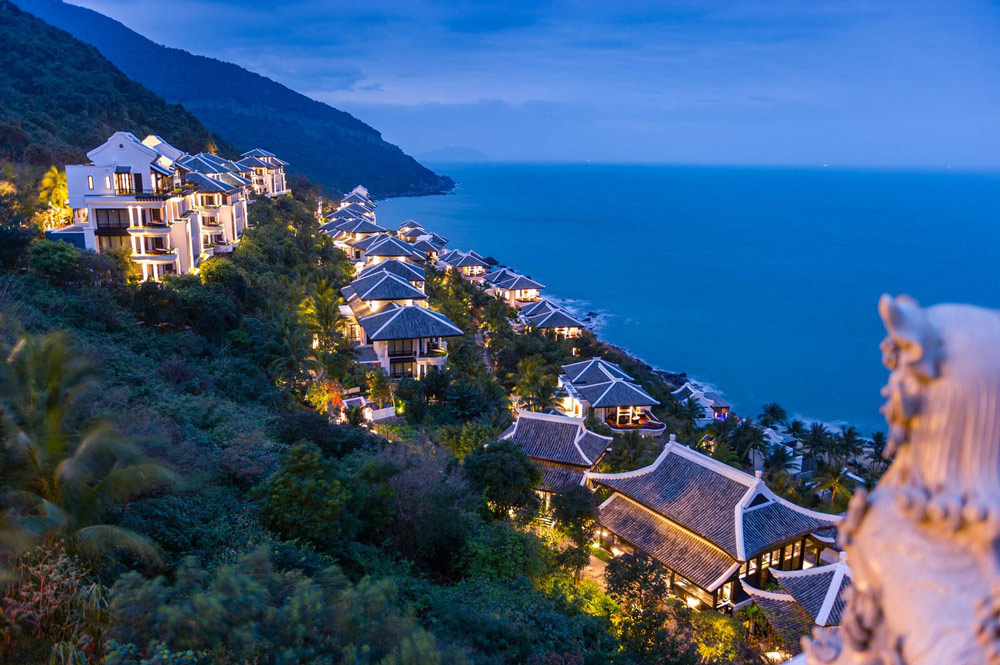
Da Nang's hotels split three ways: luxury beach resorts strung along Vo Nguyen Giap and the Son Tra and Non Nuoc coast; reliable four-star hotels on the beach road and the Han River; and value stays clustered in An Thuong. Which tier is right for you depends less on budget than on how far you are willing to travel for dinner.
Booking sites will tell you what each property is good at. This page also tells you who each one is wrong for — which resorts will bore a teenager, which ones put every meal behind a shuttle timetable, and which upgrade we would not pay for. We book these rooms for travelers most weeks, and the rebooking patterns are visible in a way they are not from a single stay.
Two things to settle before you read the reviews. First, if you have not yet decided which part of Da Nang to base yourself in, do that first — the area decision narrows this list from thirty properties to six. Second, if you are still shaping the wider trip, our Da Nang destination guide sets out what the city is for, which matters because a resort on Son Tra and a hotel on the river produce completely different holidays.
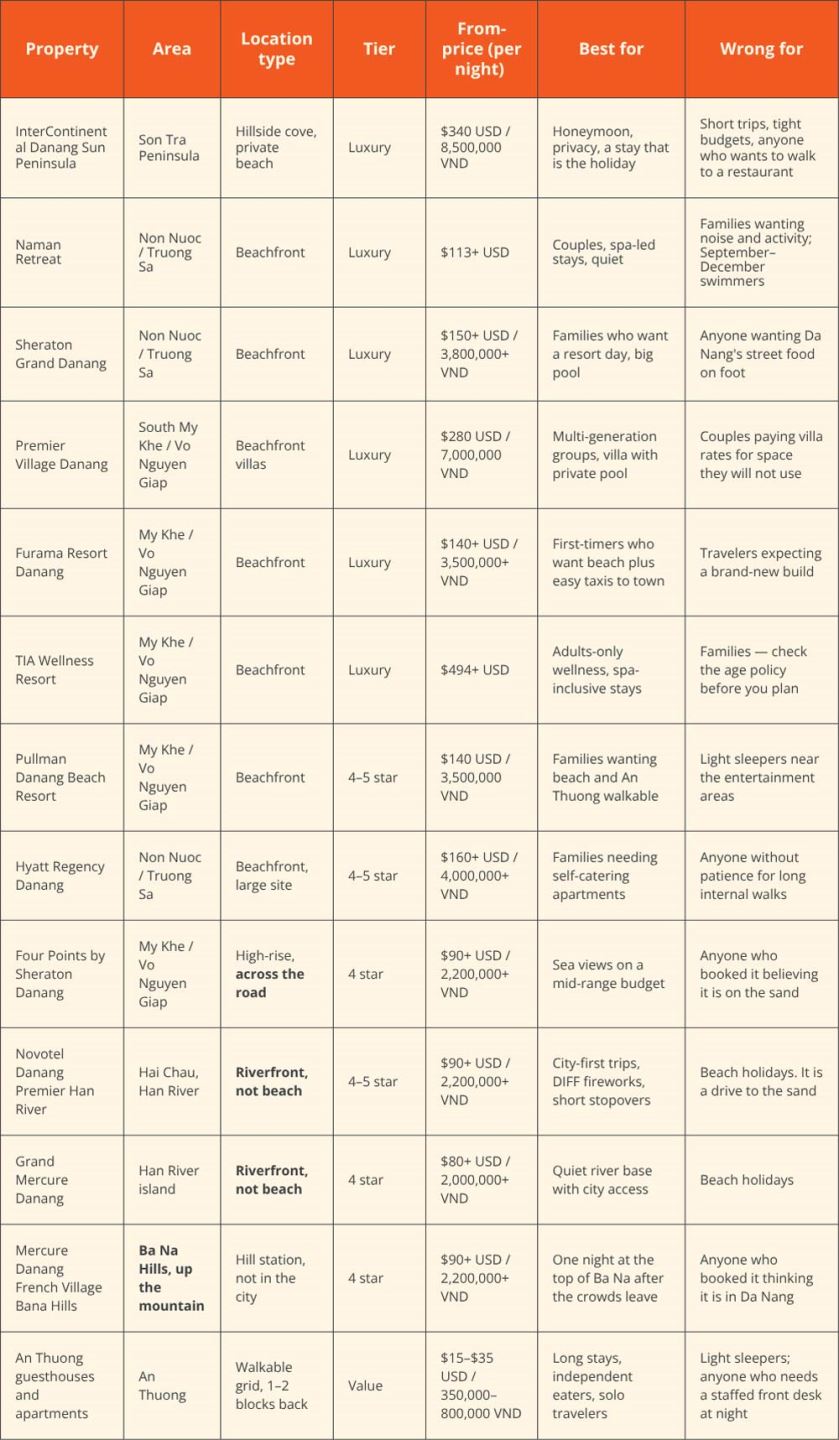
Prices are pending a dated rate pull — see the note above. Star ratings are the properties' own classifications, not ours, and we do not publish review counts or rankings.
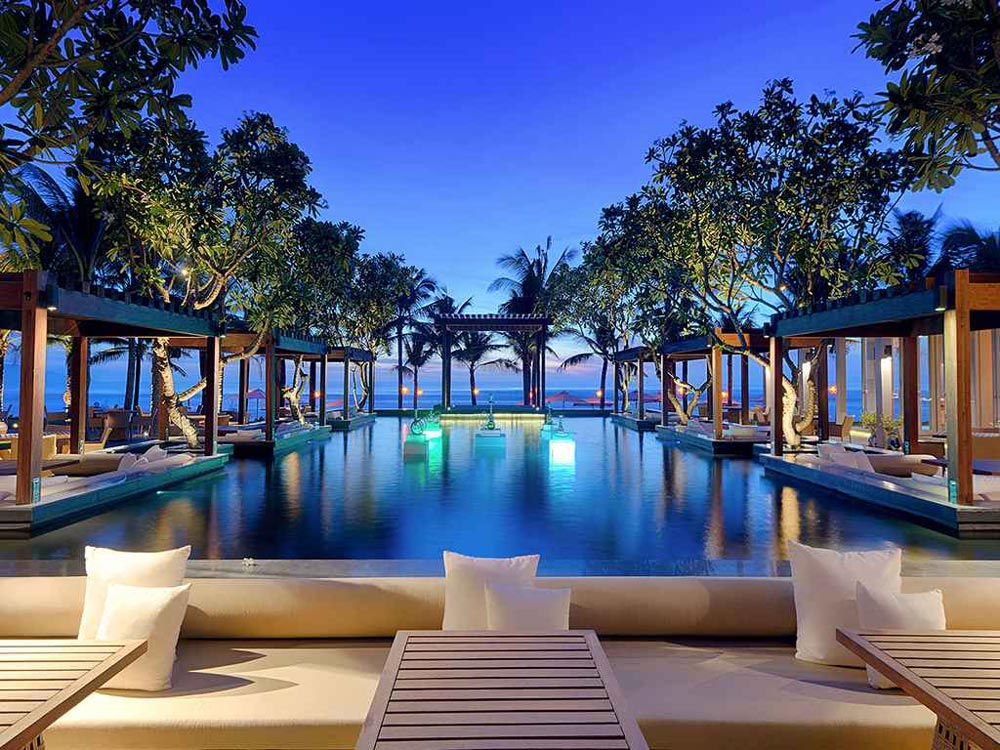
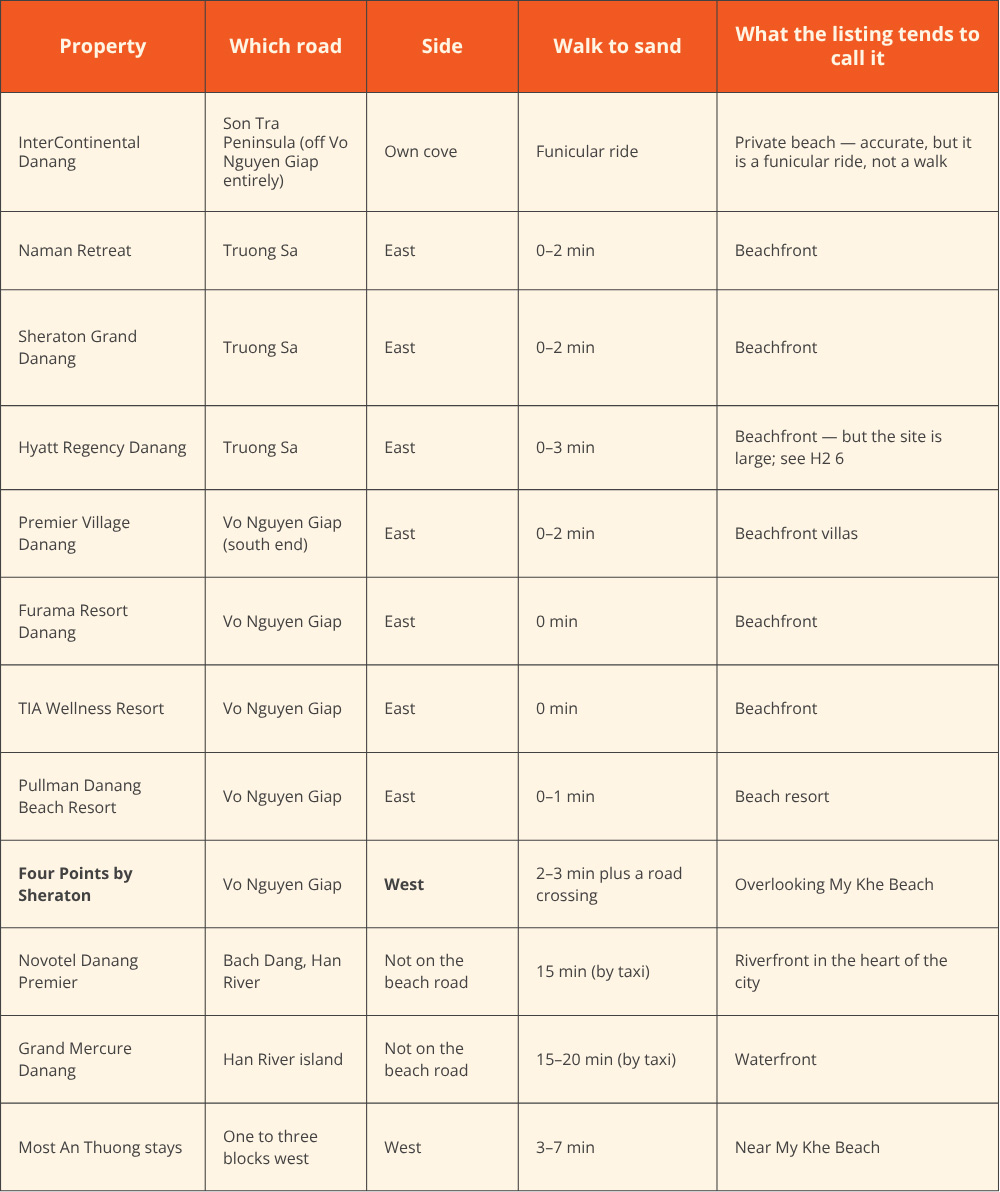
Here is the test, and it works on any Da Nang property you will ever look at.
Find the road. If the hotel sits on the east side of Vo Nguyen Giap — or its southern continuation, Truong Sa — it is on the sand. If it sits on the west side, it is across a four-lane road from the sand, however the listing is worded.
That is the whole rule. It is not a subtle distinction on the ground. The east side means you walk out of the lobby, cross a strip of resort garden, and you are on the beach. The west side means you leave the lobby, wait at a crossing, and cross a busy road with motorbikes on it before you reach anything. With a toddler, a stroller, or a knee that does not like curbs, that is a different holiday.
Listings almost never lie about this. They just use language that does not require them to say it. "Beach access", "steps from the beach", "beachside location", "moments from My Khe" and "sea-facing" are all compatible with being on the wrong side of the road. The only phrasing that commits is direct beach access or private beach, and even then, check the map.
On the beach road, a sea view is a floor question, not a room-category question. Below a certain floor you are looking at the building opposite, the tree line, or the roof of the property in front — and the floor number where the view actually opens up differs by property because the block in front differs. It is exactly the sort of thing to ask us before you pay the upgrade, because we can check the stack rather than the brochure.
Two things that catch people out. Da Nang's beach road has been building upwards for years, so a "sea view" booked on the strength of a photograph taken three years ago may now include a neighbouring tower. And on the high floors of the newer blocks, the view is genuinely wide — but the beach is far enough below that it stops feeling like a beach hotel and starts feeling like a city hotel with a good window.
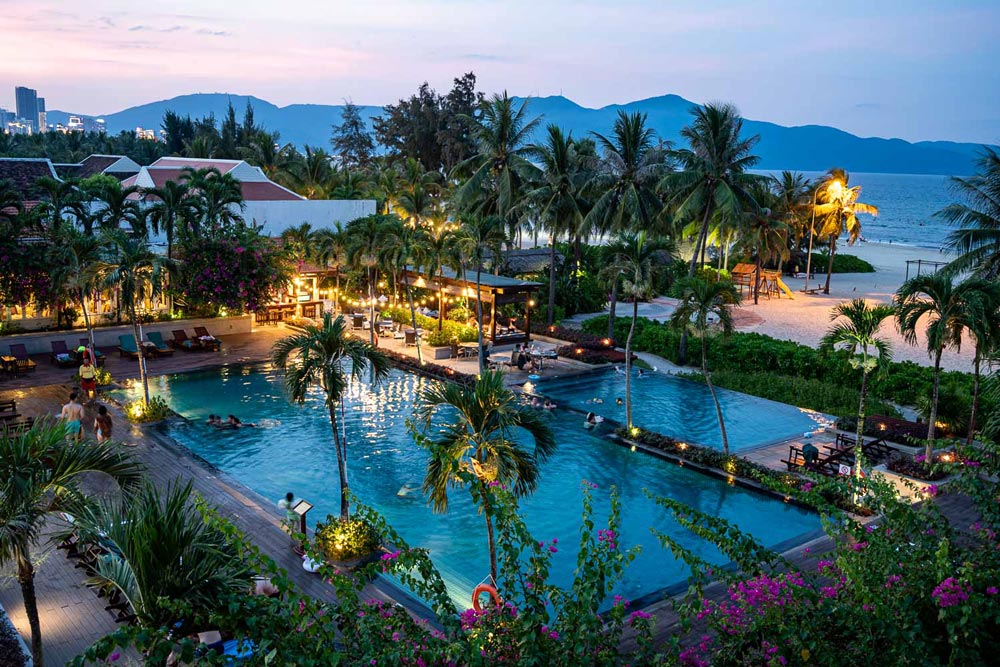
This tier buys you space, service and a private stretch of sand. It does not buy you a location that is convenient for anything except itself. Read every review below alongside H2 6.
Built into a steep cove on the Son Tra Peninsula, reached by a road that climbs away from the city. The site is arranged in tiers down the hillside with a funicular connecting them, and it has its own beach that nobody else can use.
Best for: honeymoon and privacy. If the point of the trip is the resort, this is the clearest expression of that in central Vietnam.
What the photographs do not show: the tiers are steep, and the funicular is the reason they work. When you are between funicular stops, you are on steps. Also, the cove faces the way it faces — the light and the swimming conditions in that bay are not the same as My Khe's on the same day.
Renovation / construction status: No major structural work reported; regular maintenance only.
The long-standing beachfront resort on Vo Nguyen Giap, and the one that sits closest to being walkable to real Da Nang. Mature gardens rather than a new build.
Best for: first-timers who want a beach resort but do not want the city to be a taxi ride away.
What the photographs do not show: it is not a new property, and the gardens that make it pleasant also make it the opposite of minimalist. If you are comparing it against a resort built in the last five years, the room finish is the gap. Some travelers find the age is the charm; some do not, and they should know before booking.
Renovation / construction status: Ongoing periodic room upgrades and interior touch-ups (no major closures; fully operational).
South, on Truong Sa, in the Non Nuoc stretch. Architecturally the most distinctive of the group, and heavily spa-led.
Best for: couples, and anyone whose ideal day is a treatment and a book.
What the photographs do not show: the quiet is real, and it is total. There is very little outside the gate. That is the appeal for one traveler and the problem for another.
Renovation / construction status: No active structural disruptions reported; standard landscaping and minor upkeep only.
A large Non Nuoc beachfront site built around a long pool, with the family facilities that come with a resort of that size.
Best for: families who want to not leave the property for two days.
What the photographs do not show: the pool that photographs so well is long, and long means walking. Also, everything south of An Thuong is a drive from Da Nang's food.
Renovation / construction status: Recently rebranded and refreshed with updated lobby and leisure spaces (fully operational).
Villas rather than rooms, at the southern end of the Vo Nguyen Giap beachfront, many with a private pool.
Best for: multi-generational groups and families who want their own kitchen, their own pool and doors that close.
What the photographs do not show: a two-couple villa is excellent value and a two-person villa is not. You pay for the footprint whether you use it or not. If there are two of you, this is the tier where we would push you towards a suite elsewhere.
Renovation / construction status: Regular cyclical villa maintenance and kitchen fixture upgrades completed (verify prior to booking).
Beachfront on Vo Nguyen Giap, wellness-led, with spa treatments built into the rate rather than sold on top.
Best for: adults traveling to rest, who will actually use the treatments — that is what makes the inclusive rate work out.
What the photographs do not show: the rate only makes sense if you use the spa. Booked as a plain beach hotel, you are paying for something you are not taking. Check the current age and children policy directly — it has been an adults-focused property and the policy as of September 2026 is children of all ages are welcome to stay, though spa facilities and wellness activities have age restrictions (typically guests must be 12 and older for spa access).
Renovation / construction status: Fully operational following its comprehensive post-rebrand transformation; only routine ongoing maintenance applies (verify prior to booking).
For privacy above all, the Son Tra cove. For a spa-shaped honeymoon with a beach you can actually walk out onto, Naman or TIA. For a honeymoon where you want dinner somewhere other than your hotel more than twice, none of the above — book Vo Nguyen Giap north of An Thuong and accept a slightly less dramatic setting in exchange for a city you can reach.
The honest version: several couples we book are happier at a four-star on the beach road with the saving spent on two nights somewhere else in Vietnam than at a five-star cove they never leave. That depends entirely on whether the resort is the holiday or the base.
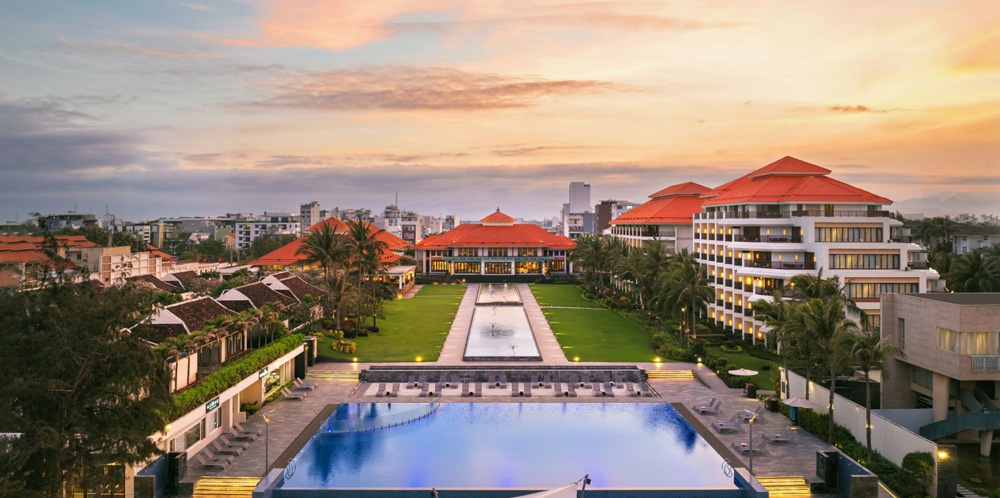
The tier where location errors cost the most, because the properties are spread across three completely different parts of the city. State the location type before anything else.
On the east side of Vo Nguyen Giap, close enough to An Thuong that you can walk out to dinner. This is the combination most travelers say they want and few book, because it does not photograph as dramatically as the southern resorts.
Wrong for: light sleepers in the rooms nearest the entertainment and pool areas — ask for a quiet allocation at booking, not on arrival. What the photographs do not show: the property layout places certain rooms and garden areas close enough to active local beachfront venues and the resort's open social hubs that ambient evening sound can carry, making room placement critical for light sleepers..
Non Nuoc beachfront, with both hotel rooms and serviced apartments. The apartments are the reason to choose it: a kitchen changes a family trip.
Wrong for: anyone who dislikes long internal walks, and anyone who wants to eat outside the resort without a car. What the photographs do not show: the sprawling, campus-like scale of the resort, meaning rooms in the outer residence blocks require a lengthy walk across the grounds to reach the main pools, restaurants, and beach.
A tower on the west side of Vo Nguyen Giap. The views are genuinely good and the rooftop is a real asset. It is not a beach hotel.
Wrong for: anyone who booked it as beachfront. That is not a small disappointment when you are carrying beach kit across four lanes twice a day with children. What the photographs do not show: the crossing. Listings photograph the view out, not the walk down.
On the Han River in Hai Chau, in the city rather than at the beach. Excellent for a short stop, for a business-shaped trip, and for DIFF, when the fireworks launch from the river.
Wrong for: a beach holiday. It is a drive to the sand every day. What the photographs do not show: during DIFF the riverfront is closed off and extremely busy on show nights. That is the reason to book it and also the reason not to.
On an island in the Han River. Quieter than the Bach Dang strip and still close to the city.
Wrong for: anyone expecting to walk to a beach. What the photographs do not show: its location on Green Island (Dao Xanh) means that while it is surrounded by the calm waters of the river, it sits within a quiet, somewhat isolated residential enclave rather than right on a bustling urban street or walkable commercial strip.
This is not a Da Nang city hotel. It sits at the top of Ba Na Hills, roughly an hour out of the city and up a cable car. Booking it as a city base is the single most common accommodation mistake we correct.
Best for: exactly one thing — staying overnight at the top so you have Ba Na before the day crowds arrive and after they leave. That is a genuinely good reason to book it, for one night. Wrong for: everything else. There is no beach, no city, and no leaving after the last cable car.
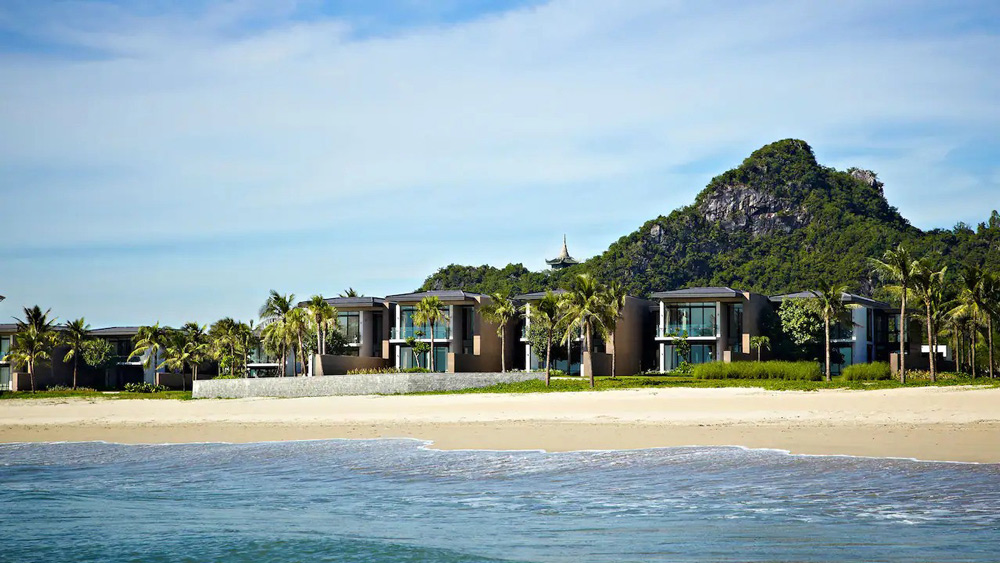
Value in Da Nang concentrates in An Thuong, the grid of small streets a block or two behind the southern end of My Khe, and in the older city center around Hai Chau. This is where cheap hotels in da nang vietnam actually leads, and for a lot of travelers it is the correct answer rather than the compromise.
What you get. Small hotels and apartment blocks a short walk from the beach, rooms at a fraction of the beach-road rate, and — the real argument — you are inside the restaurant district rather than commuting to it. The perks that travelers mention unprompted are concrete ones: free bicycles, a genuinely useful breakfast rather than a token one, a small rooftop pool, and staff who will handle a laundry or a visa question without a service charge.
What you give up, plainly:
For long stays of a month or more, the value tier is where the maths works, and monthly rates are negotiable in a way nightly rates are not. Rates: typically $300 to $700 USD (7,500,000 to 17,500,000 VND) per month for a furnished studio or 1-bedroom apartment in the An Thuong grid, depending on building age and amenities.
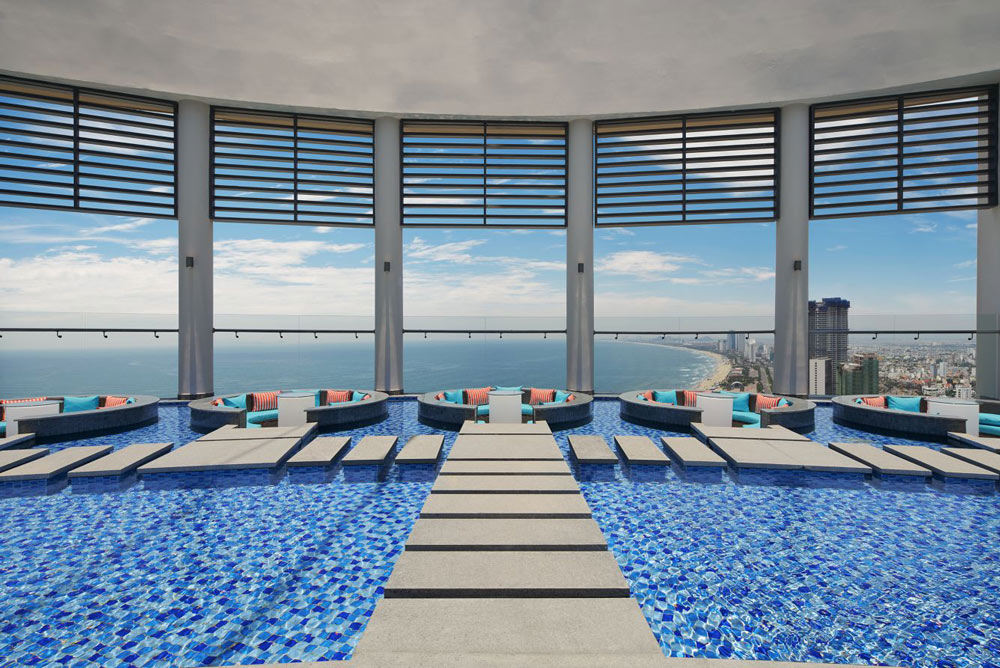
This is the section booking sites cannot write, so read it before the price comparison rather than after.
The large southern resorts — Non Nuoc and Truong Sa — market hard to families and several of them are hard work with young children. The problems are consistent:
If you have two or three nights in Da Nang, do not book Son Tra or Non Nuoc. On those sites every meal outside the resort is a taxi each way or a shuttle timetable, and on a short stay the transit eats the trip. The InterContinental cove and the far southern resorts are three-night-minimum properties. Book them for four nights or book the beach road instead.
How many nights Da Nang justifies in the first place is a separate question, and it changes this answer completely — see how many nights Da Nang is worth.
Ask these four questions of any property before booking, because the brochure answers none of them:
We check these for travelers who tell us mobility matters, and the answers differ enough between properties in the same star band to change the recommendation.
This is the one that turns an expensive booking into a bad one. From roughly September into December, the sea off Da Nang gets rough, red flags go up, and on some days the beach is closed to swimming altogether. October and November also carry the typhoon and heavy-rain risk for central Vietnam.
If your holiday is the beach, a beachfront resort in those months is the wrong booking, not a discounted one. The saving is real and so is the reason for it. Check the conditions for your dates against when Da Nang's beaches are actually swimmable before you commit, and consider whether a river or city hotel with a good pool is a better use of the money.
In the June–August peak and across DIFF, some of the beachfront five-stars price at a level where we would rather move the traveler than book them. What we do instead, in order:
Named properties and the peak figures that trigger this: InterContinental Danang (exceeding 12,000,000 VND / $480+ USD per night for entry rooms) and Premier Village or Sheraton Grand (exceeding 8,000,000 VND / $320+ USD per night during peak summer weekends and DIFF fireworks events).
Every figure in this section is provisional pending a dated rate check. The numbers previously on this page are more than a month old and were flagged for verification when written. We will show you the old one that can help you plan around.
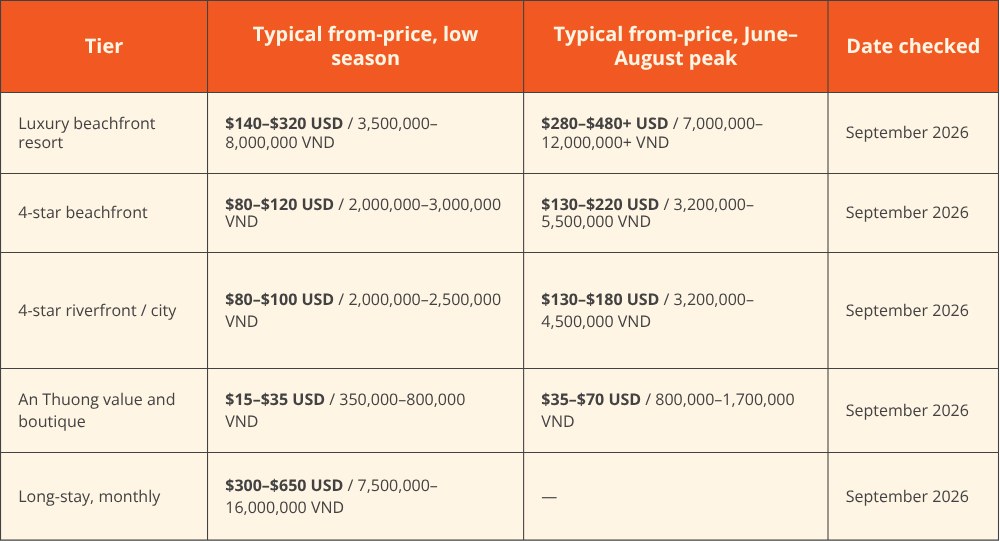
The two spikes. Rates rise across the June–August domestic summer peak, and again around DIFF, the fireworks festival, which hits the riverfront properties hardest because that is where the show is. The percentage premium for each: 30% to 50% across general summer peak weeks, surging by 100% to 200% (doubling or tripling baseline rates) for prime riverfront properties during high-demand DIFF fireworks nights. The figures on the previous version of this page were unverified and have not been carried over.
For the months where the rate and the weather are both in your favour, see the cheapest months to visit Da Nang.
What is and is not in the rate. At every tier, check four things: breakfast (often included at four-star, often not in the lowest luxury rate), club or executive lounge access, the airport shuttle, and whether a service or resort fee is added at checkout. The last one is the one that surprises people.
Da Nang airport is unusually close to the city, which is why so many properties can offer a transfer at all — and why paying for a private car is not expensive if the free option does not suit.
Before the table, the thing worth knowing: "free shuttle" almost never means a car when you want one. In practice it means a fixed timetable published at the front desk, seats allocated first-come, no guarantee on a full day, and a last return that is often earlier than dinner ends. If you land late, or you are traveling with a lot of luggage or small children, a private transfer you pay for is usually the better call even at a property that offers the free one.
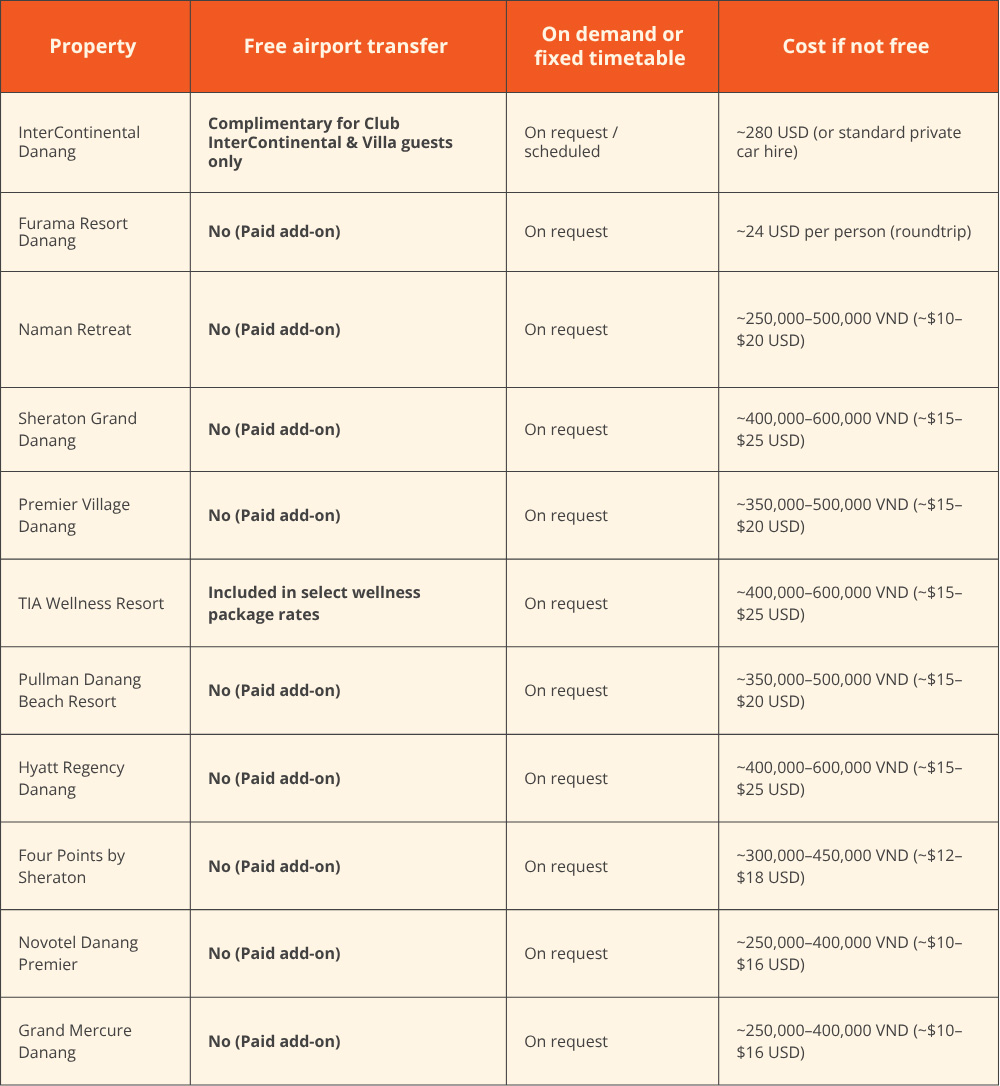
Transfer terms change more often than room rates, so this table needs a per- property confirmation rather than a copy from a listing. If your arrival is awkward, tell us the flight number and we will arrange the transfer as part of the trip rather than leaving you to the timetable.
The most useful thing we do on a Da Nang booking is usually not finding a cheaper hotel. It is moving the dates.
Shift a trip two or three weeks off the June–August peak and the same room drops by enough to fund a real upgrade — a beachfront room instead of a garden view, a villa instead of a suite, or two extra nights. The weather in the shoulder weeks is close to identical; the price is not. If your dates are flexible at all, ask what the same room costs a fortnight either side before you book anything. This is where the negotiated rates we hold through hotel partnerships do the most work, because the saving compounds with the seasonal one.
The limit on the trick: it does not work into September. Past the shoulder, the saving is the sea getting rough, and that is a different trade.
"The upgrade people ask for is the sea view. The upgrade that changes the holiday is the room's position on the site — how far it is from the pool, the restaurant and the sand. We would take a garden room near everything over a sea-view room at the far end, and travelers almost never think to ask for it." — the view from our consultants, who book these properties every week
Applied to the tiers on this page:
Asia Mystika has been booking these properties since 2020, and across 25,000+ individual travelers the pattern that shows up is not in any single review: which properties get requested again by name, and which produce a message on arrival day. We are an agency with partner relationships — we do not own or run any hotel on this page, which is precisely why we can tell you when one is not worth the money.
Specific properties on both sides of that pattern: Furama Resort Danang and An Thuong guesthouses/apartments consistently generate repeat requests by name for their location and authentic local integration, whereas isolated luxury or mid-tier high-rises across the road from the beach frequently produce arrival-day messages regarding noise, unexpected room finishes, or distance from dining.
Dietary, religious and allergy requests are the other thing that separates these properties in practice, and it is invisible on a listing page. Whether a halal or strictly vegetarian breakfast is genuinely available, or produced reluctantly on request, varies more than the star rating does.
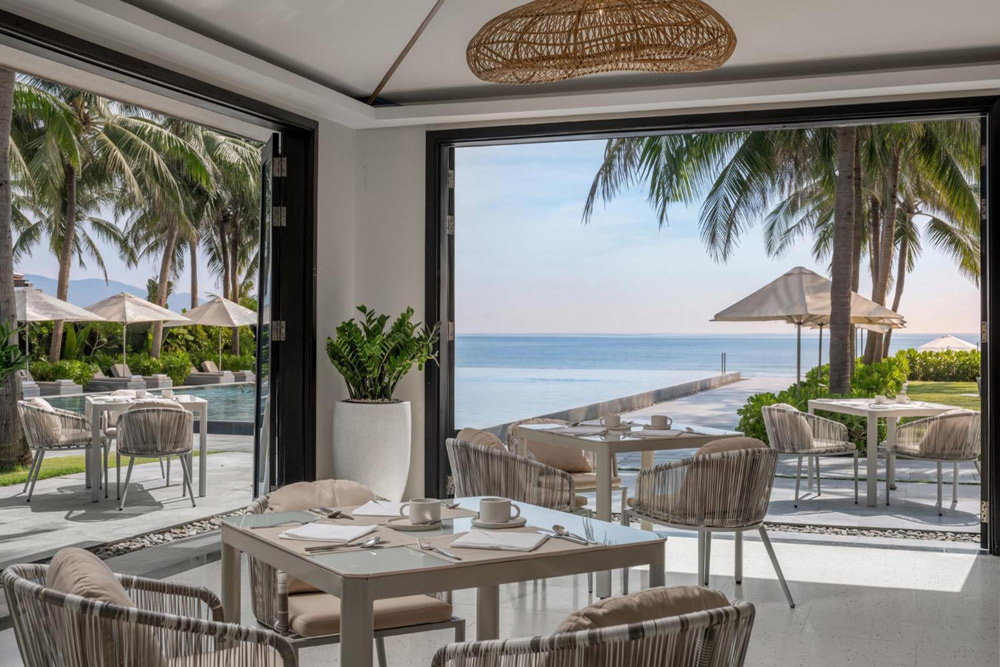
Yes — it is on the east side of Truong Sa with direct beach access. The qualification is size: it is a large site, so the walk from some room blocks to the sand is longer than the map suggests. Distance: 3 to 7 minutes on foot depending on your exact room block.
Anything on the east side of Vo Nguyen Giap or Truong Sa. Four Points by Sheraton and most An Thuong stays are on the west side and involve a road crossing, regardless of how the listing is phrased. Full table in section 2.
For a resort-day family, a large beachfront site with a proper children's pool and a kitchen option — Hyatt Regency's apartments and Premier Village's villas are the two structures that work best. For families who want to eat out, Pullman on Vo Nguyen Giap near An Thuong beats anything further south.
The isolated southern and peninsula properties, unless you are staying four nights or more. Long internal walks, adult-shaped pools and nothing a small child will eat after the buffet closes are the recurring three, and all of them are predictable before you book.
Some do. A free shuttle almost always means a fixed timetable with seats first-come rather than a car on demand, and the last return is often earlier than you want. Only select VIP or villa tiers include complimentary transfers (such as Club InterContinental or specific TIA wellness packages), while standard bookings across all listed resorts require a paid add-on or private car arrangement — see section 7.
The low-season months are cheapest, and from September into December the reason is that the sea is rough and the beach may be under red flags. The genuinely good value sits in the shoulder weeks either side of the summer peak. Dated figures: October and November offer the lowest rates, with 5-star beachfront rooms dropping 35% to 45% below peak summer prices (averaging around $140–$180 USD / 3,500,000–4,500,000 VND per night), though shoulder weeks in February and March provide the ideal balance of lower rates and good weather.
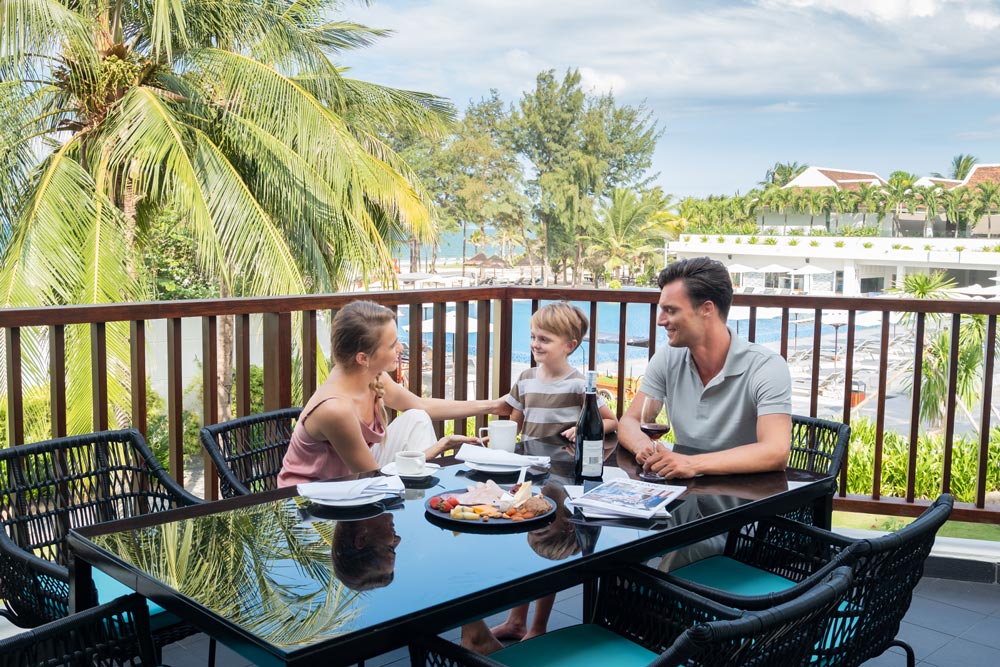
If you want to leave this page with two or three names rather than thirty tabs:
Da Nang is usually two or three nights inside a longer route rather than a destination on its own, and the hotel choice looks different once you know what comes before and after it — our Bests of Vietnam 15-day tour shows where the Da Nang nights normally sit and what they are doing there.
Tell us your dates and what you actually want out of the trip — beach, food, kids, quiet, a knee that objects to steps — and we will shortlist two or three properties against real availability and the rates we hold through our hotel partners, then say plainly which one we would book and why the others are wrong for you. Free quote, no obligation. Email sales@asiamystika.com or reach us on WhatsApp at +84 866227878.
