 Hotline: +84 866 227 878
- SG$ Singapore Dollar
- A$ Australian Dollar
- £ British Pound Sterling
- C$ Canadian Dollar
- € Euro
- MYR Ringgit Malaysia
- US$ United States Dollar
- đ Vietnamese Dong


 Hotline/Whatsapp: +84 86 622 7878
 Email: sales@asiamystika.com
 About Us
 Destinations
 Travel Styles
 Travel Guide
 Blogs
Blogs

Yes. Hoi An's Old Town floods most years, and October and November carry the highest risk — those two months take 40 to 50% of the river basin's entire annual rainfall. Rain is not the issue; the Thu Bon coming up is. The worst in about sixty years was October 2025. Most trips inside the window are still worth taking. This page covers which are not.
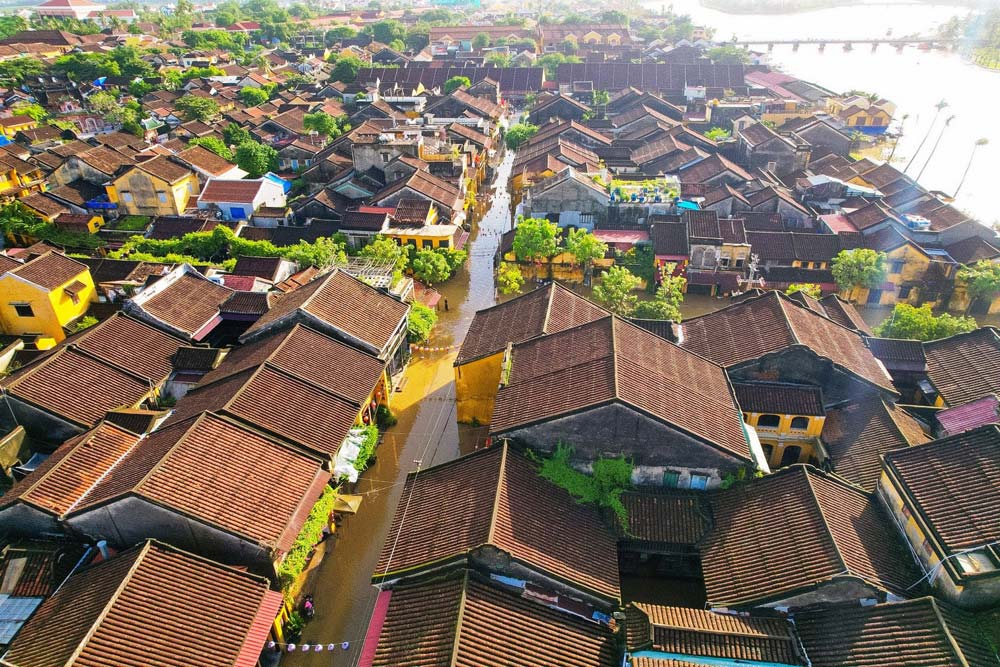
The Old Town sits low, on a river, a few kilometers from the sea. It floods. Not as a disaster story every few years, but as a normal feature of the autumn wet season, and the people who live and trade there plan around it. That is the fact almost nothing else ranking for this question will say plainly, because saying it costs bookings.
Three readers arrive at this page and there are three different answers.
This page will tell you when not to come. Every commercial site ranking for "hoi an flooding" has a reason to soften that, and most of them do. We would rather move your dates than sell you a week you regret, so the rest of this is written the way we would say it to you on a call.
The rainy season starts in September, floods themselves run October to December, and the peak is October and November. That is the published record for the Vu Gia–Thu Bon, the river system Hoi An sits at the bottom of, and here is what each part of it rests on:
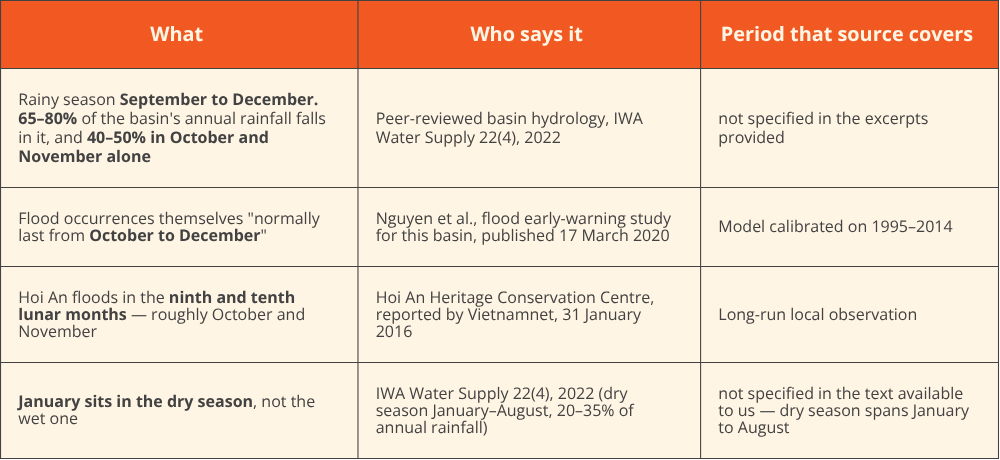
That 40–50% figure is the one worth carrying away. Two months out of twelve taking close to half the year's rain is why Hoi An's flood season is short, sharp and predictable in its timing even when it is unpredictable in its severity.
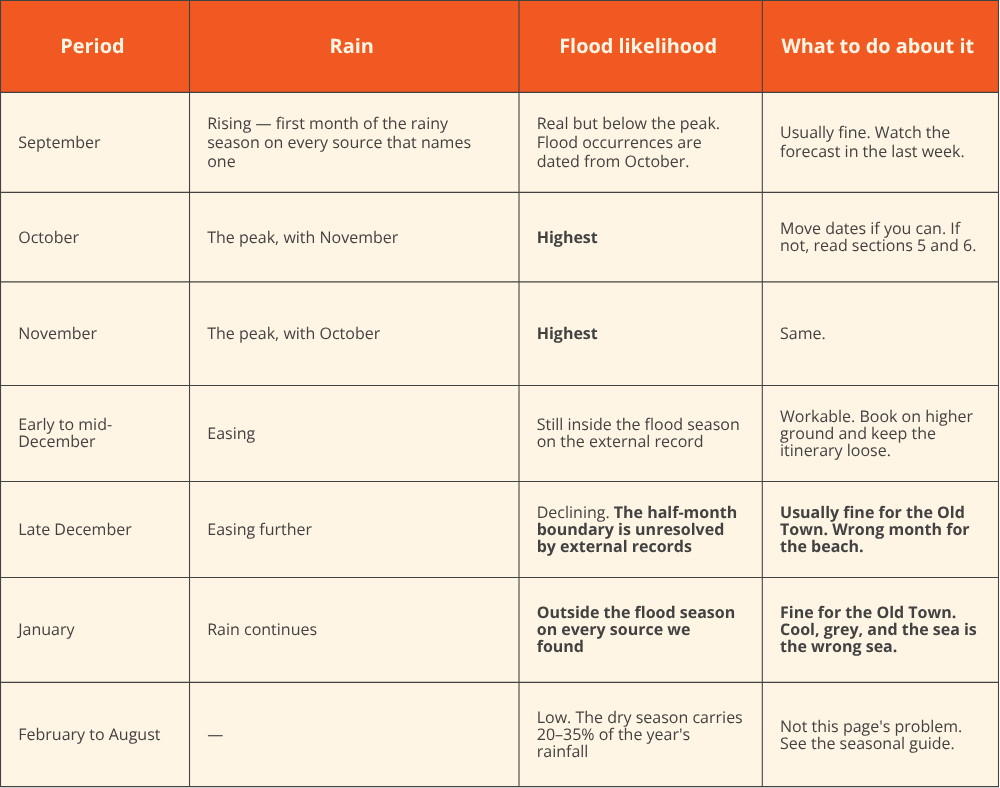
Two of our own internal sources disagreed about the edges of this window, and the external record backs a different one of them at each end. We are saying which, because a page that quietly picked a side would be doing the thing we are criticizing everyone else for:
Vietnam did not submit to the World Meteorological Organization's 1991–2020 Standard Normals, which we checked directly against the NOAA archive on 8 September 2026 — there is no Vietnam folder in it. So no authoritative station normal for this coast is publicly available, and the commercial weather sites that publish one disagree with each other by roughly 420 mm on the annual total and cannot even agree whether October or November is the wettest month. Every one of them is uncited. If you have read a confident millimeter figure for Hoi An somewhere, that is where it came from.
What to check instead: Vietnam's National Center for Hydro-Meteorological Forecasting publishes current river levels and warnings, and your own government's travel advisory covers disruption. Both are worth more than any monthly average, including one we could have put here.
For the rest of the year, our seasonal guide to Hoi An takes the same window and the same sources and puts them beside the heat, the sea and the crowds.
Every page ranking for this query collapses these into "rainy season". They are completely different problems.
Rain. Most days inside the window. Warm, heavy, often over in an hour. It is a nuisance and it changes nothing about whether you should come.
Street flooding. Water standing in the low Old Town streets and along the riverfront for hours, occasionally a day or two. Common. It changes what you can do on a given day. It does not usually change whether the trip works.
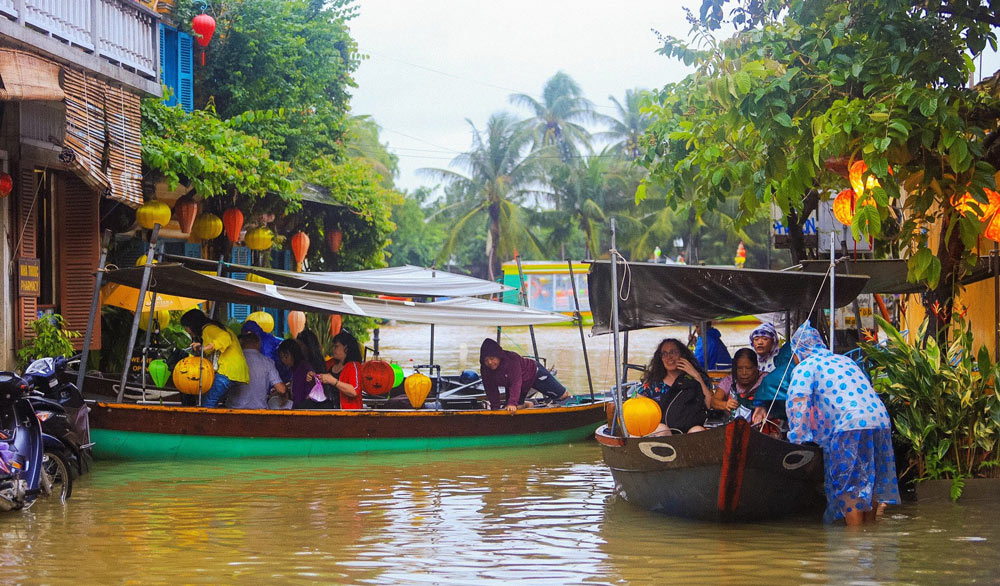
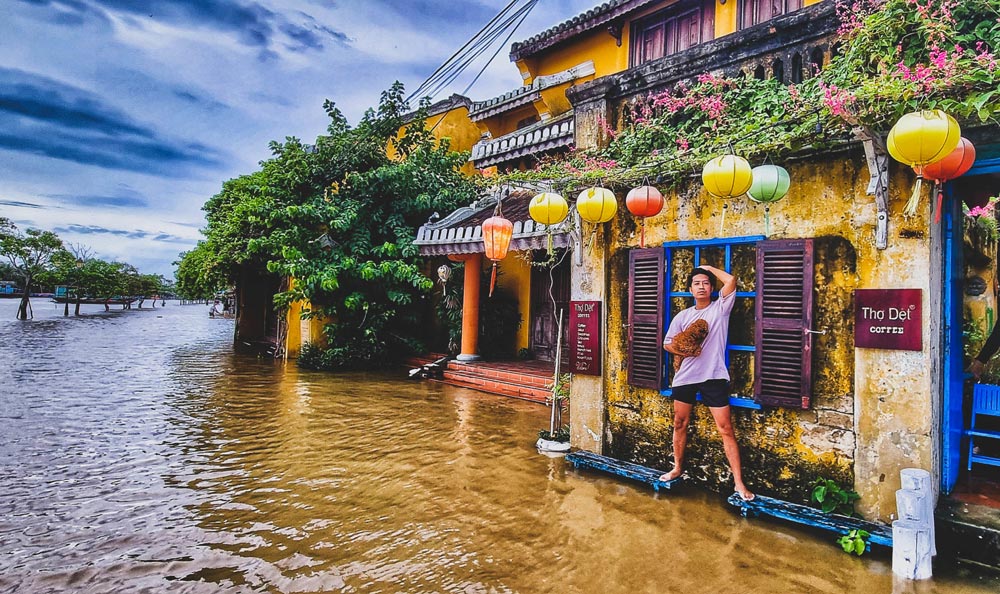
A real flood. The Thu Bon up, boats where people normally walk on Bach Dang Street, ground floors cleared out, businesses shut, and it lasts days rather than hours. This happens most years, and it is what people are actually searching for when they type "hoi an flooding".
A typhoon making landfall. Rare, separate, and the only one of the four that touches flights. A flooded street does not cancel your plane. A typhoon can.
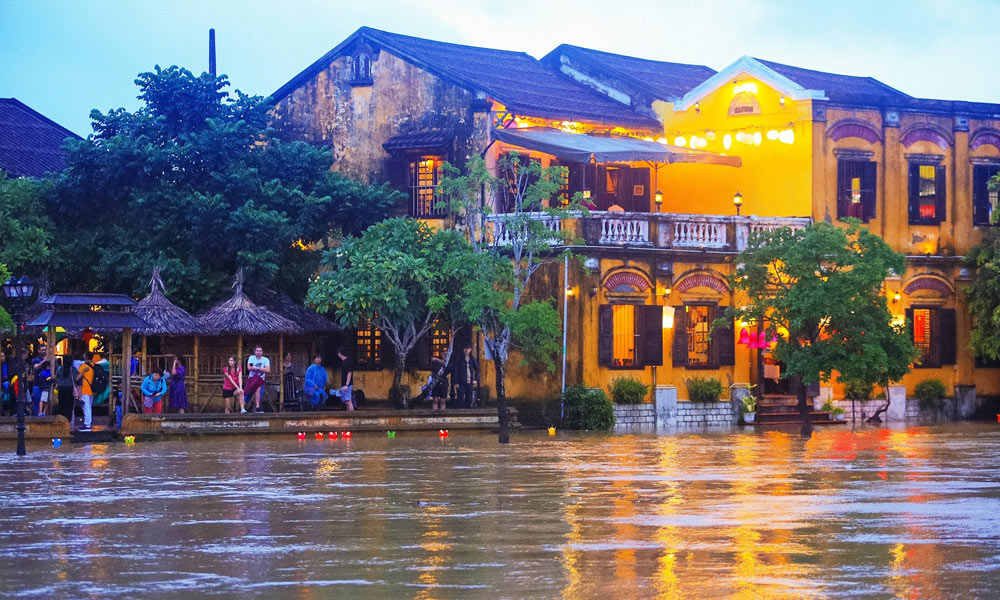
Read a photograph of boats in the Old Town as evidence of the third state, not the second, and not of a once-in-a-decade catastrophe either.

The useful question is not how much water. It is what stops working.
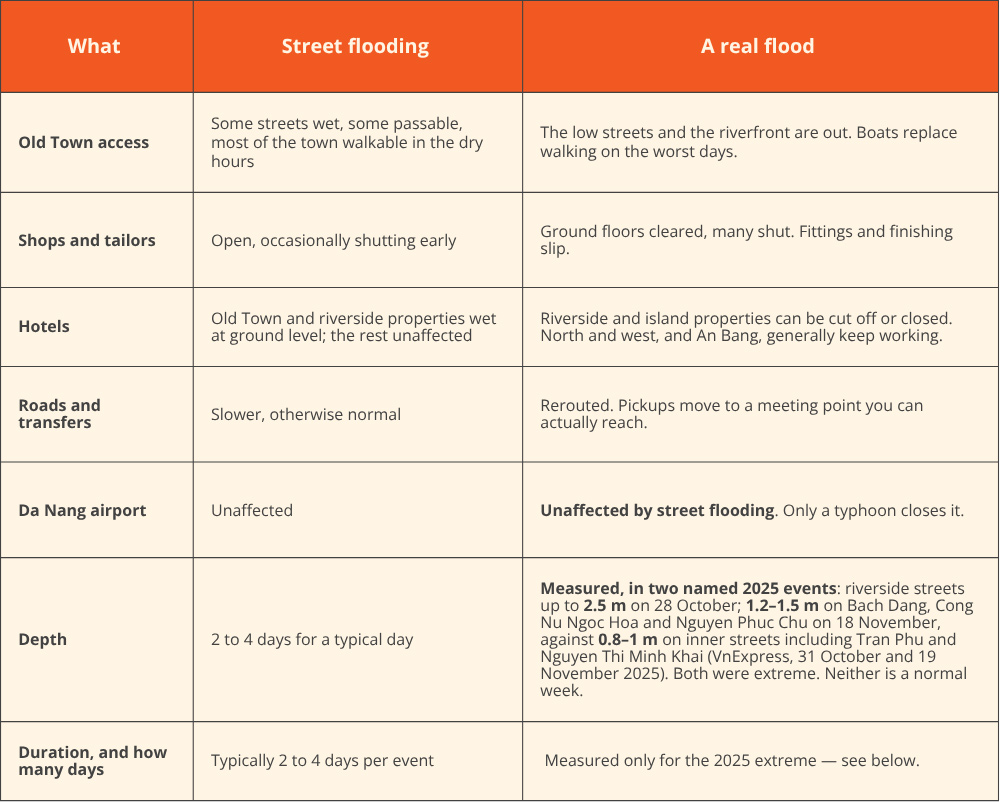
The Old Town is the flood zone. That is not incidental — it is the whole reason this question matters. The ticket booths, the approach to the Japanese Covered Bridge, the riverside restaurants and the market all sit in the low ground beside the Thu Bon. When the river comes up, the part of Hoi An you came to see is the part under water. Whether the booths operate during a flood is suspended or relocated to higher ground; ask at your hotel on the day. For what is there when the streets are dry, our destination guide to Hoi An Ancient Town covers it properly.
Tailors close, and orders stall. This is the consequence nobody writes about and the one that catches people out. Hoi An tailoring runs on a two-or-three-day cycle of fitting, adjustment and collection, and that cycle is completely dependent on a shop being open and a person being able to walk to it. If you have three nights, a suit on order and a flood in the middle, you do not get the suit.
And the part that catches people out twice: a shop does not reopen the moment the water goes. After the October 2025 flood, ground floors in the Old Town were left with 20 to 30 cm of mud in them (VnExpress, 31 October 2025), and shifting that is a day's work before anyone opens a door. Budget the recovery, not just the flood.
If tailoring is a reason you are coming, either give the order more days than you think it needs, or place it on the dry side of your trip. Our guide to how Hoi An tailoring actually works covers the process; the timing risk is this page's.
Boats are a novelty for one afternoon. On a real flood day, locals run small boats through the Old Town streets and will charge a visitor to ride one. It photographs well. It is also somebody's flooded home, and by the second day it is transport rather than an experience. Take the ride once if it appeals. Do not build a trip around it.
Transfers still run. The 30 km between Da Nang and Hoi An is not usually the problem; the last few hundred meters to a riverside hotel is. Expect a changed meeting point rather than a canceled car. How the connection normally works is in our guide to the Da Nang to Hoi An transfer.
Flights are a separate question. Street flooding in Hoi An has nothing to do with Da Nang International Airport, 30 km away. Typhoons do, and Da Nang has its own weather pattern and its own timing — Da Nang's own weather and typhoon window is the page for that, not this one.
My Son is an outdoor site on low ground reached by road. In heavy rain it is unpleasant; in a flood it may not be reachable at all. Keep it flexible rather than fixed to one morning.
The honest answer to "how bad" is the autumn of 2025, and any page on this subject that has not been updated for it is out of date.
Between 26 and 31 October 2025 the Thu Bon rose to 5.62 m at the Cau Lau gauge just upstream of Hoi An, at 02:00 on 30 October — 14 cm above the 1964 benchmark of 5.48 m, and the highest reading in roughly sixty years. That is from the AHA Centre's flash update and from VOV, both on 30 October 2025 and both citing Vietnam's National Center for Hydro-Meteorological Forecasting. The Old Town went waist-deep. Around 40,000 tourists were moved between hotels, and 35 people died across central Vietnam (AFP and Gulf News, 30–31 October 2025). It is not a travel inconvenience story for the people who live there, and we are not going to write it as one.
One distinction almost every report of this flattened, and it is worth keeping: the record broke upstream, not in the town. The gauge in Hoi An itself peaked at 3.39 m the same morning — one centimeter below its own 1964 mark of 3.40 m. So 2025 was the biggest flood this river basin has seen in sixty years and, measured at Hoi An's own gauge, fractionally short of the biggest flood Hoi An has seen. Both statements are true. They usually get reported as one.
Water stayed above alarm level 3 for 60 to 73 hours across the Huong, Vu Gia and Thu Bon systems (NCHMF via VOV, 30 October 2025). The river had dropped back by the morning of 31 October. Then it happened again — the Old Town flooded a second time within a fortnight and a third time on 18 November 2025 (VnExpress, 19 November 2025). Three floods in three weeks.
The other half of the picture is what survived. UNESCO's review the following year found the 1,155 heritage sites inspected after the floods structurally intact, with dozens showing degradation (UNESCO, published 6 May 2026, updated 9 June 2026). The town took the worst water in sixty years and is still standing and still working, which is the part the photographs do not carry.
What 2025 is not is a forecast. It was an exceptional year, and three floods in three weeks is not a normal autumn. How often Hoi An floods in an ordinary year, and how long an ordinary flood lasts, is uncalculated or absent on this page and stays unverified. The frequency figure you will find repeated across the travel sites ranking for this question traces back to a single uncredited newspaper sentence. We would rather tell you we do not know than pass it on.
We move people off October and November.
Not off the whole wet season, and not off Hoi An. Off the two months that take 40 to 50% of the basin's annual rainfall between them and that the flood literature and the town's own heritage office both name as the peak. September is wetter than people expect but sits ahead of the flood season proper; December is inside it but declining.
The finer answer — whether it is a specific fortnight inside those two months rather than the whole of both — is unsupported by available data. No published source we could find resolves this window to half a month, in either direction, and we would rather say so than name weeks we cannot evidence. A reader rebooking flights deserves better than a confident guess dressed up as precision.
Who should move, and who should not. Two nights in Hoi An, the Old Town as the only reason for them, and no slack anywhere in the trip: move. A ten-day central Vietnam leg with Hue, Da Nang, the coast and a couple of soft days in it: do not move. The second trip absorbs a bad forty-eight hours without noticing. The first one is the bad forty-eight hours.
The trade you are actually making is smaller than it feels. Shifting a Vietnam itinerary two or three weeks later usually costs nothing but a few emails, and it buys a materially better week. People resist it because the dates feel decided. They are rarely as decided as they feel, and this is the single most valuable conversation we have with clients in the autumn.
And the sentence nobody else on this page's search results will write: if the Old Town is the only reason you are coming, and your dates are locked inside the peak, do not sleep in Hoi An. Base yourself in Da Nang or on the coast, day-trip in when the water allows, and spend the rest of the time somewhere the weather is not deciding your itinerary. You lose the evening Old Town, which is a real loss. You do not lose the week.
What is genuinely good about coming anyway. Not consolation — actual advantages. Rates are lower and rooms are available at properties that are impossible in March. The town is quieter than it ever is in the dry season, which is worth more in Hoi An than almost anywhere else in Vietnam. Cooking classes, tailoring and the museums run normally on dry days, and there are more dry days inside the window than the phrase "rainy season" suggests. And the full-moon lantern nights fall inside it — the full-moon lantern nights are one of the few things about Hoi An that are better in the autumn than in the spring.
If you are reshaping a central Vietnam route around this, our Best of Central Vietnam route is the shape most of these conversations end up at, and the Hue and Hoi An pairing is the two-city version when the Hoi An nights need to shrink.
This is the one decision that changes your trip most, and it is missing from every Hoi An accommodation guide we have read. They all organize by area. None of them says which of those areas floods.
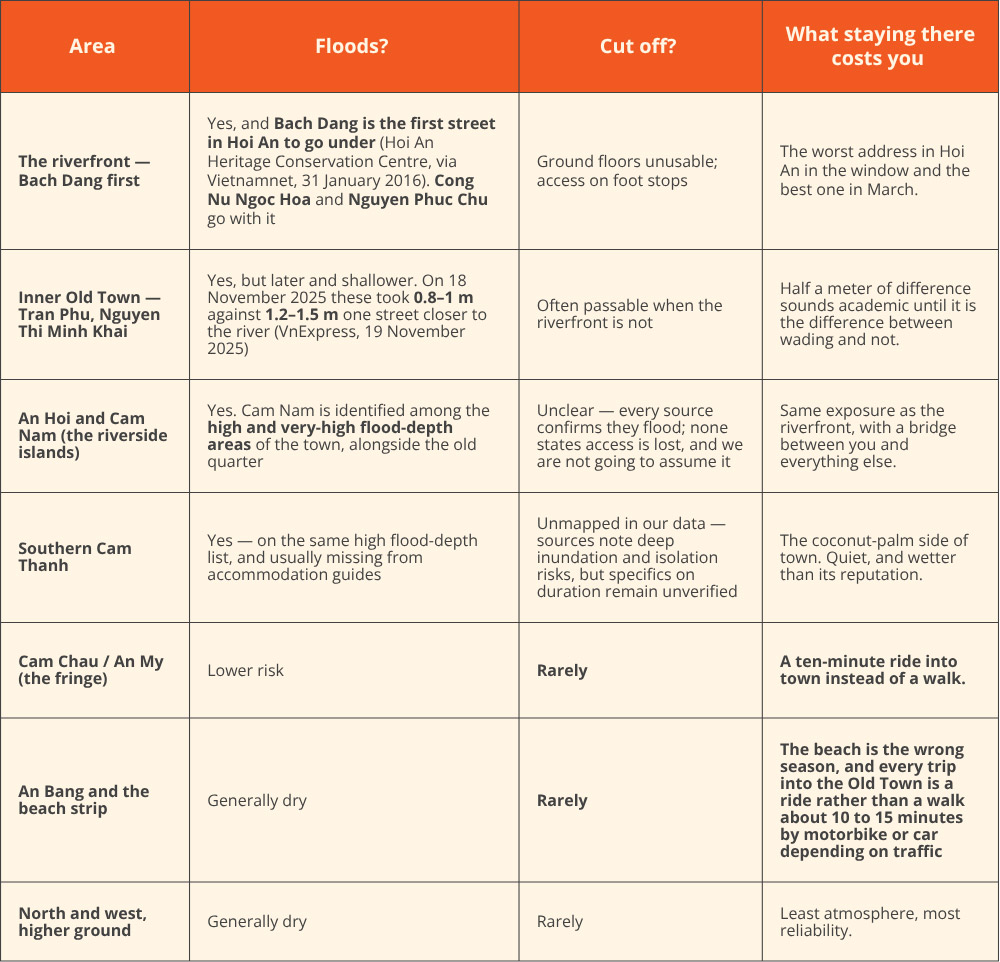
The flood-depth mapping for Cam Nam, the old quarter and southern Cam Thanh comes from a peer-reviewed remote-sensing study of flood inundation across Hoi An's heritage area, published in 2023 and built on 2021 Sentinel-2 satellite imagery. The street-by-street depths above are measurements from two 2025 events, not a normal year.
Two things to add to that table.
Ground floor versus first floor is a real question in the window, not a preference. If you are booking Old Town or riverside between October and November, ask for a room above the ground floor and ask what the property does when the river comes up. A hotel that has been there for years will answer that question immediately and without embarrassment. One that gets defensive about it has told you something.
The riverside view room in November is a trap worth naming. It is the room everyone wants, it photographs beautifully, and it is the first one affected. In March, book it. In the window, book the higher floor or the other side of town and walk to the river.
Which specific properties suit you, area by area, is a different question and a longer one — our full Hoi An area-by-area guide has it. This section exists only to add the fact that guide is missing.

For the reader who cannot move and wants a plan rather than sympathy.
Reliable on a wet day, including most flood days: a cooking class, if it is on the dry side of town and the market visit can be dropped. Tailoring fittings, on the same condition. The ancient houses and small museums in the Old Town, on a street-flooding day but not in a real flood. Coffee and a long lunch, which in Hoi An is a genuine activity rather than a fallback.
Reliable because it is not in Hoi An: Da Nang, 30 km up the coast, frequently has a completely different day than Hoi An does, and the museums, the malls and the covered attractions there are a straightforward escape. Getting there is the Da Nang to Hoi An transfer in reverse.
Not reliable, whatever a listicle tells you: anything on the riverfront, anything on the islands, the market, My Son, a boat trip on the river, and the beach. In a real flood these are closed, unreachable, or a bad idea. Listing them as rainy-day options — which several pages do — is how a family ends up standing outside a shut gate.
Honestly not worth bothering with: the flood-tourism version of Hoi An. Wading the Old Town for photographs gets old inside an hour, most of the shops you would have gone into are shut, and the town is not putting on a show for you. Take one boat ride if it is running and then go and do something dry.
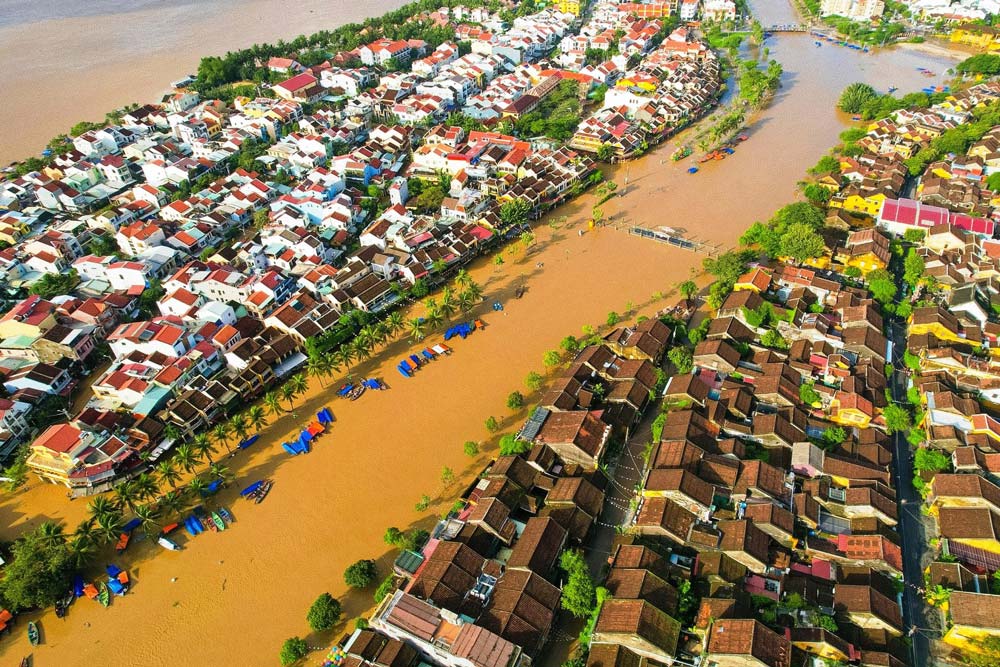
The flood is not the expensive part of the problem — the route is. Almost everything written about Hoi An flooding treats Hoi An as if it were the whole trip. It is usually two to four nights inside a ten-to-fifteen-day itinerary, sitting between Hue on one side and Da Nang on the other, which means bad water in Hoi An does not cost you Hoi An. It costs you the Hai Van road, the day you were going to spend getting to Hue, and the connection at the far end. When we reshape an autumn trip, we are usually not protecting the Hoi An nights. We are protecting the two travel days either side of them, because those are the ones with no slack in them.
We book the dry side of town first and argue about the view second. In the window, our default is to base clients north or west of the Old Town, or out at An Bang, and walk or ride in. Nobody asks for that. Everybody wants the river. It is the single most reliable adjustment we make to an autumn Hoi An stay, and the people who take it have a better week than the people who do not.
The tailoring order is where this goes wrong quietly. Nobody arrives in Hoi An planning around whether a shop will be open on Thursday. But a suit needs a fitting cycle, that cycle needs open doors and walkable streets, and a two-day closure inside a three-night stay ends the order. If a tailored jacket is part of why you are coming in October, we will tell you to place the order on your first morning, not your second afternoon.
Neither of the two things we actually sell changes in a flood week, and that is the point of booking a trip like this rather than assembling it yourself. The itinerary is built around you and can be rebuilt in a day — brand.md claim 1, and in the window it stops being a selling line and becomes the product. And somebody is reachable on WhatsApp while you are there, which matters most on the morning a road is closed and you need a different plan by lunchtime.
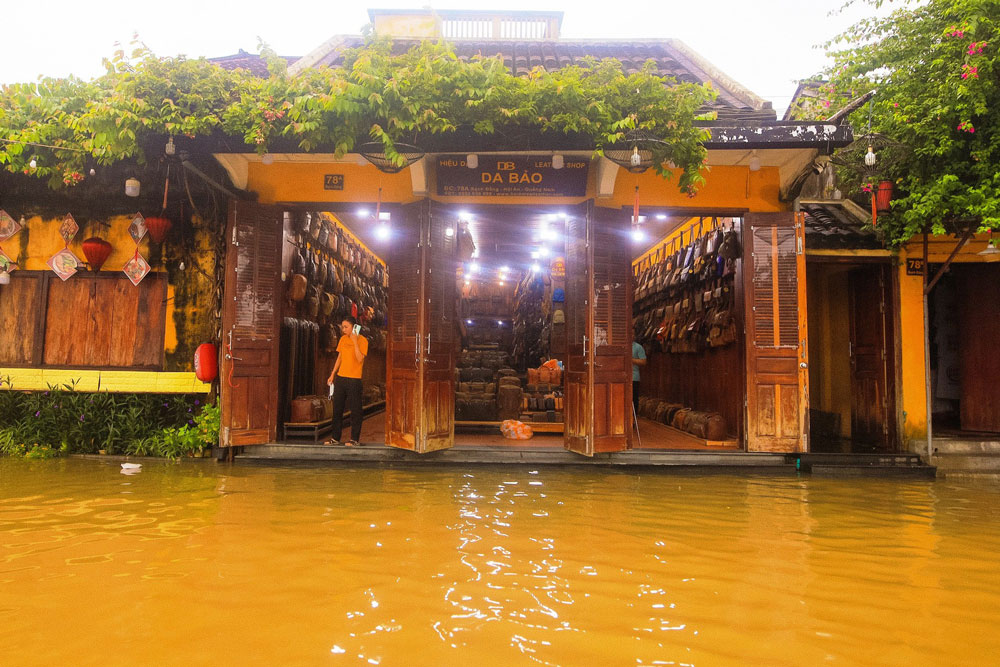
The Old Town floods most years. It is a normal part of the autumn wet season rather than an emergency, and the town is set up for it. How many times in an average year is unrecorded in reliable historical data, as frequency varies heavily by year depending on typhoon landfalls and seasonal rainfall intensity — see section 3 for why we will not give you the number everyone else does.
October and November are the peak: those two months carry 40 to 50% of the river basin's whole year of rainfall (IWA Water Supply 22(4), 2022). The rainy season starts in September and flood occurrences run October to December (Nguyen et al., 2020, calibrated on 1995–2014). Nothing we found puts flooding in January, and no source resolves the December boundary to half a month, so we leave that as unresolved in our source material. Check a current hydro-meteorological source close to your dates.
October 2025 for the river basin, 1964 for the town itself, and the two are closer than they sound. On 30 October 2025 the Thu Bon hit 5.62 m at Cau Lau upstream — 14 cm over the 1964 record and the highest in about sixty years — while the gauge in Hoi An itself reached 3.39 m, one centimeter under its own 1964 mark of 3.40 m (AHA Centre and VOV, 30 October 2025, citing NCHMF). The Old Town flooded three times in three weeks that autumn. Section 3 has what that looked like.
It is the month we most often move people off, if their dates are movable and the Old Town is the reason for the trip. If the dates are fixed, October is still workable — stay on higher ground and keep the itinerary loose.
On a street-flooding day, largely yes. In a real flood, no: the low streets and the riverfront are under water, boats replace walking, and many businesses are shut.
Street flooding in Hoi An does not affect Da Nang International Airport. A typhoon can. They are different events and should not be planned for as one.
In a real flood, many do — ground floors are cleared and fittings slip. Place an order early in your stay rather than late, and give it more days than the shop says it needs.
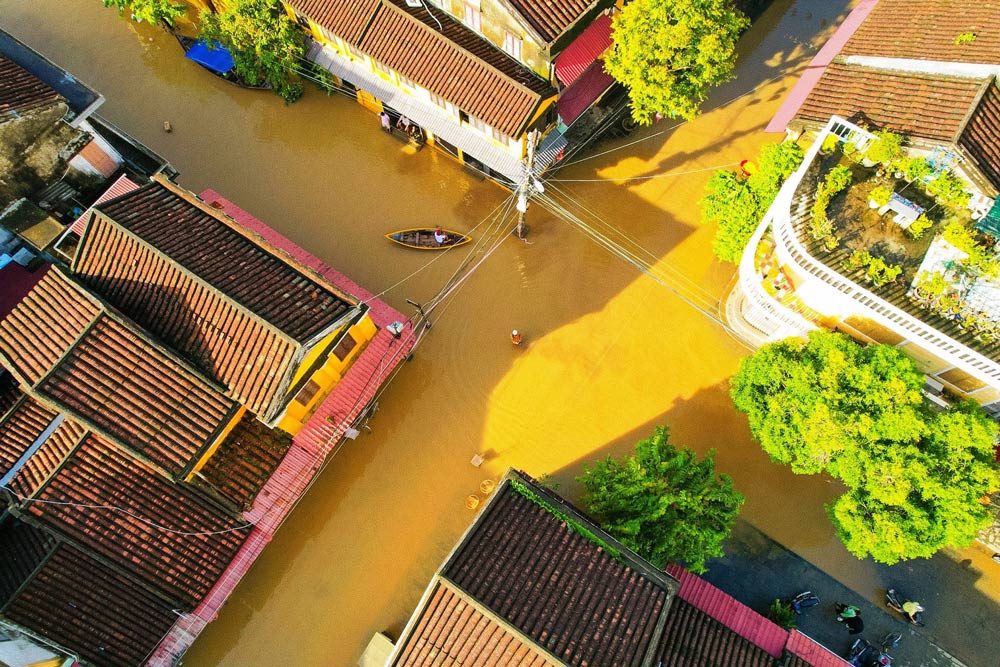
If your dates are movable and they land in October or November, our advice is to move them, and it usually costs nothing to do it. If they are not movable, the trip still works — it just needs building differently, on the dry side of town, with slack around the travel days.
Tell us the dates you have in mind and what you want out of the trip, and we will draft a route you can pull apart, including an honest answer about whether your dates are the problem. Free quote, no obligation, and you can reach us on WhatsApp at +84 866227878 or by email at sales@asiamystika.com. If you want to see the shape these conversations usually land on first, start with our Best of Central Vietnam route.
