
- SG$ Singapore Dollar
- A$ Australian Dollar
- £ British Pound Sterling
- C$ Canadian Dollar
- € Euro
- MYR Ringgit Malaysia
- US$ United States Dollar
- đ Vietnamese Dong


 About Us
 Destinations
 Travel Styles
 Travel Guide
 Blogs

A straight comparison of Phu Quoc and Nha Trang — which one fits a north-to-south route, which one costs you two travel days, and why the month you are going matters more than the beaches.

Choose Nha Trang if you want a walkable beach city, want to keep moving on a north-to-south route, or are traveling outside Phu Quoc's December-to-March dry window. Choose Phu Quoc if you want a resort-based beach stay with calmer water and will spend most of two travel days to get it.
On a first trip of ten to fourteen days, that usually means Nha Trang: three nights there costs you three nights, because it sits on the corridor you are already traveling, while three nights on Phu Quoc costs closer to five days. The exception is a trip built around the beach — a week to do very little, in December through March, with nowhere to be afterward, and the travel days stop mattering. The question is not which place is better, but whether the beach is the trip or part of it.
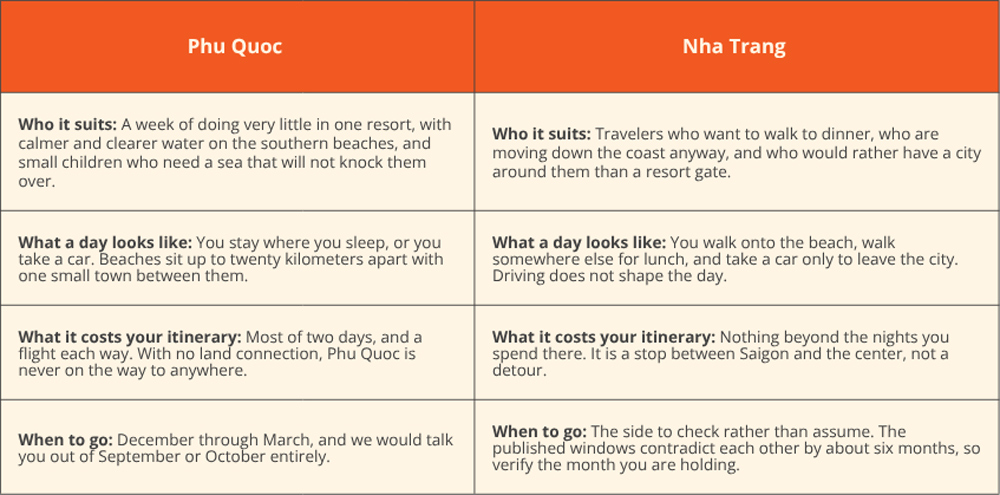

Nha Trang puts the beach, the restaurants and the hotels in one walkable strip. Phu Quoc spreads its beaches up to twenty kilometers apart with one small town, so the island needs a car and Nha Trang does not. The sea is calmer on Phu Quoc; the evenings are easier in Nha Trang.
Nha Trang is the capital of Khanh Hoa province on the south central coast, and small enough to cover on foot or by bicycle, as our Nha Trang Beach destination guide says. Phu Quoc is an island in the Gulf of Thailand with Duong Dong as its only real town and resorts strung along a west coast, so the walk from your room is a walk to the beach and nothing else. Expect a car for every meal you do not eat at the hotel, which our Phu Quoc island overview covers in detail.
In Nha Trang, dinner is a decision you make on the way out of the door, because the restaurants and seafood places share the same few streets as the hotels. On Phu Quoc it is a decision you make in the morning, because changing your mind at seven means finding a car. That is why our Nha Trang guide reads like a city guide while the Phu Quoc ones read like a logistics plan.
The water on Phu Quoc's southern beaches is calmer and clearer than the city water in Nha Trang, and if floating for an hour with small children is the point of the trip, that is the strongest single argument for the island. Nha Trang's beach is a city beach: convenient, busy, and fine for a swim rather than a day. We have not ranked the Phu Quoc beaches here — our dedicated piece on which Phu Quoc beach suits which kind of day is the one to read before you book a hotel.
Phu Quoc is the more expensive of the two, on lodging and food, and the reason is structural: much of what you eat and drink arrives by boat or plane, and the accommodation stock skews toward resorts rather than small hotels. Nha Trang gives you more choice at every price point, including the cheap end, because it is a working city and not a resort coast. We will not publish a percentage, because every figure we could find traces back to a site selling tickets — compare two real hotels on your own dates and the direction is obvious.

The month can decide it outright. Phu Quoc's genuine dry season runs December through March — not the November-to-April window the guides repeat — and September and October each average over 380 mm of rain across about 22 rain days, which rules the island out for an autumn beach trip.
Those figures come from two places that agree with each other: the Kiên Giang provincial government's own climate data for the province Phu Quoc belongs to, and a climate reference that states its reference period as the years 2000 to 2020. On the same data, April averages about 150 mm across about 12 rain days and November about 170 mm across about 13 — which is why the dry core is December to March, not November to April. These are long-run averages and any single year runs wetter or drier, so treat them as the shape of the year rather than a forecast for your dates.
The Nha Trang side is not something we are willing to state, and we would rather tell you that than guess. The two sit on opposite coasts, their seasons do not run together, and the published windows for Nha Trang contradict each other by roughly six months — we have read guides putting its dry season March to September and others November to April, for the same stretch of coast. We have found no non-commercial climate source for Nha Trang that names its reference period, which is the standard the Phu Quoc figures meet. So check your month against a source that says which years it is averaging, and be wary of a confident window without one. For the Phu Quoc side in full, our month-by-month piece on when to visit the island carries the rainfall and rain-day count for all twelve months.

Phu Quoc's weaknesses are logistical: nothing is walkable, parts of the island are an active construction site, and the flight each way costs most of two days. Nha Trang's are that the beach is a city beach, the strip is loud at night, and what you travel there for mostly sits outside the city.
The car dependency is the complaint we hear most, and it surprises people who read about the beaches without looking at where they are. Large stretches of the island are being built out, so a quiet beach in a photograph can have a crane behind it by the time you arrive. A run of rough sea days leaves no fallback either, because the island is not a place you walk around in the rain. We talk people out of Phu Quoc on any trip under about ten days, because the arithmetic does not work.
The beach fronts a city, with the traffic, the high-rises and the noise that implies, and travelers who pictured a quiet coast come back disappointed. The strip is loud after dark, which is a feature if you want a bar and a problem if you want the window open. And the things our own Nha Trang guides spend the most words on — the islands, the diving, the waterfalls, the cable car — sit offshore or out of town, so a good week there is day trips from a base rather than time on the sand. If your main reason to travel is quiet water, this is the wrong city and we would say so.

Every comparison on this question weighs beaches, nightlife, diving and cost, as if the two were interchangeable slots in an itinerary. The difference is measured in days rather than features. Nha Trang sits on the corridor between Saigon and the center, so it can be a stop on a route you were already taking; Phu Quoc is a flight in and out with no land connection. We build these routes for a living — and on a twelve-day itinerary that is usually the whole argument, before anyone mentions sand.
Every ranking page answers "which is better" without asking when you are traveling, which is the wrong order. It is the first thing we ask, because half the answer is often settled already: Phu Quoc averages over 380 mm of rain across about 22 days in both September and October, so an autumn beach holiday there is a bad booking whatever a comparison says. The honest other half is that we cannot yet state Nha Trang's rough-water months from a source we trust, so we do not state them — we tell you to check that month instead. Less satisfying than a verdict, and more use than a confident one nobody can back.

Phu Quoc has the calmer water and the resort stay; Nha Trang has the walkable city and the easier itinerary. Phu Quoc is better for a dedicated beach week, Nha Trang for a stop on a longer route.
Nha Trang, on both lodging and food. The published percentages come from sites selling tickets, so treat the gap as a direction rather than a figure.
Yes, but Phu Quoc has no land connection, so adding it means a flight each way and roughly two travel days. On a trip under two weeks it usually costs more than it returns.
Phu Quoc, for calmer and clearer water on its southern beaches. Nha Trang's city beach is more convenient but busier.

Two questions decide it. One of these places is a stop on a route you are already taking and the other is a two-day detour; and the month can settle the whole thing before a beach gets a word in, because December through March is a different island from September and October.
Which leaves the uncomfortable part. The comparison every page publishes — beach against beach, bay against bay — is the one least likely to decide your trip. The beaches are not the variable. Your dates and your route are.
Tell us the dates you are holding, how long you have and what you want out of the trip, and we will tell you which of the two fits — including telling you to drop Phu Quoc if your month or your day count is wrong for it. A consultant builds the itinerary with you and keeps adjusting it until it fits, the trip is private, and someone is reachable on WhatsApp while you travel. Free quote, no obligation.
If the beach is the point, our southern Vietnam and Phu Quoc beach holiday pairs the mainland south with an island beach stay, and it is easier to react to than a blank page. For Nha Trang we do not sell a packaged tour, so we would build that leg into a tailor-made route around your interests, pace and budget. Weighing a different pair? Our Da Nang and Hoi An comparison answers the other question travelers ask at this stage.
WhatsApp: (+84) 866.22.7878
Email: sales@asiamystika.com
Website: www.asiamystika.com
