
- SG$ Singapore Dollar
- A$ Australian Dollar
- £ British Pound Sterling
- C$ Canadian Dollar
- € Euro
- MYR Ringgit Malaysia
- US$ United States Dollar
- đ Vietnamese Dong


 About Us
 Destinations
 Travel Styles
 Travel Guide
 Blogs

Phu Quoc's dry season is December to March, not November to April. Which months hold, and how to tell a couples resort from a family resort with a package.
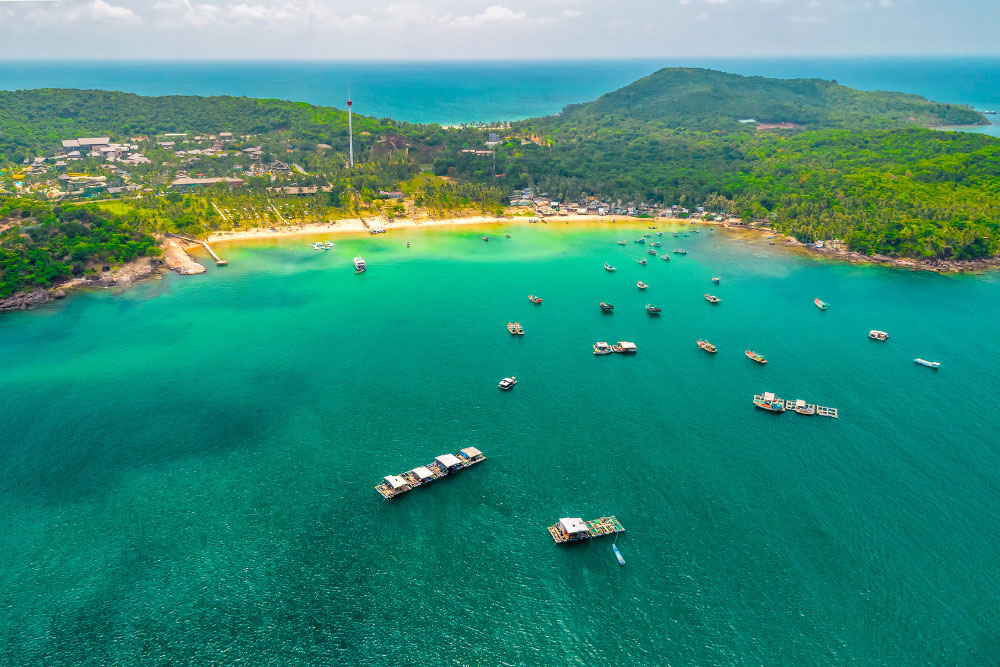
Phu Quoc suits a honeymoon that wants seclusion and a resort you barely leave, and it works best from December to March. The trade-off is that the island is the trip. There is no old town to wander after dinner, no mountain pass, no second city — which is the point for some couples and the whole problem for others.
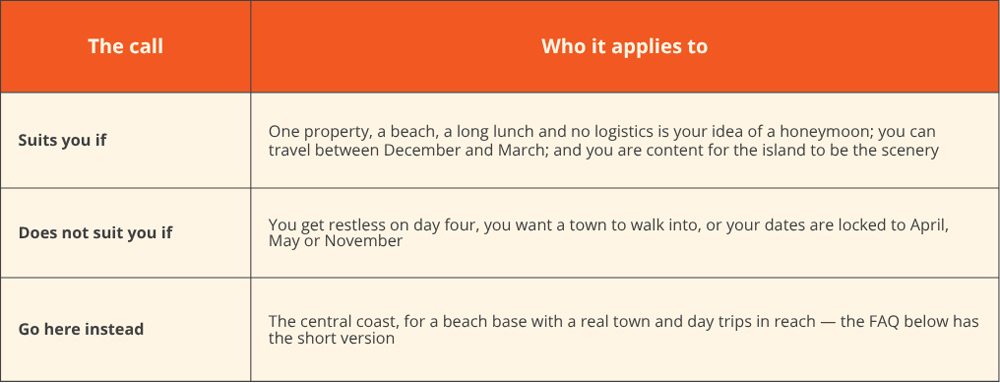
If you have not settled on the destination at all, where in Vietnam to honeymoon is the step before this page a dedicated guide. This one assumes you have landed on Phu Quoc and want to know which month and which kind of property.
It asks you to be happy doing very little, in one place, with the same people serving you dinner for a week. That is a genuine pleasure and also a real preference, not a universal one. The couples who come back from Phu Quoc happiest wanted the days to be boring in a good way. The ones who come back flat usually booked the island because the photographs were the best, then found that six nights is a long time to look at one bay.
The honest test is your last holiday. If you spent it moving, this island will feel thin by day five.
The best months for a Phu Quoc honeymoon are December through March, the island's genuine dry season. November and April are advertised as dry season and are not: April averages 150 mm of rain across 12 days, November 170 mm across 13.
Nearly every page ranking for Phu Quoc's best time to visit gives the dry season as November to April. Two non-commercial sources disagree, and they are the ones we follow.
The Kien Giang provincial government's published description of the province's natural conditions gives the rainy season as April to November and the dry season as December to March. A climate reference with a stated 2000–2020 period puts the same boundary in a different form: 150 mm across 12 rain days in April and 170 mm across 13 in November, against 30 to 55 mm and four to six rain days in January, February and March.
The industry version overstates the season by a month at each end. That matters more on a honeymoon than on any other trip, because a honeymoon is one week, booked once, with no second attempt. A couple booking April on the strength of "dry season, November to April" is booking twelve rain days.
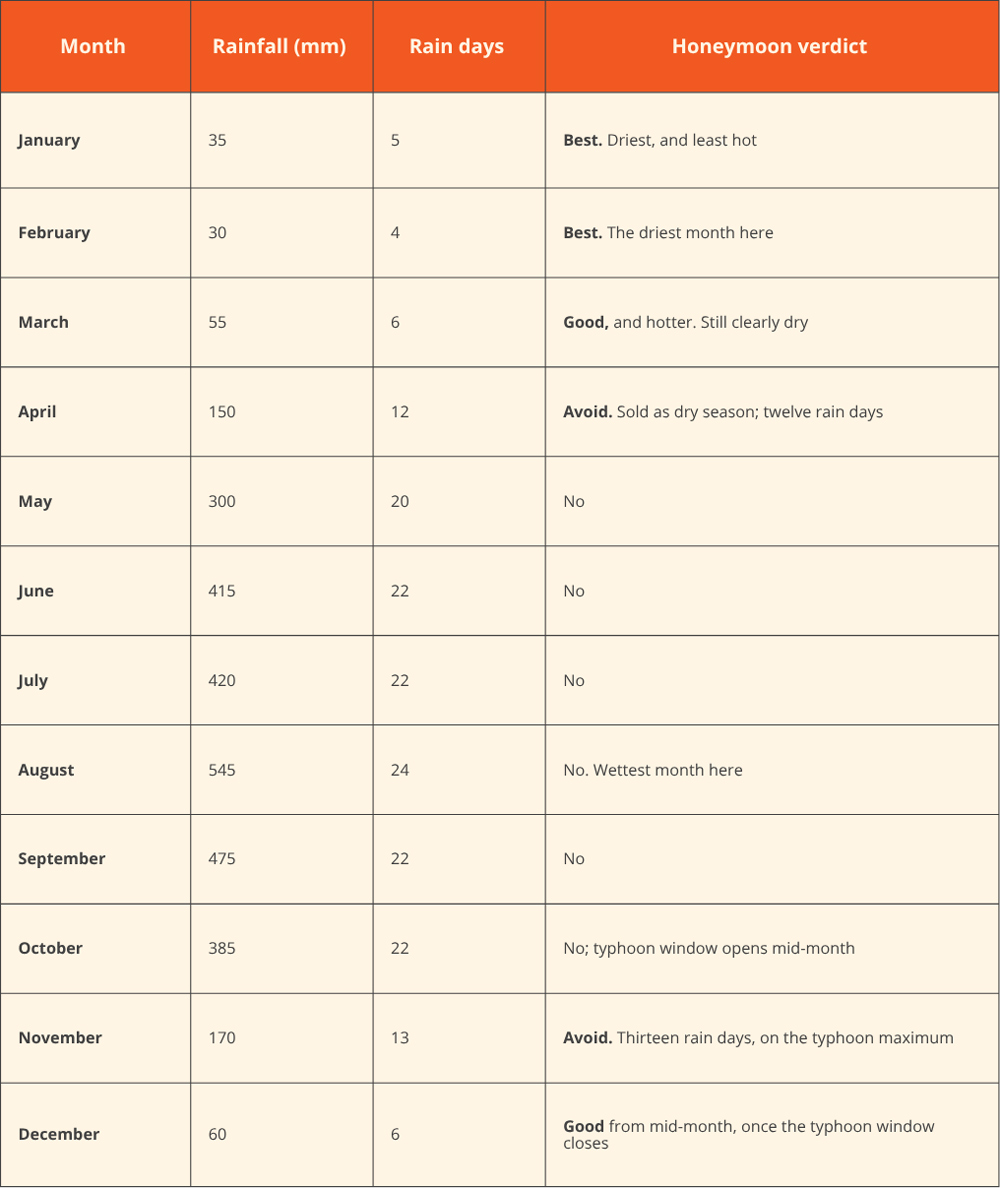
Shoulder rates are cheap in April and November for the reason the table shows, not as a favor to early bookers.
The same climate reference puts southern Vietnam's typhoon season at roughly 15 October to 20 December, with a maximum in early November. Read that next to the row above it: November is the month sold as the start of the dry season, offered at a discount, and sitting on the typhoon maximum. No page we looked at puts those two facts in the same paragraph.
This is not a warning to stay away in November. Most Novembers pass without a storm reaching the island, and that figure is a seasonal window rather than a forecast for your dates. It is a warning that November's price is doing something, and that a honeymoon is the wrong trip to absorb a bad week on. If your dates are fixed in November, build slack into the travel days at both ends and choose a property that is still pleasant in rain — which is a different property from the one that photographs best.
Phu Quoc's annual rainfall is given as 2,400 to 2,800 mm in one place, about 3,000 mm in another, 3,030 mm in a third, and 4,000 mm for the north of the island in a fourth. That is a spread of roughly 1,600 mm between compilers who name no measuring station between them, so we will not pick one and present it as a fact.
The monthly shape is a different matter: every source agrees which months are wet, which are dry, and roughly by how much. So the table above publishes and the annual total does not. If you see a confident single annual figure on a travel page, it was chosen rather than measured.
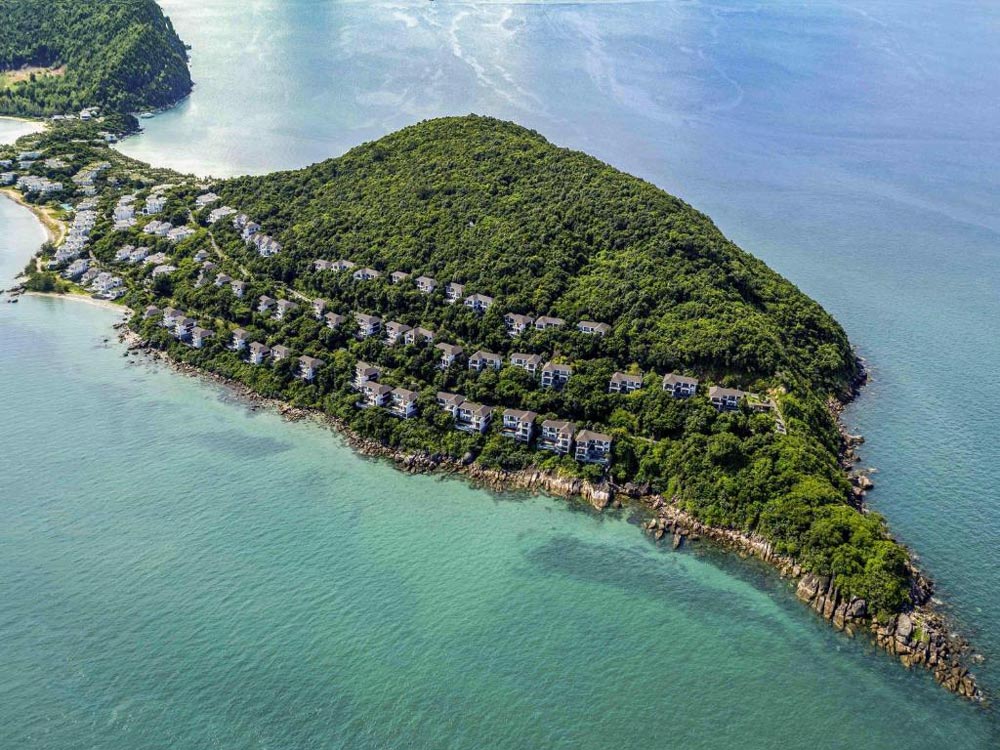
A genuine Phu Quoc honeymoon resort is built around adult quiet — villa privacy, a restaurant that works for two, no children's club at its center. A family resort with a honeymoon package bolted on is a different purchase, and the layout shows which one you are buying.
We name no individual property here, deliberately. We arrange rooms through hotel partners and own nothing on this island; a named shortlist would need rate and policy checks that go stale inside a season, and the worst error this page could make is telling you a resort is adults-only when it is not. So instead of a list, here is the diagnostic. It takes about ten minutes per property and works on any of them.
1. What is the main pool for? One pool plus a children's club means the main pool is the family pool, whatever the honeymoon page says. Two pools is the minimum for a genuinely quiet week, and the question to ask is which one is quiet in August — that answer tells you how the property thinks about itself. 2. Is there more than one restaurant, and does one of them work for two people at eight in the evening? A single buffet is fine for three nights and grim for seven. Ask what is open on a Tuesday in low season, not what is listed on the website. 3. Is the privacy structural or decorative? A villa with a wall, a hedge and its own water is private. A villa with a sliding door onto a shared path is a room with a nice photograph. Ask for the site plan rather than the gallery. 4. Does the property's own current page say adults-only, on the day you look? Not a reseller, not a listicle, not a package page — the property's own site, today. And if it does, ask whether the policy covers the whole property or one wing, because partial policies are common and are not the same thing.
If a property cannot answer question two or three in writing, that is itself the answer.
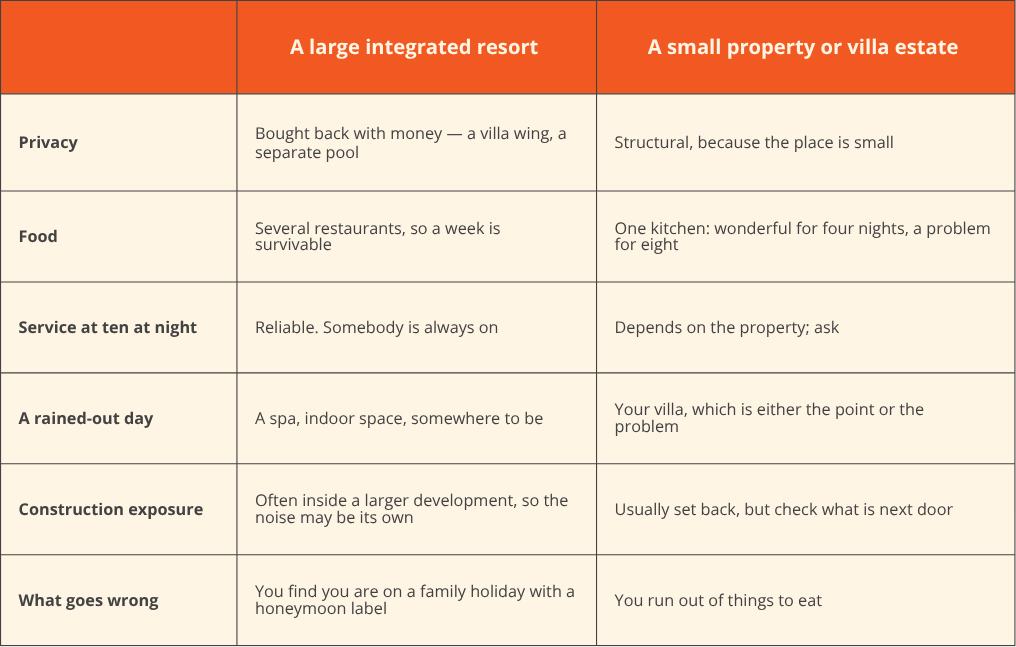
Neither is better. The large resort is the safer choice for seven nights or more, and the worse choice if being among other people is what you came to avoid. Our default for a week is a large property with a genuinely separate adult wing; for four or five nights, a small one.
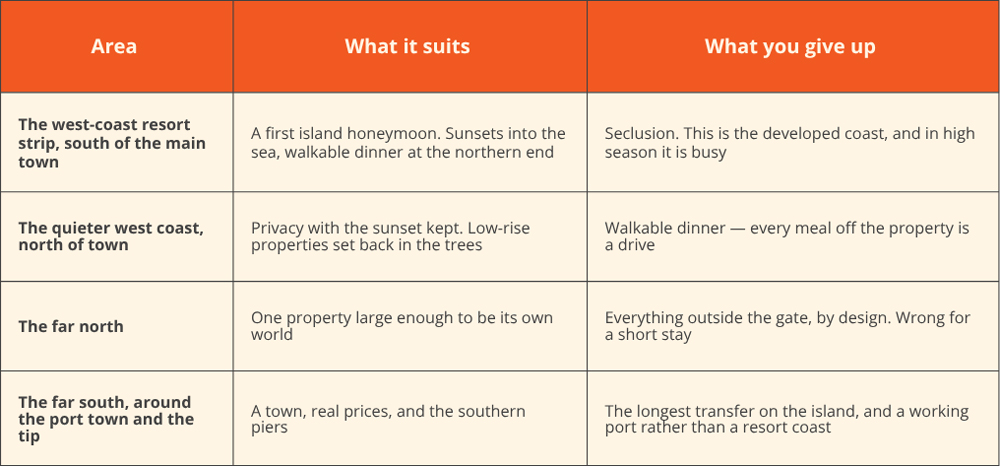
The lodging decision deserves more room than one table, and it has its own page:
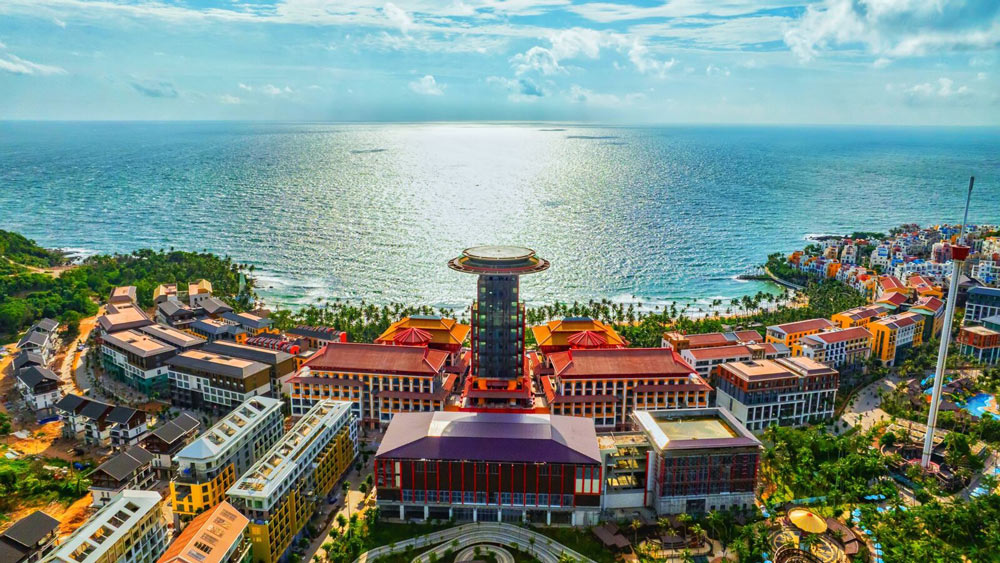
Phu Quoc disappoints honeymoon couples in three predictable ways: the island is being built on, its headline attractions are one company's theme-park assets, and seven nights in one resort runs out faster than expected.
Phu Quoc is hosting the APEC Economic Leaders' Week in November 2027 and is being rebuilt for it. Viet Nam News reported in October 2026 that twenty-one key projects must be substantially complete and in trial operation by 31 May 2027, with preliminary investment of about 137 trillion dong — an airport expansion with a second 3,300-meter runway, a new provincial road from the airport to the south, an urban railway, two reservoirs, and the conference complex on reclaimed land at Bai Dat Do.
The works are concentrated rather than everywhere, so this is not a reason to go elsewhere. It is a reason to ask one question before you pay a premium: what is being built on the other side of your property's boundary, and when does it start in the morning. That is the question nobody asks and the one that spoils honeymoons on this island right now.
Much of what the island is marketed on — the cable car, the theme parks, the purpose-built waterfront town — belongs to a single developer. That is not a criticism of the venues. It does mean "things to do in Phu Quoc" is largely one company's estate presented as a destination, and if that style is not yours there is less left than the lists imply. What there is to do on the island is the honest inventory.
The sea day is the fragile one. Boat trips get flagged off at short notice when the water turns, and in the shoulder months that is a live possibility rather than a rare one. Build the week so a canceled sea day is an inconvenience and not the day you lose — which means not saving the one excursion you care about for your last morning.
Most honeymoons here are booked at seven nights because that is how flights price, and seven nights in one property is a genuine test. Days one to four are the holiday you imagined. Days five to seven are when you find out whether there is a second restaurant, whether the quiet pool is quiet, and whether you like each other's company with nothing to look at.
The fix is cheap and almost nobody does it: keep one day movable. Not a booked excursion — a day with nothing in it that you decide on the morning. On a seven-night island stay, that single unscheduled day is worth more than an upgrade.
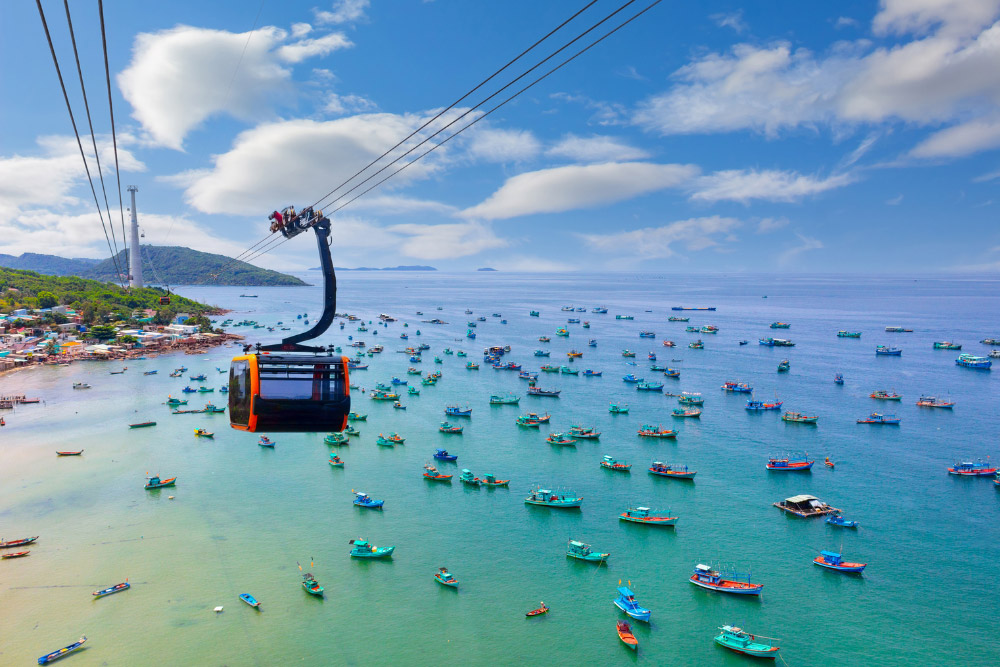
Every page here sells a November-to-April dry season, and the months at its edges are the ones couples get offered cheaply. The provincial government's own figures and a climate reference with a stated 2000–2020 period both put the dry season at December to March. April is twelve rain days. November is thirteen, and sits on the southern typhoon maximum.
What we can do with that, and an aggregator cannot, is name the two months that read as safe and are not, from a dated reference period — then move the dates inside the core rather than take the shoulder rate. If a quote for April or November looks like a bargain, price the same trip in February before you accept it. Often the difference is smaller than the rain-day difference, and when it is not, you are at least choosing knowingly.
Resort marketing on this island runs on awards, and couples choose a once-only trip on them. We do not repeat an award we cannot date and trace to a primary record — including on our own older pages, which is the more awkward half of the policy.
The reason is simple: an award tells you who entered, and when, and under what category. It does not tell you whether a property suits two people in April. An undated award with no linked source is not a data point; treat it as decoration. Section three's four questions are what we use instead, and they are deliberately the kind of thing you can check yourself in an afternoon.
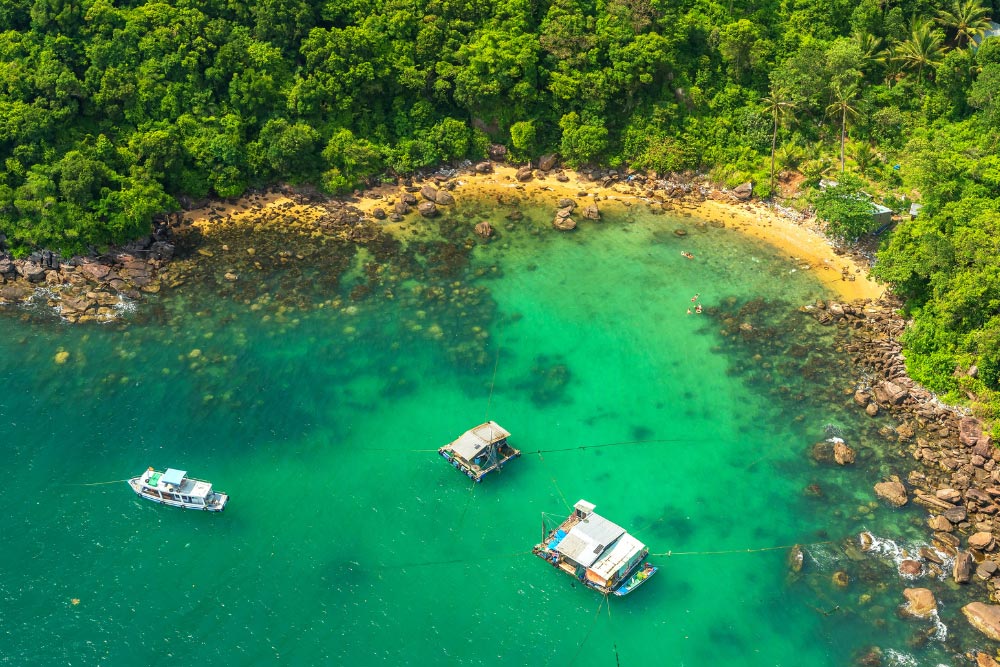
Yes, for a honeymoon built around one resort and a quiet beach, between December and March. It is the wrong island if you want a town and day trips within reach.
December through March, the island's genuine dry season. January and February are the driest, around 30 to 35 mm of rain across four to five days.
Not reliably, despite being sold as dry season. April averages 150 mm of rain across 12 days on a climate reference with a stated 2000–2020 period.
Phu Quoc for a pure island stay where the resort is the whole trip; Da Nang for a beach base with a town, mountains and a historic quarter nearby. Our Da Nang honeymoon guide makes that case properly.
A few properties are structured for adults, but "honeymoon package" and "adults-only" are not the same thing. Check the property's own current page before booking, and ask whether the policy covers the whole property or one wing.
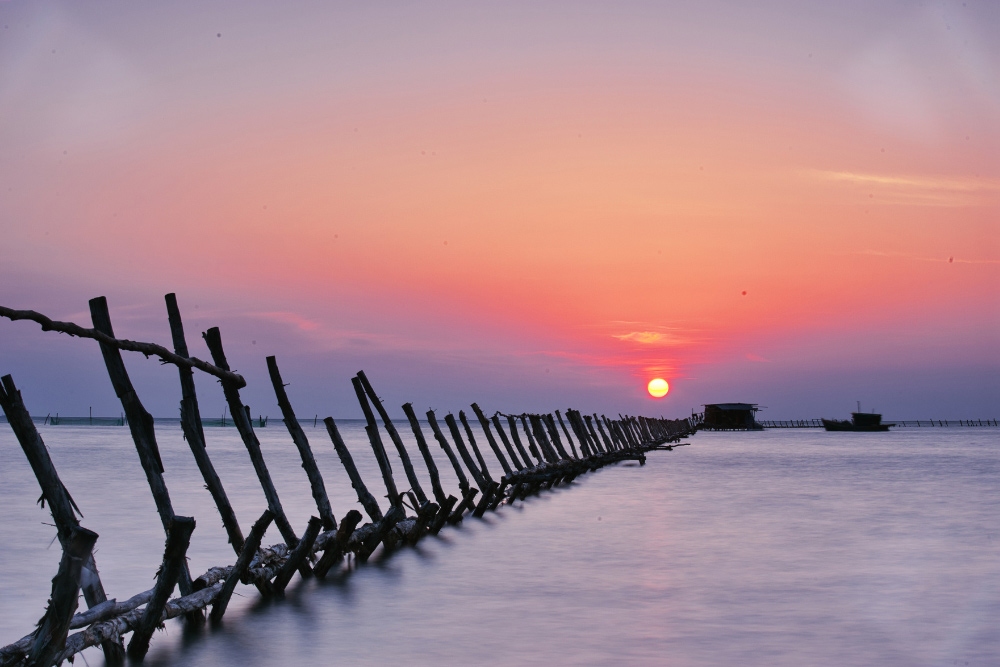
Two decisions, in this order. The month decides whether the honeymoon works. The property decides what it feels like. Get the order wrong and the best villa on the island cannot save a week of rain.
Most couples make them backwards — the villa chosen from a photograph, then whatever dates the price suggests. The price suggests April and November for a reason, and the reason is in the table above.
Send us the dates you have in mind and roughly what you want the week to feel like, and we will tell you which months hold, which coast fits, and what kind of property to look at — including the times we think you should move the dates rather than spend more on the room. If your dates are April or November, we will say so, and say what moving them is worth. Free quote, no obligation, and a conversation rather than a checkout.
Our five-day island itinerary is the shape this takes when the island is the whole trip; southern Vietnam paired with the island is the shape it takes when a week in one resort sounds like three days too many. Both are starting points to argue with rather than products to buy.
WhatsApp: (+84) 866.22.7878
Email: sales@asiamystika.com
Website: www.asiamystika.com
