 Hotline: +84 866 227 878
- SG$ Singapore Dollar
- A$ Australian Dollar
- £ British Pound Sterling
- C$ Canadian Dollar
- € Euro
- MYR Ringgit Malaysia
- US$ United States Dollar
- đ Vietnamese Dong


 Hotline/Whatsapp: +84 86 622 7878
 Email: sales@asiamystika.com
 About Us
 Destinations
 Travel Styles
 Travel Guide
 Blogs
Blogs

Planning a Central Vietnam itinerary? Da Nang, Hoi An and Hue sit within two hours of each other — here is how to sequence them, how many bases to use, and complete 5, 7 and 10-day plans.

This is the most efficient region in Vietnam for a first visit, and the reason is geography.
Da Nang sits in the middle, on the coast, with the region's only international airport. Hoi An is 30 km south — about 45 minutes by road. Hue is roughly 100 km north — two to three hours, depending on whether you take the tunnel or the Hai Van Pass.
That is the entire region: two hours end to end, three destinations, and within reach of all of them, two UNESCO World Heritage Sites (Hoi An Ancient Town and My Son Sanctuary), an imperial capital, a mountain resort, a long swimmable beach and one of Asia's great coastal roads.
Very few places anywhere pack that much into a two-hour radius.
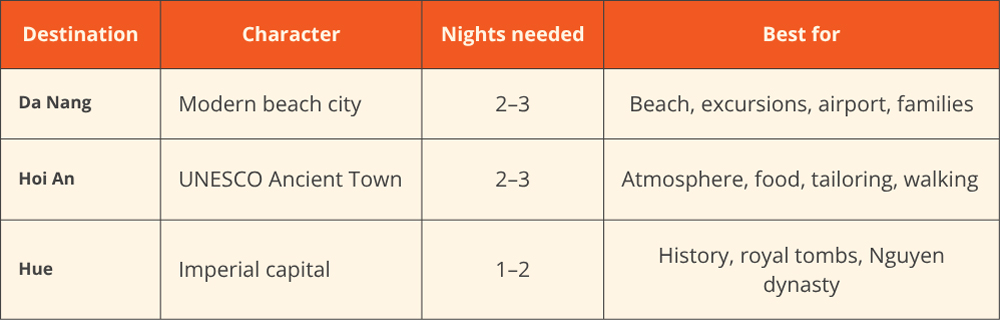

The answer depends on how you arrive.
Flying in: start in Da Nang, because that is where the airport is. From there, either Da Nang → Hoi An → Hue, or Da Nang → Hue → Hoi An.
Travelling south overland from Hanoi: start in Hue, then Da Nang, then Hoi An, and fly out of Da Nang.
In both cases, our strong preference is to end in Hoi An. Arriving into a modern city and gradually slowing down into a lantern-lit old town has a natural rhythm to it. Doing the reverse — leaving Hoi An for Da Nang — can make the final days feel like an anticlimax.
There is also a practical argument. Hoi An is the place people wish they had given more time to, and ending there means you can extend by a night if you fall in love with it.

This is the single most important planning decision in Central Vietnam, and most travelers get it wrong by thinking about days instead.
Every base change costs you roughly half a day. Pack, check out, transfer, check in, unpack, reorient. On a five-night trip, three bases means you spend a day and a half of it moving between hotels.
Here is the honest guidance:
This is what we build most often. Da Nang gives you the beach, the airport, Ba Na Hills and the Marble Mountains. Hoi An gives you the atmosphere, the food and the evenings.
A typical split is 2 or 3 nights in each. Hue becomes a long day trip, or gets left for another visit — which is an honest trade rather than a failure.
If beaches are not your priority, basing in Hoi An and Hue and using Da Nang only as an arrival airport is entirely reasonable.
You lose Ba Na Hills and My Khe Beach, and you gain deeper time in the two places with the most history. For culturally-led trips this is often the better shape.

Two bases, one major excursion, and Hue deliberately left out rather than compressed.
What you are giving up: Hue, My Son Sanctuary, and the Hai Van Pass. That is the honest cost of five days, and it is the right trade — adding Hue here would mean three bases in five nights, and you would remember the transfers.

Seven days is where Hue becomes an overnight rather than a compressed day trip — which is the difference between seeing the Imperial City and seeing the royal tombs as well.
This is the itinerary we recommend most often. It covers everything essential without a single rushed day, and the Hai Van Pass crossing on day three turns the longest transfer into one of the best parts of the trip.

Ten days is where a Central Vietnam trip stops being a tour and becomes a holiday. The additions are not more sights — they are rest days.
If you have more than ten days, the natural extensions are Phong Nha caves to the north or a beach stretch at Lang Co. Both add a day of travel, so weigh them against simply slowing down further.

All three destinations are connected by good roads, and one of the legs is genuinely worth doing for its own sake.
45 minutes by road, 30 km. There is no train — Hoi An has no railway station, which surprises a lot of travelers.
Options are a private transfer, Grab, a tourist shuttle or the public bus. Fold in the Marble Mountains, which sit almost exactly on the route.
One practical note: vehicle access into Hoi An's Ancient Town is restricted, so agree a pickup point with your driver the night before an early departure.
Two to three hours, depending on route. The Hai Van Tunnel is faster and dull. The Hai Van Pass over the top adds around 30 minutes and delivers the best coastal scenery in Central Vietnam.
Take the pass unless the weather is bad. It generates its own cloud, so morning crossings are more reliable.
The train between Da Nang and Hue is a genuine alternative — it runs along the coast *below* the pass, takes two and a half to three hours, and is one of Southeast Asia's most scenic short rail journeys. Some travelers do the pass one way and the train the other, which is a lovely solution.
Three to four hours direct, or longer with stops. Most travelers route via Da Nang anyway, so this is usually the Hai Van Pass journey with an extra 45 minutes on the front.

One important thing to understand: all three destinations share the same weather pattern. There is no escaping rain by moving between them.
The dry season runs roughly February to August, with the hottest months from May onward. The wet season runs roughly September to December, peaking in October and November.
Central Vietnam's seasons are different from Hanoi's and Ho Chi Minh City's, which catches out travelers planning a multi-region trip. Do not assume that good timing for Hanoi means good timing here.
If you travel in the wet season, build in a buffer day so that Ba Na Hills and the Hai Van Pass can move rather than be lost.

An Asia Mystika guide explains:
“The number of bases matters more than the number of days. I have seen guests do three cities in five nights and spend half the trip with a suitcase in a car boot. Give me the same five nights across two bases and I will show you more, not less.” — Jen — Asia Mystika guide, Da Nang.
This is counterintuitive, because the instinct when planning is to fit in everything. But a hotel change is not a neutral event — it eats a morning at one end and an afternoon at the other, and it costs you the ease of knowing where things are.
Two bases and a long day trip will nearly always give you a better trip than three bases and no day trips.
Whatever length you choose, schedule Ba Na Hills and the Hai Van Pass early in the trip.
Both are weather-dependent. If the summit is fogged in on day two, you still have days left to try again. Save it for the last day and you may lose it entirely — and it is usually the thing people came for.

Five days covers Da Nang and Hoi An with one major excursion. Seven days adds Hue properly. Ten days allows rest days and My Son without rushing.
Da Nang first if you are flying in, since it has the only airport. Hue first if travelling south overland from Hanoi. Either way, ending in Hoi An gives the trip a better rhythm.
Both, if you have five nights or more. Da Nang for the beach, airport and mountain excursions; Hoi An for atmosphere, food and evenings.
You can, but it means three bases in five nights and roughly a day and a half spent changing hotels. Two bases with Hue left for another trip gives a better holiday.
Hoi An is 30 km (45 minutes) south of Da Nang. Hue is around 100 km (two to three hours) north, via the Hai Van Tunnel or the Hai Van Pass.
Yes, and it is one of Southeast Asia's most scenic short rail journeys — it runs along the coast below the Hai Van Pass and takes two and a half to three hours.
Roughly February to August. All three destinations share the same weather, so the wet season from September to December affects the whole region.
It is the most efficient region in Vietnam for a first trip — two UNESCO World Heritage Sites, an imperial capital, a mountain resort and a swimmable beach, all within two hours of one airport.

Here is the whole thing in one line:
Fly into Da Nang, use two bases for anything under a week, cross the Hai Van Pass rather than the tunnel, and end in Hoi An.
Central Vietnam is the easiest region in the country to travel and the easiest to over-schedule. Two UNESCO sites, an imperial capital, a mountain resort and a beach sit within two hours of one airport — which makes it tempting to try to hold all of it at once.
The travelers who enjoy it most are not the ones who saw everything. They are the ones who unpacked twice instead of four times, and who had a spare afternoon in Hoi An to do nothing at all.
This is the trip we build most often, and no two versions are the same. The sequencing decisions — how many bases, which day for the mountain, whether Hue earns a night, which direction to cross the Hai Van Pass — are the difference between a trip that flows and one that feels like a schedule.
If you want to save time and effort while traveling to Vietnam, contact Asia Mystika, a trusted tour agent in Vietnam. We are based here. We handle the hotels, the private transfers between all three cities, the guides who make My Son make sense, and the timing that keeps the Golden Bridge out of the cloud.
Tell us how many nights you have and what matters most to you, and we will sequence the rest around it.
